Beekeeping has seen a significant rise in popularity across Florida, attracting individuals for various reasons, including commercial production, as a rewarding hobby, or to enhance pollination in home gardens. As interest in honey bees continues to grow, it is important to remember that beekeeping in Florida is regulated by state law. Regardless of the purpose a particular person has for maintaining beehives on their property, they must comply with specific legal requirements to ensure responsible beekeeping practices in the state of Florida.
Beekeeping Registration
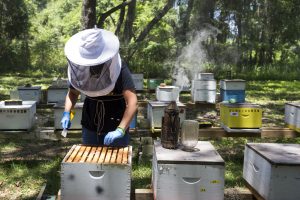
All beekeepers in Florida, whether operating as hobbyists, commercial producers, or sideliner operations, are required to register all their bee colonies with the Florida Department of Agriculture and Consumer Services (FDACS). The main purpose of beekeeping registration is to prevent the spread of honey bee pests and diseases and to minimize the propagation of Africanized bees throughout Florida. The first step will be to contact your local apiary inspector to schedule an appointment. The inspector will then visit your apiary to assess the condition of your colonies. If the colonies are healthy and free of Africanized bees genes, an official registration number, after paying a fee (which varies with the number of colonies you have), will be issued.
- For detailed information on the FDACS beekeeping registration process, please click here.
- To locate your local apiary inspector, please click here.
Keeping Honey Bees In Non-Agricultural Locations
In Florida, beekeeping is permitted in both rural and urban areas. While it is legal to maintain honey bee colonies in non-agricultural areas, beekeepers must comply with applicable laws and regulations. Individuals keeping bees in non-agricultural locations are required to comply with the guidelines addressed in the Beekeeper Compliance Agreement. This agreement provides detailed information regarding colony density (example: number of colonies per acre), safety procedures, and best management practices for responsible beekeeping. It is important to note that although state regulations allow beekeeping in non-agricultural locations, property owners governed by a Homeowners Association (HOA) must also comply with HOA rules. If an HOA prohibits beekeeping, residents will not be allowed to keep honey bee colonies on their property, regardless of state law.
- For more detailed information about the Florida Beekeeper Compliance Agreement, please click here.
Honey Bee Removals or Eradication
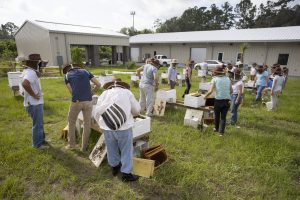
There are several common misconceptions about honey bee removals or eradication. One of these misconceptions is the belief that honey bee colonies cannot be eradicated. In reality, eradication is not illegal and plays an important role when honey bees become a risk to public safety. Only a licensed pest control operator or company is authorized to perform eradication services. On the other hand, the removal of live bee colonies, which includes the bees, comb, brood, and honey, may be performed by any Florida-registered beekeeper or licensed pest control operator. However, bee removal should only be carried out by individuals with the proper training, equipment, and liability insurance. Without these, the process can become dangerous and may result in serious consequences if someone is injured during the removal.
- For more information about honey bee removals or eradication, click here.
Selling Honey
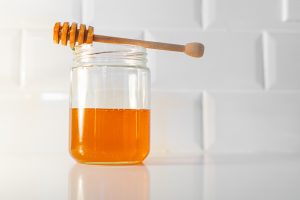
Many individuals have questions about how to legally sell honey in Florida. Under the Florida Cottage Food Law, honey may be sold directly to consumers without the need for a food permit. It is important to notice that under the cottage food law, honey must be bottled in the kitchen of a private residence cottage food operator. This means that commercial kitchens do not fall under cottage food operations. Sellers must also comply with all regulations, including labeling, described in the Cottage Food Law. It is important to remember that prepared foods containing honey are not permitted under the Cottage Food Law. If you plan to sell prepared foods that include honey as an ingredient, a Food Manager Certification may be required, along with other applicable licenses depending on the type of product you wish to sell. Additionally, if you wish to sell honey as a retail or wholesale product, you will need to obtain the appropriate commercial permits.
- For more information about the Florida Cottage Foods, click here.
- For information about bottling, labeling, and selling Honey in Florida, click here.
- For information about retail sales, click here.
- For information about wholesales, click here.
Conclusion
Beekeeping in Florida is a rewarding activity, but it is important to always comply with all state regulations, specifically colony registration and in non-agricultural locations, to follow the beekeeper compliance agreement. Proper procedures must also be followed when involving honey bee removals and honey sales. Following these rules ensures safe, responsible, and legal beekeeping practices across the state.
- If you need more information about honey bee regulations, please contact your local UF/IFAS extension agent. There is a UF/IFAS office in every county in Florida. To find your local office, click here.
University of Florida is an Equal Opportunity Institution
 3
3