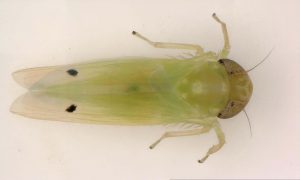
The University of Florida Institute of Food and Agricultural Sciences (UF/IFAS) is alerting growers to a new pest of concern making its mark in South Florida farms and nurseries: the invasive two-spot cotton leafhopper.
Measuring only 2.5 to 3 millimeters in its adult stage, the two-spot cotton leafhopper can cause serious damage to food and ornamental crops, and UF/IFAS experts are encouraging vigilance among South Florida farmers and residents.
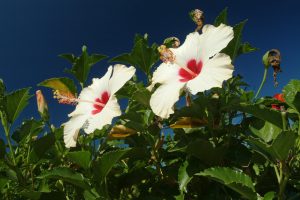
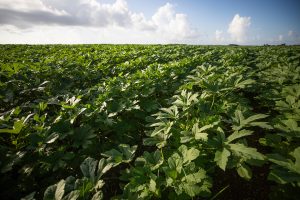
“The two-spot cotton leafhopper is a serious pest of cotton, okra, eggplant, peanut, roselle, soybean, sunflower and tropical hibiscus. For South Florida this is bad news as okra and tropical hibiscus are important and popular crops for the region,” said Alexandra Revynthi, assistant professor of ornamental entomology and acarology at the UF/IFAS Tropical Research and Education Center in Homestead.
First detected in Florida in December 2024 by the Florida Department of Agriculture and Consumer Sciences, the tiny destructive insect feeds on plant sap, causing yellowing, browning, curling and wilting of leaves – a symptom known as hopperburn. Because the insects are so small, the damage often appears before farmers even notice the pest. In crops overseas, infestations have caused yield losses of more than 50% by the pest that goes by other names including Indian cotton jassid, Indian cotton leafhopper and cotton jassid.
While South Florida growers may see the greatest impact on crops like okra, eggplant, roselle and tropical hibiscus, the pest’s reach extends statewide. In Central and Southwest Florida, these same crops are widely planted in commercial fields and home gardens. In North Florida, staple crops such as cotton, peanut, sunflower, potato and soybean could also be at risk. Ornamental hibiscus, both tropical and hardy varieties, are cultivated throughout Florida, making landscapes another potential entry point for the pest.
The Florida Department of Agriculture and Consumer Services–Division of Plant Industry (FDACS-DPI) has listed the two-spot cotton leafhopper as a regulated pest. So far, detections have been confirmed in several counties across the state, with the potential to spread further.
UF/IFAS TREC and UF/IFAS Extension Miami-Dade County have prepared the following factsheet with information on monitoring, chemical and biological controls against the insect, as well as how and where to send samples.
For questions regarding the two-spot cotton leafhopper, please call the Division of Plant Industry Helpline at 1-888-397-1517 or email photos to DPIhelpline@FDACS.gov.
###
by Lourdes Mederos, rodriguezl@ufl.edu
ABOUT UF/IFAS
The mission of the University of Florida Institute of Food and Agricultural Sciences (UF/IFAS) is to develop knowledge relevant to agricultural, human and natural resources and to make that knowledge available to sustain and enhance the quality of human life. With more than a dozen research facilities, 67 county Extension offices, and award-winning students and faculty in the UF College of Agricultural and Life Sciences, UF/IFAS brings science-based solutions to the state’s agricultural and natural resources industries, and all Florida residents.
ABOUT UF/IFAS TROPICAL RESEARCH AND EDUCATION CENTER
The mission of UF/IFAS Tropical Research & Education Center (UF/IFAS TREC) is to develop and disseminate science-based information about tropical horticulture and natural resource sciences through teaching, basic and applied research, and extension, to sustain and enhance the quality of human life and the natural environment. Established in 1929, UF/IFAS TREC is the only state university research and education center in the continental U.S. focusing on tropical and subtropical crops. Our faculty, scientists and students conduct cutting-edge research and disseminate findings to the public in areas such as crop and plant breeding and biotechnology, sea level rise, soil and water management, environmental conservation, climate change, invasive plant pests and disease management, agriculture and ecosystems sustainability, and much more. The Center’s unique location—between Florida Bay and Everglades National Park—strategically situates research to the Caribbean region, Latin America and tropical regions worldwide.
trec.ifas.ufl.edu | @UFTropical | #IFASTREC
 1
1

