As a double Gator, Dr. Christina Finegan earned both her bachelor’s and Ph.D. through UF’s Plant Molecular and Cellular Biology program, where she honed her interests in plant genetics and breeding. Her time in research labs within the UF/IFAS Horticultural Sciences Department, particularly with mentors like Drs. Marcio Resende and Matias Kirst, sparked her early fascination with applying genetics in practical ways. Today, at Bayer, she plays a strategic role in shaping breeding pipelines to deliver superior crop varieties that address grower needs around yield, sustainability, and resilience.
Dr. Finegan shares her path, insights from her academic and professional career, and practical advice for aspiring geneticists considering a career in agriculture.
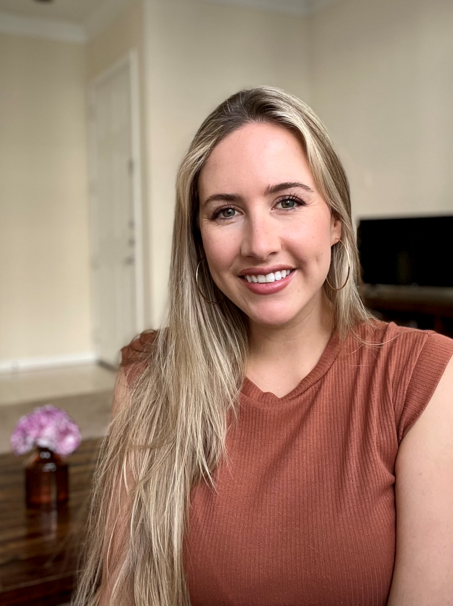
Can you share a bit about your journey in horticultural sciences and how it led to your current role?
I started my undergraduate studies at the University of Florida, knowing I was interested in genetics and biology, but I didn’t have a solid plan. During undergrad, I took a few related classes and ended up majoring in Plant Sciences with a focus on plant genetics.
Throughout that time, I had different research opportunities in David Clark’s lab and Harry Klee’s lab, where I spent the most time. That’s when I really started learning about quantitative genetics and how it can be used to transform plant breeding in ways I hadn’t previously considered. It was incredibly exciting!
My faculty mentors were Marcio Resende and Matias Kirst; their guidance was instrumental in helping me grow, not just scientifically, but also in learning how to take ownership of a project, and manage my time and resources effectively to really drive a project forward. The lessons I learned from both of them continue to influence how I approach my work today.
During my Ph.D., I dove deeper into the tools and techniques that ultimately led me to apply for the position I have now, where we’re now applying those quantitative genetics tools to innovate for the next generation of plant breeding. I was working with marker-assisted selection at the time, and thinking about how to expand it.
What is your role as a geneticist and research focus at Bayer?
My title is Senior Quantitative Geneticist, and I’m in what we call the Product Design team. What that means within the breeding organization is that we’re the group focused on bringing new breeding technologies and quantitative genetic strategies into practice. The team is responsible for generating the next generations of potential products.
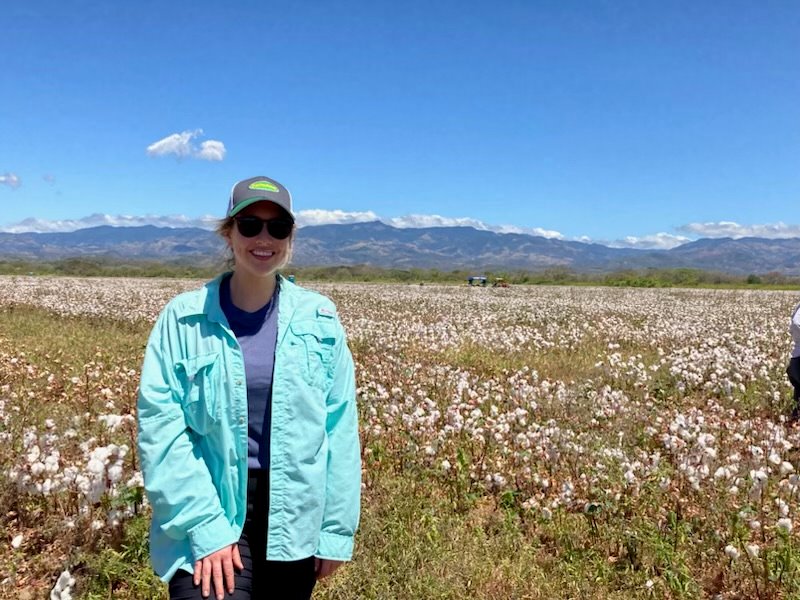
I mostly work in our cotton breeding program, although our quantitative geneticists have responsibilities across different crops. That’s why my background is in the cotton field.
We talk a lot about breeding being like picking a needle from a haystack. Our job as an organization is to make haystacks with more needles in them. How do we shift those distributions in the direction we want them to go? My role is to develop improved models that can help us drive those decisions and to shape the breeding pipelines and design them in a way that aligns with quantitative genetics principles… what’s going to give us the best future progeny and future parents to drive the program now and in the future.
The goal is to release varieties that give growers the highest quality cotton and highest yield, with minimal input, ultimately increasing profitability and the sustainability of cotton production.
What is Bayer’s mission, and how does your work support that mission?
On the website, you’ll see, “Health for all and hunger for none.” That’s the high-level mission. Within breeding and crop science R&D, we are really grower-focused. Every time we make a decision about how something needs to be set up or advanced, we ask: how do we create and deliver the best possible genetics and traits to our customers, our cotton, corn, and soybean farmers?
We focus on what we call “precision breeding.” It’s about shifting from just selecting the best of what we have to truly designing the best, putting growers’ needs at the top of the page and figuring out how to balance everything to provide the best grower solutions.
How do the roles of a plant breeder and a quantitative geneticist differ?
Historically, you would see the quantitative geneticist in a support role for a plant breeder, taking the data and applying models to determine which individuals and which genetics are driving the performance we want to see. But I think at Bayer, in this newer way of thinking about plant breeding, it’s much more of a partnership, where quantitative genetics informs the strategies for how the breeding pipeline is actually set up and run, and how decisions are made… in addition to improving and providing the models that drive breeding decisions.
What does a typical day look like for you?
It’s a very seasonal role. I think anything in agriculture is, especially when we are conducting field trials. Earlier in the year, we focused a lot on data analysis of the previous year’s field trials and driving those decisions on what goes to the next stage or what we need to bring back into our breeding populations. As we move throughout the year, there are various activities still in that category driving the decisions of what we need to do next. Then, when those are in a little bit of a downturn, there’s a lot more focus on innovation projects, thinking about how we can do this process better next time.
There’s also a lot of connection, coordination, and collaboration required. A significant part of the work is developing these models, and then you also need to have a collaborative role in shepherding those results through so that the quantitative genetics can have a realized impact on the pipeline itself.
How do you see academia, research, and industry intersecting in your current role?
We have some ongoing collaborations with researchers at different institutions. The one I’m most closely involved in is a partnership with the Roslin Institute at the University of Edinburgh. We have collaborations with Dr. Gregor Gorjanc’s [Highlander Lab] folks, Daniel Tolhurst, and a postdoc there, Dom Waters. We’re looking at different ways to incorporate environmental information to generate GxE predictions – various prediction and selection methods that incorporate genotype-by-environment interactions. Aside from this co-development, there’s always this effort to see what’s next coming out of academia that we think can help us further innovate how we’re doing things. I think it’s a big connection.
What new technologies or methods in plant breeding and genetics are you most excited about?
I’m really excited about developments in the prediction of genotype-by-environment interactions. I’m also really excited about the strides being made in gene editing technologies and thinking about how this can really change breeding processes. I think there’s exciting work going on at Bayer in that space – always seeing what’s new in terms of these technologies that can take what we think we know and flip it on its head.
What skills have been most valuable to you in your career so far?
One thing that I wish everyone I worked with had taken was one of these experimental design courses that, at the time, Dr. Esteban Rios was teaching, called Field Plot Techniques. The experimental design of field trials has unique considerations that I think are really important. If someone is looking to go into plant breeding or quantitative genetics in industry, that’s one important skill.
The other is just the ability to work with large datasets. If there are any opportunities to get your feet wet in that field, whether it’s working with SQL or just understanding the limitations of things that you’re used to working with; that practical experience and thinking about speed and scale is really important.
For the soft skills, the ability to jump in, and go into something with confidence but also remain really open-minded. Knowing how you learn best is a huge one and something that we look for in applicants.
To communicate in order to coordinate a project across people who have totally different backgrounds, skill sets, and day-to-day responsibilities, diverse audiences, is key. Helping them understand what you need from them and how that may be different from how they are currently approaching the project, and also the why, is really integral to actually facilitating change when there’s something you want to bring to the table.
What advice would you give students deciding between a career in academia or industry, or aiming to work at a company like Bayer?
The first thing I would advise a student, especially if they’re unsure whether they’re interested in industry or academia, is to ask themselves: which part of a project excites you the most?
The second piece of advice would be to network. I think people are generally open to sharing what they do day to day. Internships or co-ops are excellent opportunities to see what that really looks like in practice, what skills make someone successful.
Networking might sound like vague advice, but once you know which part of a project you’re most interested in, you’ll have more productive networking conversations.
Communicating with someone who you are and what you’re interested in really helps people give practical advice about where they might see you in an organization.
Sometimes it can be a bit of a black box in terms of how an organization is set up or where different kinds of work are happening, but if you can describe what you enjoy, it’s easier for someone to point you in the right direction, toward the right connection.
 4
4