 Welcome to Nutrition Stories, a series exploring hot topics in nutrition and dietetics. Our guest is Ashley Cucchiara, a graduate of the UF Didactic Program in Dietetics (DPD) in the Food Science and Human Nutrition (FSHN) Department at The University of Florida. In this article, Ashley addresses healthcare providers working with children who have or are suspected to have ARFID (Avoidant/Restrictive Food Intake Disorder). Understanding how to recognize and diagnose this eating disorder can empower providers, within their scope of practice, to help children with ARFID get the assistance they need to live healthy lives.
Ashley:
Many of us have foods we simply do not like, whether it is because of its taste, texture, or smell. For children with ARFID (Avoidant/Restrictive Food Intake Disorder), however, this feeling goes far beyond simple dislike. Unlike other well-known eating disorders, ARFID is not associated with concern about gaining weight or body appearance. Instead, it is a complex eating disorder characterized by fear of certain foods, disinterest in eating, and/or sensory aversions that can severely impact a child’s health.1 If left untreated, it can lead to extreme malnutrition, weight loss, and psychological impairments.2

Unveiling ARFID: Bringing Light to an Unseen Disorder
Before the DSM-5 (Diagnostic and Statistical Manual of Mental Disorders, Fifth Edition) recognized ARFID as its own disorder, it was categorized as a “Feeding Disorder of Infancy and Early Childhood.”2 This category had a few problems, particularly that it was designed for children ages six and under.1 While ARFID can manifest in this age group, it also occurs in older children, teenagers, and even adults–something that was previously not acknowledged. Furthermore, previous criteria did not fully capture the behaviors and characteristics seen in these individuals, which led to a delay in proper recognition and treatment.1 When ARFID was officially included in the DSM-5 in 2013, it raised awareness of the disorder.
Despite this progress, ARFID is still relatively hard to detect in clinical practice, especially compared to disorders like anorexia nervosa or bulimia nervosa. Many clinicians are not familiar with this disorder, which can lead to a potential misdiagnosis or lack of appropriate support.3 As a result, children with the disorder may struggle for years without receiving proper care, which can take a toll on their physical and mental well-being. By improving early recognition of the disorder, clinicians can significantly change the course of a child’s health and development, leading to better long-term outcomes.
 Distinguishing ARFID: Signs, Symptoms, and Behaviors
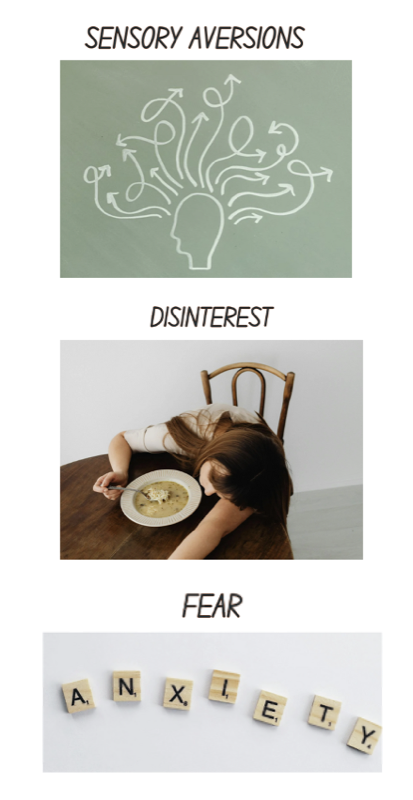
The tricky part about recognizing ARFID is that it can look like picky eating, and picky eating is considered typical in children. Although there is no standard definition for picky eating, it is widely accepted as consuming a limited variety of foods due to the rejection of both familiar and unfamiliar options.2
While picky eating may be concerning, most children will grow out of it over time.4 In children with ARFID, however, these behaviors are persistent and can last into adulthood.4 Children with ARFID do not avoid certain foods simply because they prefer others; instead, certain foods may not feel “safe” to eat. This fear explains why children avoid or restrict certain foods. Unfortunately, a child with ARFID will not be waving a red flag, so being able to recognize it is important. One of the first things to look at is the child’s behaviors. These include:
- Extreme Food Selectivity: Children with ARFID often limit their food choices to a very narrow range, refusing entire food groups or eating only a few specific foods consistently.5
- Fear or Anxiety Surrounding Food: Intense anxiety when confronted with unfamiliar foods, which may be related to fears of choking or vomiting.
- Disinterest in Eating: Little to no interest in food, eating very small amounts of food, or skipping meals altogether.
- Sensory Sensitivity: The taste, texture, smell, or appearance of certain foods is intolerable for a child.
If a child is exhibiting one or multiple of these behaviors, it may be a sign of ARFID. Other signs and symptoms can include weight loss, delayed growth, dizziness, fainting, abdominal pain, and nutritional deficiencies.6

Screening for ARFID: Tools for Accurate Diagnosis
If you suspect a child may have ARFID, there are several screening tools available to help with diagnosis. It’s important to note that not all these tools have been fully validated for all populations, so clinical judgment should always be applied. These screening tools include:
- Pica, ARFID, and Rumination Disorder Interview (PARDI-AR-Q): This tool is specifically designed to assess symptoms and issues related to ARFID and excludes questions related to pica or rumination disorder.7
- Nine Item ARFID Screen (NIAS): The NIAS is a brief, nine-item screen focused on identifying ARFID symptoms.8 It also helps distinguish between different ARFID presentations, such as fear, sensory sensitivity, or disinterest in food.8
- ARFID-Brief Screener (ARFID-BS) and Short ARFID Screen (SAS): Like the NIAS, both the ARFID-Brief Screener (ARFID-BS) and the Short ARFID Screen (SAS) are designed to identify individuals at risk for ARFID. However, the ARFID-BS places greater emphasis on clinical implications, such as low weight and nutritional deficiencies.3
- Eating Disturbances in Youth Questionnaire (EDY-Q): The EDY-Q consists of 14 items, 12 of which cover ARFID.9 This test assesses eating disturbances, particularly in children.9
- Eating Disorder Examination Questionnaire (EDE-Q): This tool can be used to assess weight and shape concerns to rule out an ARFID diagnosis.9
- Strengths and Difficulties Questionnaire (SDQ), Autism Spectrum Quotient (AQ-10), Health of the Nation Outcomes for Children and Adolescents (HoNOS): These tools can be used in conjunction with others to assess broader behavioral, psychological, and developmental concerns that may accompany ARFID.3
Treating ARFID: The Road to Recovery
One of the challenges with treating ARFID is that there is no standardized approach. In fact, limited evidence is available to guide health care providers in treating ARFID.1 However, treatment options exist that may be effective, even if they are not specific to ARFID.
By becoming more educated on ARFID, healthcare providers will be able to help children and their families navigate the disorder, leading to less adverse complications.
One of the most promising methods is Cognitive Behavioral Therapy (CBT), which is often used to treat depression, anxiety disorders, eating disorders, and severe mental illnesses.10 CBT adapted for ARFID has been successful in managing different clinical manifestations of this disorder by reducing symptoms such as increasing food acceptance and reducing anxiety towards foods.1`
Additionally, Family-Based Therapy (FBT) is another promising treatment option for addressing eating disorders in adolescents. This approach encourages parents or caregivers to actively participate in the recovery process by helping to manage eating behaviors and providing necessary support to their child.1

Navigating ARFID: Strategies for Long-term Success
While the treatment options are limited, there are other ways to help a child struggling with ARFID. One of the main ways is through parental involvement. However, many parents may not know how to respond to their child’s ARFID diagnosis. To help guide them, healthcare providers can introduce some of the following strategies:
- Introduce New Foods Slowly: Do not force eating. Instead, try to gradually introduce new foods in small portions. Start by allowing the child to interact with foods through touching or smelling before progressing to tasting.
- Create a Positive Environment: Ensure mealtimes are calm. Avoid pressuring your child to eat, as this can cause stress and further food aversions. Create a space that gives the child room to explore new foods.
- Reinforce Small Victories: Celebrate progress, even if it’s simply taking a bite out of a new food.
- Incorporate Safe Foods: Include foods the child is comfortable with alongside less familiar ones. This practice can help make the child feel safe and comfortable when trying new foods.
- Work with a Professional: Children with ARFID should work closely with healthcare professionals, such as therapists and dietitians specializing in eating disorders. Working as a team will help to ensure the child’s physical and emotional needs are being managed appropriately.
Early Intervention in ARFID: The Key to Long-Term Success
It’s important to recognize ARFID is not something that will change overnight—it takes patience and a lot of support. Without this support, ARFID can lead to poor health outcomes for the child, making early diagnosis and intervention crucial. The sooner this eating disorder is identified and addressed, the better the long-term outcomes are for the child. By becoming more educated on ARFID, healthcare providers will be able to help children and their families navigate the disorder, leading to less adverse complications. Early intervention does not just change a child’s relationship with food—it gives them the opportunity to lead a healthier and more fulfilling life.

References
- Fonseca NKO, Curtarelli VD, Bertoletti J, et al. Avoidant restrictive food intake disorder: recent advances in neurobiology and treatment. Journal of Eating Disorders. 2024;12(1):74. doi:https://doi.org/10.1186/s40337-024-01021-z
- Silvers E, Erlich K. Picky eating or something more? Differentiating ARFID from typical childhood development. The Nurse Practitioner. 2023;48(12):16. doi:https://doi.org/10.1097/01.NPR.0000000000000119
- Archibald T, Bryant-Waugh R. Current evidence for avoidant restrictive food intake disorder: Implications for clinical practice and future directions. JCPP Advances. 2023;3(2). doi:https://doi.org/10.1002/jcv2.12160
- Sanchez‐Cerezo J, Nagularaj L, Gledhill J, Nicholls D. What do we know about the epidemiology of avoidant/restrictive food intake disorder in children and adolescents? A systematic review of the literature. European Eating Disorders Review. 2022;31(2). doi:https://doi.org/10.1002/erv.2964
- Zimmerman J, Fisher M. Avoidant/Restrictive Food Intake Disorder (ARFID). Current Problems in Pediatric and Adolescent Health Care. 2017;47(4):95-103. doi:https://doi.org/10.1016/j.cppeds.2017.02.005
- Brytek-Matera A, Ziółkowska B, Ocalewski J. Symptoms of Avoidant/Restrictive Food Intake Disorder among 2-10-Year-Old Children: The Significance of Maternal Feeding Style and Maternal Eating Disorders. Nutrients. 2022;14(21):4527. Published 2022 Oct 27. doi:10.3390/nu14214527
- Bryant-Waugh R, Stern CM, Dreier MJ, et al. Preliminary validation of the pica, ARFID and rumination disorder interview ARFID questionnaire (PARDI-AR-Q). J Eat Disord. 2022;10(1):179. Published 2022 Nov 22. doi:10.1186/s40337-022-00706-7
- Burton Murray H, Dreier MJ, Zickgraf HF, Becker KR, Breithaupt L, Eddy KT, Thomas JJ. Validation of the nine item ARFID screen (NIAS) subscales for distinguishing ARFID presentations and screening for ARFID. Int J Eat Disord. 2021 Oct;54(10):1782-1792. doi: 10.1002/eat.23520. Epub 2021 Apr 22. PMID: 33884646; PMCID: PMC8492485.
- Kambanis PE, Thomas JJ. Assessment and Treatment of Avoidant/Restrictive Food Intake Disorder. Curr Psychiatry Rep. 2023;25(2):53-64. doi:10.1007/s11920-022-01404-6
- American Psychological Association. What Is Cognitive Behavioral Therapy? American Psychological Association. https://www.apa.org/ptsd-guideline/patients-and-families/cognitive-behavioral. Published 2017.
Interested in learning more about ARFID? Read this article addressing parents and caregivers of children with ARFID, as well as this AskIFAS article about ARFID.
Looking for more posts sharing stories about nutrition hot topics? Check out the rest of the UF/FSHN Nutrition Stories Series!
 2
2