For over 20 years, the case study competition hosted by the Graduate Student Section at the Agricultural & Applied Economics Association has served as an arena for Food and Resource Economics graduate students to showcase their ability to apply classroom knowledge to real-world situations, pitting them against their peers from some of the most prestigious programs across North America. This year, Faith Aiya and Prabin Adhikari, both Ph.D. students in Food and Resource Economics at the University of Florida, placed first, the first University of Florida team ever to do so.
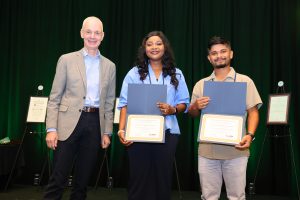
“Winning first place at the AAEA Case Study Competition was both an honor and a humbling milestone,” Faith said.” “Competing against 11 outstanding teams from across the country and emerging at the top validated the depth, creativity, and rigor of our analysis. It was especially meaningful as this marked the Food and Resource Economics Department’s first AAEA case competition first-place win in over two and a half decades, making the recognition even more rewarding.”
For Prabin, this was his first time competing in a case study competition, which allowed him to approach the challenge with a fresh perspective and a healthy dose of curiosity.
“Receiving the first-place award at the national AAEA Case Study Competition was truly an unforgettable moment for me,” Prabin said. “As this was my very first case study competition, it was incredibly rewarding to see our team’s hard work and strategic thinking recognized on such a prestigious platform.”
While the competition was a first for Prabin, Faith was able to build upon prior success, having competed both at AAEA before and participating in the global IFAMA Venture Building Challenge last November, for which her team was the runner-up.
“My prior experience with case studies proved invaluable as it shaped my approach to team coordination, time management, and building a compelling narrative grounded in evidence,” Faith said. “These lessons, combined with the targeted coaching from Dr. Zhang and Dr. Chen, and the in-depth financial analysis conducted by Prabin and I, were instrumental in helping us deliver a winning presentation.”
This year’s case study centered on AMAGGI, a leading Brazilian agribusiness powerhouse with operations spanning the full value chain, from large-scale grain production and processing to global commodity trading, logistics, and renewable energy generation.
“Agribusinesses like AMAGGI have a significant role to play in mitigating environmental impact while ensuring food security,” Prabin said. “This case challenged us to think about sustainability not just as a social responsibility, but as a strategic imperative that can drive long-term success. It reinforced the idea that responsible innovation is essential for building a better world for future generations.”
For the competition, team’s were instructed to design a strategic roadmap enabling AMAGGI to “embrace the future” by advancing sustainability commitments while safeguarding profitability amid commodity price volatility and tightening global ESG standards.
“The competition was a masterclass in strategic problem-solving under pressure,” Faith said. “I deepened my understanding of how to merge economic, policy, and sustainability perspectives into actionable, financially sound recommendations.”
Both Faith and Prabin emphasized that their success in the competition comes largely as a result of their collaboration. Both praise the teamwork exemplified not only by each other, but also with mentors Dr. Xumin Zhang and Dr. Lijun “Angelia” Chen.
“Having strong mentorship from Dr. Xumin Zhang and Dr. Angelia Chen really helped us shape our ideas and prepare a compelling presentation,” Prabin said. ”I’ll carry forward these lessons to future competitions and academic challenges.”
 2
2