Developed by our Ecology and Natural Resources program, the “Wondering About Wildlife?” blog series provides answers to frequently asked questions and concerns about the wildlife around us. This blog focuses on reducing negative encounters with coyotes and helping them to retain their natural fear of humans.
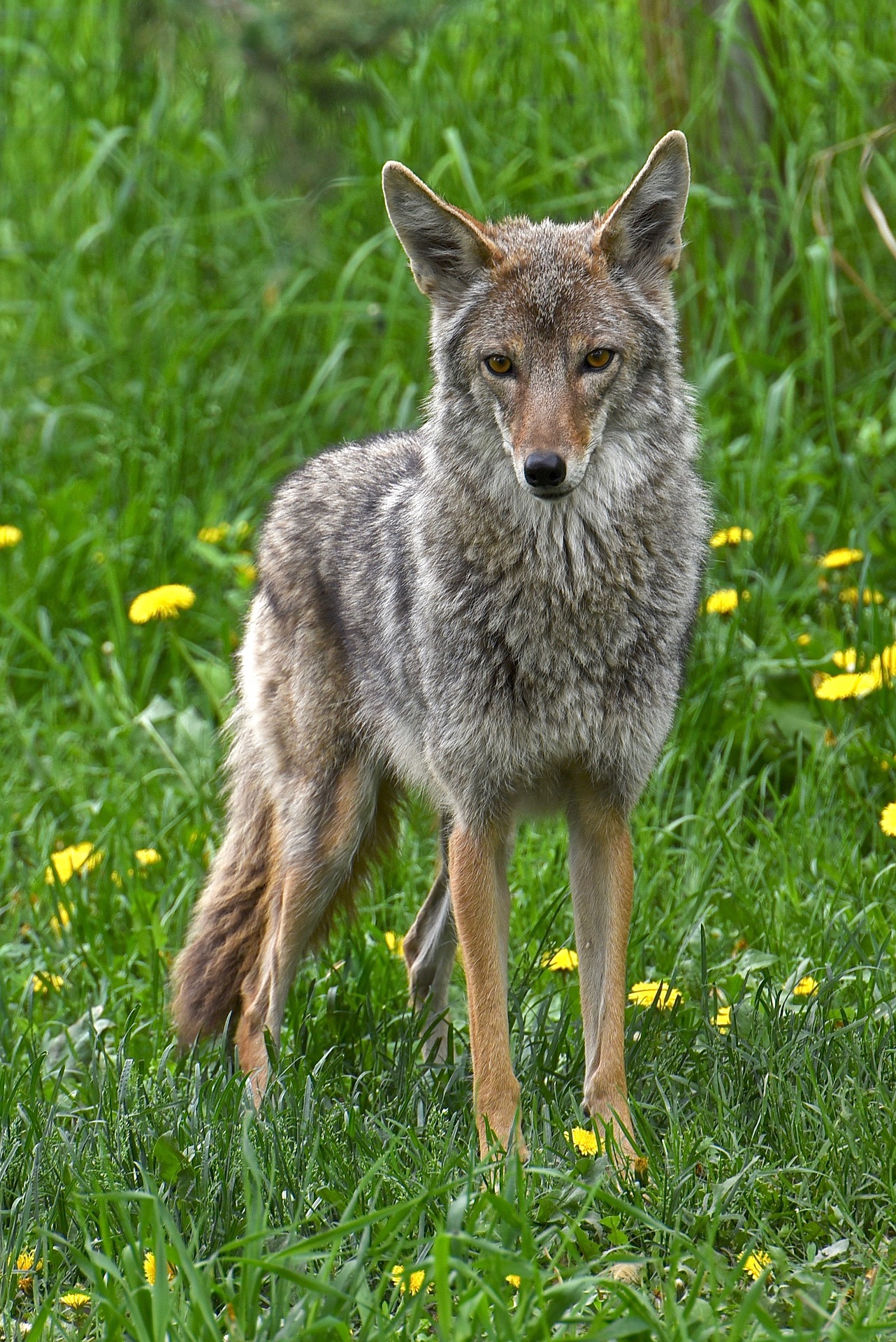
Coyote (Canis latrans)

Coyotes are a medium-sized member of the dog family standing at about 2 feet tall and 3.5 to 4 feet long. Their color varies from light to dark but generally is usually a yellowish-brownish grey with lighter undersides and throats. They have bushy tails with black tips. In Florida, most adults average between 25 and 30lbs, about half the weight of an average Labrador retriever.
Is there a coyote in the area?
Coyotes have naturally expanded their range into Florida and are now found in every county. Like racoons, coyotes have become accustomed to developed areas and have adapted to living near humans, often taking advantage of the readily available food in residential areas. It is not uncommon to see or hear a coyote even in neighborhoods. While coyotes are not overly shy, they’re crepuscular (most active at dawn and dusk) and may avoid notice, so here are some other tips to determine if you’ve had a coyote in your area.
Coyote scat averages 4″ long and tends to be shaped in logs like that of a domestic dog. Unlike a domestic dog’s, it is usually lighter in color, contains the fur of prey and may also contain berries, palm fruit, etc. It can vary day to day, between individuals, seasonally and depending on diet.
Like all canines, coyotes have tracks with a two-lobed heel pad and four toe pads. Tracks are ~2.5 inches long by 2 inches wide. In comparison to domestic dogs, coyote tracks tend to be narrower and may only leave claw marks above the two most forward toes.
You may also identify that coyotes are in your area if you hear their vocalizations. Coyotes do not have the same type of howls like wolves, but instead usually communicate with more high-pitched barks, yips, howls, and whines. Another indirect sign of coyotes may be a decrease in the number of rabbits, or sadly, missing outdoor cats. It is always healthier and safer for your pet cats to be kept indoors and to keep dogs on a short, non-retractable leash.
Minimizing Interactions with Coyotes: Be Coyote Smart!
As with all wildlife, it’s important to minimize interactions to keep wildlife wild and to reduce the risk of conflicts. Become educated on prevention tactics and don’t allow coyotes to become accustomed to humans.
- Never feed coyotes, this includes inadvertent sources of feeding:
- Secure garbage and compost.
- Don’t leave pet food outdoors (this can also attract racoons, cockroaches, cane toads, and rodents).
- Clean up fallen fruit and bird seed.
- Monitor and secure backyard chickens.
- Keep cats indoors.
- Keep dogs (especially small dogs) on leashes and supervised. Coyotes can climb fences.
- Close off crawl spaces under buildings.
Should you see a coyote, there’s no reason to be alarmed, you are in a position of dominance. Simply assert your dominance by hazing.

- Wave your arms overhead and make noise. Yell “Shoo” or “Go away coyote!” You can wave objects like sticks or an umbrella to seem even larger.
- Make noise with whistles, pots and pans, car and air horns or coyote shakers.
- Create disturbances with motion sprinklers, water pistols, thrown rocks, or motion lights.
- If you see more than one coyote, they are likely a small family group. Coyotes do not form packs like wolves.
The goal is to make yourself seem large and loud and scary. Coyotes are very inquisitive and playful. We do not want them to become accustomed to humans and feel comfortable around us. Hazing helps them to retain their natural fear of us.
Other tips:
- If with a small child, make lots of noise as you move towards the coyote, and pick up your child. Slowly back away while continuing to be loud and large!
- If walking a dog, shorten the leash. Stand in front of a larger dog and slowly back away. Larger dogs will often be the aggressor. If with a small dog, continue to make lots of noise to frighten the coyote while slowly moving away with your dog. Picking up your dog may be safe unless the coyote becomes aggressive.
- Never run! Coyotes are playful and will think you are trying to play with them. Slowly back away and give the coyote space to move on.
Watch FWC’s video on how to haze a coyote.

If a coyote loses its fear of humans due to associating us with easy sources of food, it may exhibit unusual behavior. This could include approaching people, chasing joggers and bikers, or attacking leashed pets. Unusual coyote behavior can be reported to your nearest FWC Regional Office. Not all coyotes should be reported. If a coyote is not acting abnormally, then potentially removing that coyote just makes space for another to move into the area. Coyotes are a part of Florida’s ecosystem. Your actions can help keep coyotes wild and minimize risk to humans and pets. Learn more at FWC’s Living with Coyotes webpage.
Learn More
Check out all the blogs in the “Wondering About Wildlife?” series.

Visit UF/IFAS Extension Sarasota County’s Sarasota Starter Kit: A Guide to Living on the Suncoast 30-minute webinars for new, or current residents.
Register for Neighborhood Best Practices, an online, self-paced course that provides videos, fact sheets, resource links, and more on topics from wildlife interactions to supporting healthy water quality and Florida-Friendly Landscaping to foster thriving, informed, and sustainable communities.
Other Series of Interest
Enjoy blogs about identification, biology, ecology, and fun facts about our native wildlife with our “Wild Sarasota” blog series. Accompanying webinars and resources on over 140 species of wildlife can be found on our Florida Wildlife webpage.
 0
0