Welcome to the Back-to-School Season!

Back-to-school time can be an exciting time, as we jump back into our typical routine, but it can also be quite overwhelming. From school supplies to clothes to meals and snacks. If you’re feeling overwhelmed about what to pack for school lunches and snacks, you are not alone. Let’s take a deep breath in and exhale.
Together, we are going to explore strategies and techniques to help us get off on the right foot. While we discuss school meals and snacks, many of the strategies we cover in this blog series will also be helpful when planning meals and snacks for the whole family, especially if you are looking to stay within your food budget.
Child Nutrition Recommendations
A good place to start is by understanding what a child needs nutritionally to grow and develop. The American Heart Association gives us heart-healthy recommendations:
| Food Group | 1 Year | 2-3 Years | 4-8 Years | 9-13 Years | 14-18 Years |
| Calories (Female) | 900 | 1,000 | 1,200 | 1,600 | 1,800 |
| Calories (Male) | 900 | 1,000 | 1,400 | 1,800 | 2,200 |
| Fat | 30-40% | 30-35% | 25-35% | 25-35% | 25-35% |
| Milk/Dairy | 2 cups | 2 cups | 2 cups | 3 cups | 3 cups |
| Lean Meat & Beans (Female) | 1.5 oz | 2 oz | 3 oz | 5 oz | 5 oz |
| Lean Meat & Beans (Male) | 1.5 oz | 2 oz | 4 oz | 5 oz | 6 oz |
| Fruits (Female) | 1 cup | 1 cup | 1.5 cups | 1.5 cups | 1.5 cups |
| Fruits (Male) | 1 cup | 1 cup | 1.5 cups | 1.5 cups | 2 cups |
| Vegetables (Female) | 3/4 cup | 1 cup | 1 cup | 2 cups | 2.5 cups |
| Vegetables (Male) | 3/4 cup | 1 cup | 1.5 cups | 2.5 cups | 3 cups |
| Grains (Female) | 2 oz | 3 oz | 4 oz | 5 oz | 6 oz |
| Grains (Male) | 2 oz | 3 oz | 5 oz | 6 oz | 7 oz |
Table adapted from American Heart Association, 2024¹
We can also use the Kid’s Healthy Eating Plate², developed by the Harvard T.H. Chan School of Public Health, to visualize how to balance these food groups. The concept is to fill half the plate with fruits and vegetables, a quarter with whole grains, a quarter with lean proteins, and healthy fats in moderation, with water or dairy as a beverage. It does not necessarily mean the meals need to be compartmentalized by food group, but it serves as a visual reminder to include a variety of food groups. Key takeaway: Variety of food groups = variety of nutrients
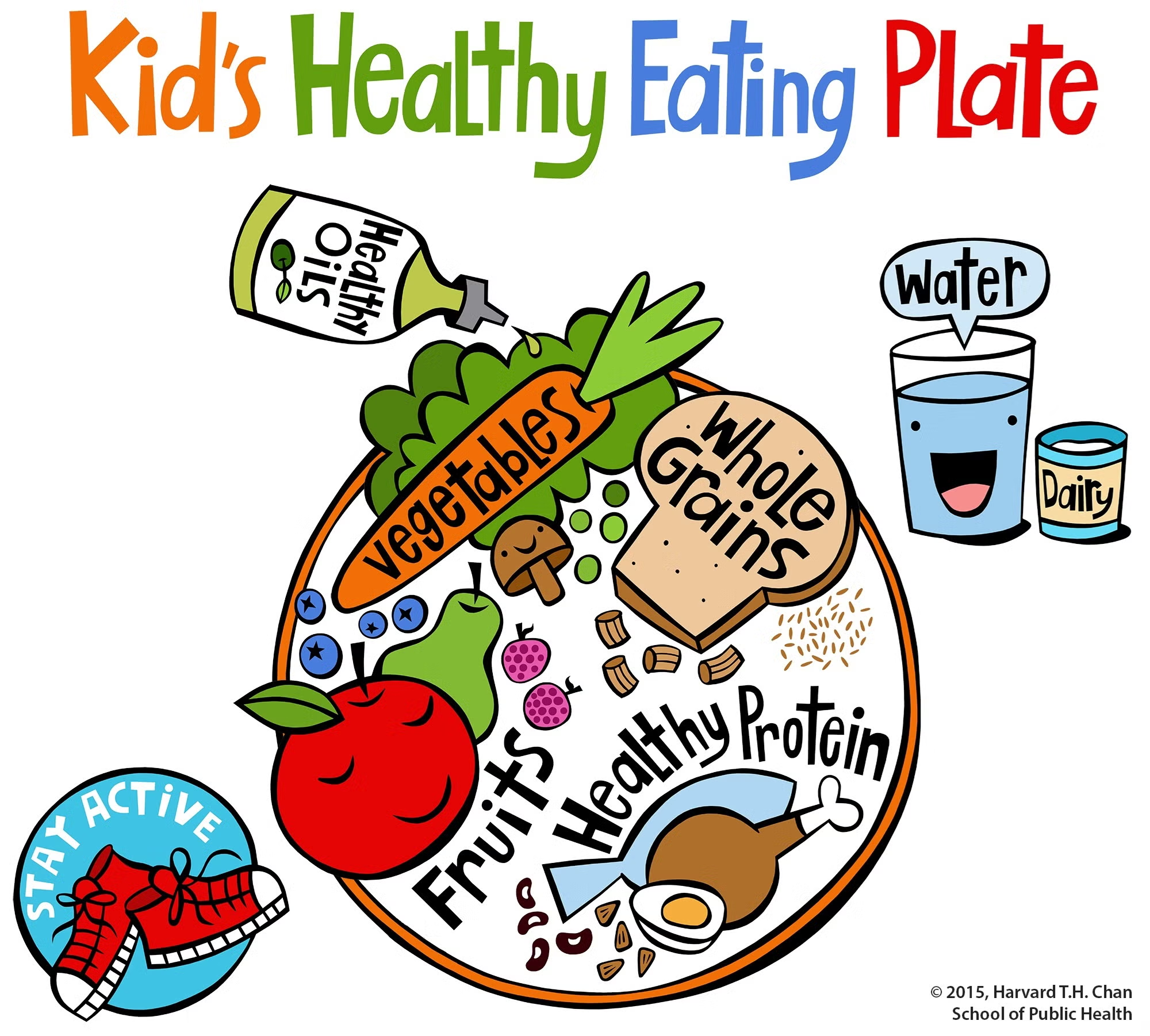
So when we are planning school lunches, you can consider this framework: Healthy Fats + Protein + Fruit + Vegetable + Grains + Dairy = Balanced Meal
Tips:
- Aim for progress, not perfection. Not every meal will have every food group, but aim to include a variety of food groups throughout the day.
- Snacks are an opportunity to fill in any missing food groups that may not have been included in meals.
When planning snacks, you can consider this framework: Protein + Carbohydrate + Healthy Fat (Bonus) = Balanced Snack
Tips:
- Combine a protein and a carbohydrate when preparing a snack to ensure it is balanced.
- Add healthy fats in moderation to help them stay full a bit longer.
As parents and caretakers, you play an important role in shaping your child’s eating habits, and by considering nutrition when planning meals and snacks, you help them build healthy habits for a lifetime.
In our next Back-to-School Means and Snacks blog, we will learn how to understand key elements of the nutrition facts label to help us make informed decisions when purchasing packaged foods.
References:
 3
3