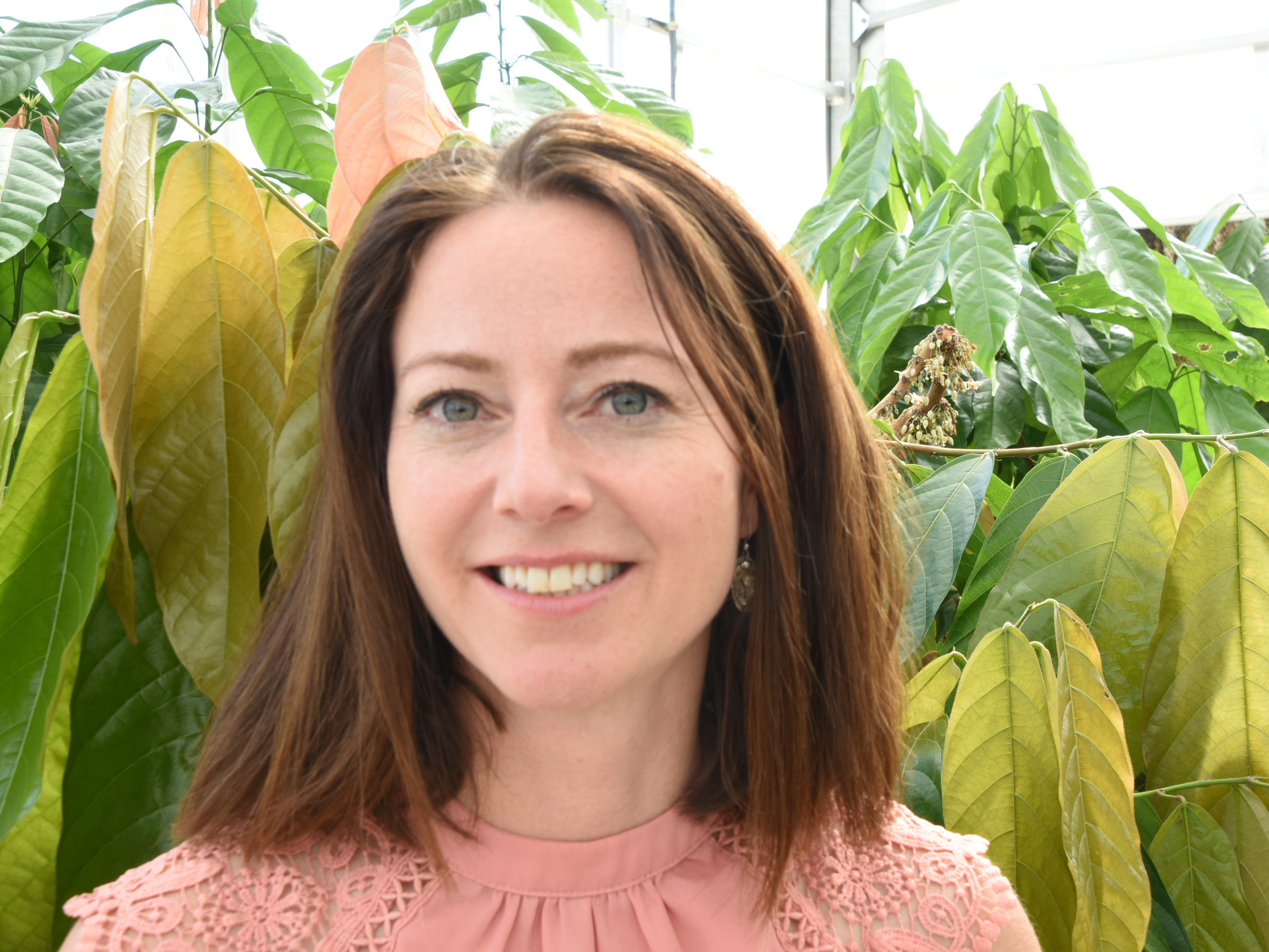
Dr. Ashley DuVal, an alumna of UF/IFAS with a Ph.D. in Horticultural Sciences, has built a career devoted to ensuring that chocolate has a sustainable future.
Now a Senior Scientist and cacao breeder with Mars Wrigley, Dr. DuVal works with a team of researchers at the company’s Plant Science Center in Davis, California, home to one of the most diverse cacao germplasm collections in the world. Her role bridges molecular genetics and field breeding, identifying traits for disease resistance, climate resilience, and yield improvement.
From cacao farms in South America to research stations in Southeast Asia, her career reflects how science can shape the future of crops, and the communities that depend on them, around the world.
Can you introduce yourself and your role at Mars?
I am a cacao breeder with Mars Wrigley, where I began working in 2015 as a member of our Genetics and Breeding team in Miami, FL. Today, our team is based out of the Mars Plant Science Center in Davis, CA, where we maintain the largest collection of cacao germplasm for breeding in the US. Our Davis site serves as the US hub for our global breeding program, which also includes research stations in Brazil, Ecuador and Indonesia where our many field trials are conducted. We also maintain cacao quarantine facilities at the USDA -SHRS in Miami, FL. Altogether, our teams consist of around 200 members from around the world working hard to help ensure that we never live in a world without chocolate! The Plant Science Center in Davis is intended to be the starting and ending point of our germplasm pipeline. It acts as both a repository of wild germplasm to screen for traits relating to pest and disease resistance, climate change adaptation and yield, while also housing elite breeding materials we have developed around the world. We like to think about these facilities as a pilot plant for field breeding, where we can focus on measuring traits that might be too expensive or noisy to measure in the field.
What does your day-to-day work as a Senior Scientist on the Genetics and Breeding Team look like?
One of the things I love most about my job is how varied my days are. I manage research projects and breeding trials related to rootstock improvement and marker discovery for abiotic stress response in our germplasm collection. On a typical day, I may be spending time in the greenhouse with experimental populations and working with our talented team, including our UC Davis graduate students, to provide guidance on their experiments. I might also be on calls with partners at our research stations or visiting field trials, as well as working with innovative AgTech startups to test new technologies in our greenhouse and ultimately for deployment in the field. During the falls I teach a course, “Chocolate, Covered”, to undergraduates at UC Davis, where we use the greenhouses as a teaching resource and even make chocolate from pods grown on our trees!
You’ve studied at Berkeley, Yale, and UF. How did each of those academic experiences shape your perspective as a scientist working in industry?
I think the most important part of my education has been the mentorship that I received at each of those institutions. I was so lucky to work with brilliant researchers and breeders who were committed to working with their students. They deeply influenced me through example, particularly by demonstrating how much it was possible to accomplish spending one’s career devoted to deep research on a topic or region. My perspective and approach as a scientist today are still shaped strongly by big picture questions from my background in resource management, forestry, and ethnobotany. At Berkeley, I learned to approach conservation issues not only through the lens of scientific inquiry, but by also understanding the role of policies, economics, and socio-cultural drivers. I think it gave me the foundations for thinking in cross-disciplinary frameworks. At Yale, I spent two field summers in the Amazon, working with açai-harvesting households and gaining the skills to conduct field work and design and test research questions. I also became fascinated by the potential of Amazonian fruits, and I jumped at the chance to work on cacao when the opportunity arose with Mars. However, the only problem was that I didn’t have a background in genetics and breeding. At UF, I was able to fill in gaps in my skills and tools to become a breeder. While my passion has always been working with trees, my lens transitioned from management and conservation of forests and trees to crop domestication and agrobiodiversity, to finally using genomics to speed up breeding of orphan crops like cacao.
What first drew you to work with cacao as your dissertation for UF? Was there a particular experience or turning point that led you to focus on this crop?
After finishing my masters, I worked as a consultant for the FAO Commission on Genetic Resources for Food and Agriculture. I was involved in work to draft the flagship “State of the World’s Biodiversity for Food and Agriculture” report, and from reading country reports it was clear that molecular tools were already bringing unprecedented speed and precision to breeding and improvement of underutilized tree crops. I could see what an exciting time it was to be working with trees, and I wanted to be a part of that progress. Around that time, Mars made headlines with the first public release of the cacao genome. A lifelong chocoholic and enthusiast for underutilized Amazonian crops, I felt like this could be my calling.
What excited me about entering the field of breeding in the age of genomics was that it might be possible to make meaningful progress to a crop within the course of my career. I contacted the Mars team in Miami to learn more about their work and learned that they were bringing on Ph.D. students. That is how I ended up at the University of Florida getting training to be a cacao breeder. I am so grateful that the company invested in my development in this area, and love that I have an opportunity to give back through mentorship of our own graduate students.
How did your doctoral research prepare you for your current breeding work at Mars?
My Ph.D. helped me set the foundation for work I continue to do today. I was able to establish trials that continued to be monitored beyond my Ph.D. and establish some foundational understandings that have been critical for designing a rootstock breeding program. My dissertation work was critical in helping me build not only the technical skills and network, but also the confidence to learn to trust my instincts as a breeder. Professor José Chaparro, my advisor, is an amazing mentor and role model. I learned so much from him about how to think about crop improvement and how to set up a breeding program. Professors Muñoz, Gezan and Darnell helped to build foundations in breeding, quantitative genetics and physiology that have been the theoretical basis for much of my work since then. Moreover, the network of professors and students I encountered at UF have been a valuable resource in my professional life as well.
By the way, Gators continue to be well represented in our team, as both our Biostatistician, Dayana Rodezno, and our Global Director of Genetics and Breeding, Derek Drost, completed their graduate studies at UF!
Can you give us a bit more insight into the research you’re conducting at Mars?
In Davis at our Plant Science Center, we’ve assembled an incredibly diverse cacao germplasm collection that covers roughly 80% of the ancestry groups of wild cacao, as well as elite selections from numerous breeding programs around the world. Additionally, we maintain Biosafety Level Two labs with a cacao pathogen diversity collection. What makes our operation particularly unique is that we have the ability to study the plant’s response to a range of stressors, both biotic and abiotic, without the noise and variation inherent in field grown trees. So, a primary focus of our work is pre-breeding evaluation and trait discovery, probing the diversity of the crop for useful variations for farmers to enter our breeding pipeline.
It is an exciting year for us at Mars – our global breeding program has been operating for 25 years, and this year has registered over 40 cultivars that will ultimately be made available to cacao farmers in Latin America and Southeast Asia!
Can you tell us how your work in cacao breeding and rootstock development supports the company’s goals and connects to global cacao-growing regions?
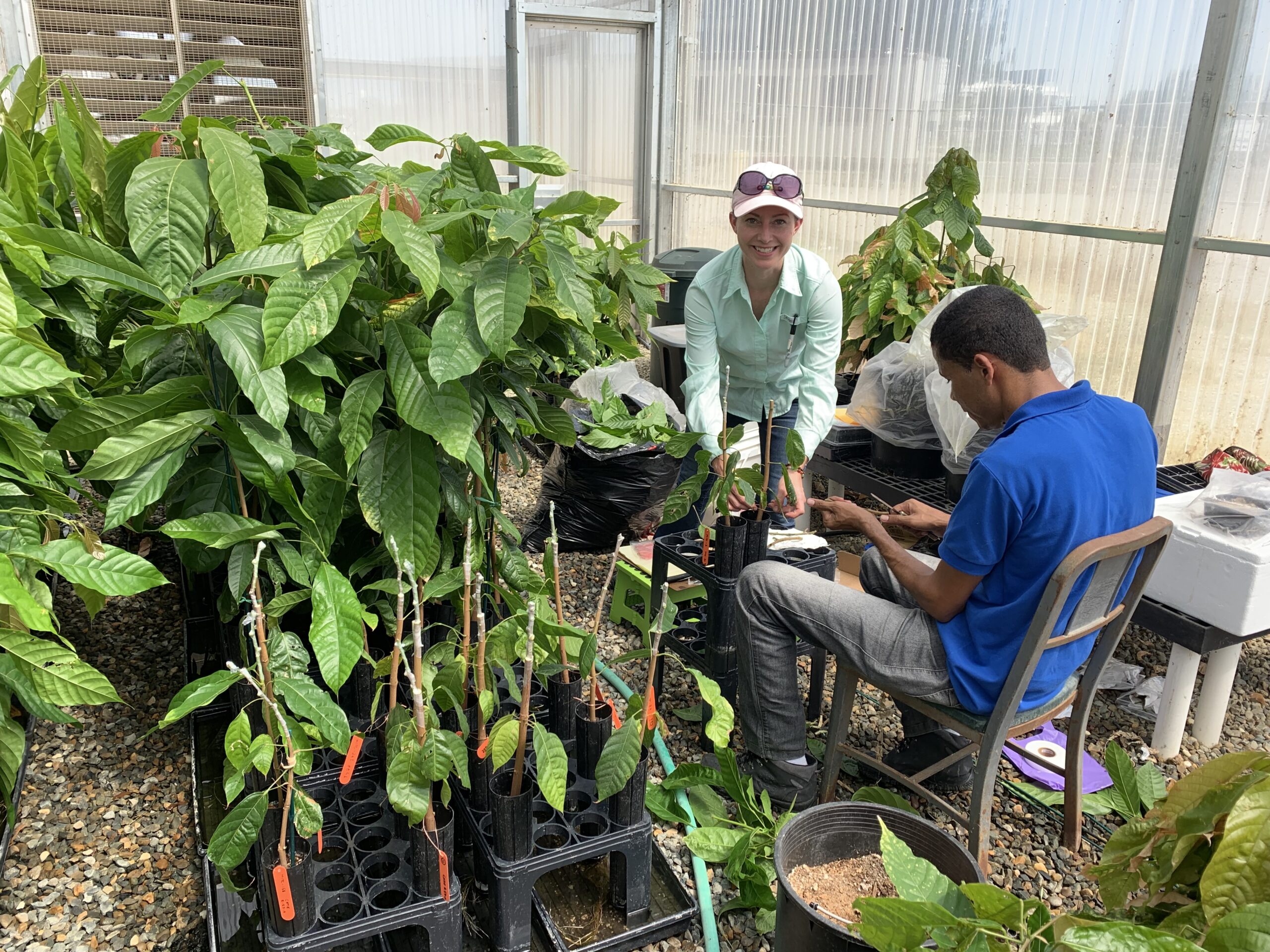
In my rootstock breeding work, a major focus is resilience to climate extremes. Global climate change will continue to impact cacao growing regions in different ways, but models all show increasing intensity of extreme events like drought and flooding. With the new generation of planting materials becoming available, improved rootstock can help stabilize the productivity of new clones and ensure they meet their genetic potential even when faced with increased frequency of climate disturbances. In addition to development of new rootstock varieties, we are working on optimal ways of growing and producing them – nursery treatments that can optimize the health and vigor of planting materials, and increase the speed and uniformity of material being grown for the field.
Our work to breed higher yielding cacao varieties and reduce the losses attributed to pests, diseases, and climate is central to the Mars Cocoa for Generations Strategy. It helps support programs that make a difference for cocoa-growing communities and the environment. Cocoa, a critical ingredient in many Mars products, is also the biggest contributor to its carbon footprint. We are working to develop not only the planting materials, but also the accompanying knowledge, tools, and resources to help modernize cocoa farming practices, and produce more cocoa on less land. These efforts support the Mars Sustainable in a Generation Plan’s aim to reach net zero GHG emissions across the full value chain by 2050.
What are some of the unique challenges of breeding a crop like cacao? How does climate resilience and sustainability influence your long-term strategies?
Cacao is a fascinating crop with numerous challenges to breeders. Despite over 5,000 years of use by human civilizations, modern breeding efforts are lagging and really began in earnest in the 1930s with work in Trinidad. Today, the most advanced selections are still only 2-3 breeding cycles from wild plants. We see large genetic gains with each generation of crosses and are seeing great progress in the speed of developing new planting materials as we make the transition from traditional breeding to genomic selection. So, the opportunity space for breeding is just enormous, but it is not without challenges!
Another obstacle we have had to overcome is the unique system of incompatibility specific to cacao. Previously, large numbers of pollinations had to be performed to determine compatibility status, but today our team has developed diagnostic markers and can predict self- and cross-compatibility to better facilitate breeding and farm design. The pollinator ecology is also poorly understood, and no doubt subject to much regional variation. These are only two factors that complicate field performance – so it should come as little surprise that genotype by environment (GXE) interactions are a big impediment in breeding progress.
It is truly a crop where genomic tools can finally help provide more accurate breeding predictions than phenotypic traits alone. We are continually optimizing our approach to data collection, often moving in favor of technology and automation to arrive at more precise measurements, reduce the cost and labor required, and make decisions faster. When you breed tree crops that farmers will have in their field for decades, you must think broadly about stability and resilience, breeding for not only the conditions today, but also the possible challenges farmers may face a decade from now.
What advice do you have for students pursuing careers in specialty crop breeding or industry research?
I would encourage students to diversify their course work and experiences to include literacy in marketing and product development, as well as soft skills. There are organizations providing scholarships and professional development opportunities along these lines, including Foundation for Food and Agriculture Research and Agriculture Future of America, that I would encourage students to explore. It is never too early to start building your networks, and your classmates will be a resource for many of you throughout your careers.
Specialty crop breeding is incredibly rewarding, and much progress could be made if more breeders ‘adopted’ orphan crops, even as a side pursuit. There are direct benefits with regards to nutrition, food security, and sustainable livelihoods to working with crops that are locally important, as many of these are lacking dedicated funding and research opportunities. Groups like the African Orphan Crop Initiative have been incredibly effective at applying modern breeding techniques to traditional or underutilized crops. Try to access and leverage the genetic resources of land races and crop wild relatives in your breeding program. Gene editing approaches make the traits found in this germplasm increasingly relevant.
What emerging technologies do you think will most shape the future of plant breeding in the next decade?
It might sound a little cliché, but there is no ignoring the elephant in the room: AI. All our experiments now generate so much data that analysis is a major bottleneck. Leveraging the ability of machine learning to summarize diverse datasets and pick out patterns that would be easy to miss will surely help scientists revolutionize their work and bring tree breeding into hyper speed – for tree breeding, that is!
 9
9