It took one elective to pivot Nadia’s initial pursuit of human health research into a Ph.D. candidate in the Plant Molecular and Cellular Biology Program. Nadia Mourad now works under the mentorship of Dr. Karen Koch, who was recently honored along with Dr. Don McCarty, with the Maize Genetics Cooperator Award for their creation of the UniformMu National Public Resource. Her research contributes to this extensive library of over 14,000 maize mutant lines, a tool that has enabled scientists globally to uncover gene functions and drive innovation in crop science. Within this legacy of discovery, Nadia is investigating how sorbitol metabolism influences maize seed development. This is a question that has intrigued plant biologists for decades as it links fundamental gene research to real-world solutions for food security and agricultural resilience.
Nadia’s experiences bridge academia and industry. From mentoring undergraduates and organizing symposiums to interning with cutting-edge ag-tech companies, she brings a well-rounded perspective to the field. In this conversation, Nadia shares insights on her research and what it means to build an inclusive and innovative future in plant science.
Tell us about yourself and what inspired you to pursue your Ph.D. in Plant Molecular and Cellular Biology at UF.
I was born in Miami, Florida to Lebanese and Chilean parents. I attended UF as an undergrad majoring in Microbiology & Cell Science. At the time, I was planning to go into human health research – until I took an elective called, The Challenge 2050 Project. That class changed the trajectory of my professional goals. In this course, we collaborated across disciplines to address the global challenges predicted for the year 2050, taking into account continued population growth, more extreme weather events, and limited resources. We even presented our big ideas at the American Seed Trade Association (ASTA) Conference to regulators in agriculture. This was my introduction to the importance of agricultural sciences. I was interested in particular how plant biotechnology could be used to solve big problems. I read everything I could on the subject and joined Dr. Kevin Folta’s lab, where I got my first hands-on experience in plant research. I also interned at HM Clause Seed Co., where I saw how seed companies use genetic diversity to develop cultivars that meet farmers’ needs. Through these experiences, I was motivated to continue to take my career in this direction and was admitted into the PMCB program.
Can you tell us about your research focus and the work you’re conducting in Dr. Koch’s lab? How does your project fit into the lab’s broader goals?
My research in Dr. Karen Koch’s lab focuses on maize (corn) genetics, specifically kernel development and carbohydrate metabolism. Dr. Koch and Dr. Don McCarty developed and maintained the UniformMu National Public Resource, a library of over 14,000 mutant maize lines publicly available for researchers to identify and study the functions of unknown genes. This kind of foundational research is essential for agriculture. By understanding what each gene does, we have been able to pinpoint those that influence traits like yield, stress tolerance, and nutrient use efficiency. Maize is the most economically significant crop in the United States, contributing $80-90 billion annually to the economy, supporting food systems, product manufacturing, and exports. Due to this, there has been a long history of breeding and improvements done with maize that have directly affected the industry today.
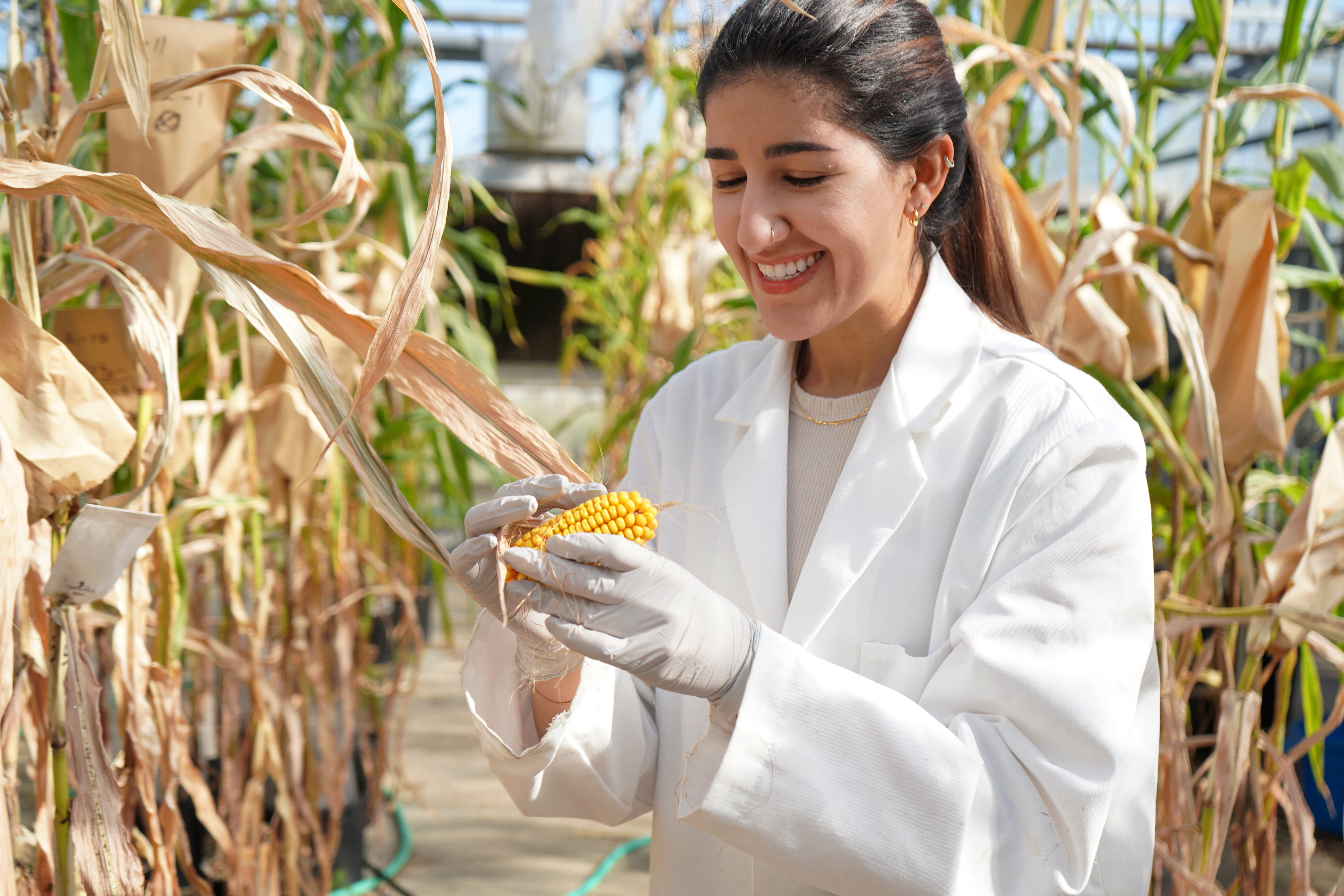
Can you explain your research on maize kernel development and sorbitol metabolism and its broader impact?
Sorbitol is a sugar-alcohol, commonly used as a low-calorie sweetener in diet foods. In plants, it is naturally produced as part of their metabolism. The role of sugar alcohols in plants has been studied; however, the importance of sorbitol in maize kernel development has remained an open question since the 1970s, when sorbitol was detected in kernels.
My work builds upon earlier research by Dr. Sylvia De Sousa and Dr. Koch, who further characterized the sorbitol synthesis enzyme in kernels. When we knocked out the gene responsible for making sorbitol, the seeds were noticeably smaller. This suggests sorbitol contributes to proper kernel development—possibly by supporting redox balance, which is especially important in tissues like some developing seeds that have low oxygen (hypoxic) conditions.
Through our investigations, we have found that a seemingly minor molecule turns out to play a surprisingly big role. The outcome of this work tells us how interconnected plant metabolism is and how it can be leveraged to change the quality and quantity of seeds or fruit.
What’s been a highlight of your research process?
My favorite part of the research season is pollination time in the field. We perform controlled crosses and take care to avoid genetic contamination. A successful pollination season is very rewarding, especially when seeing the plants flower as expected and knowing the seeds will carry the genetic combinations I need. Harvest season becomes something to look forward to because it brings the payoff of months of planning and work.
How have internships or industry experiences impacted your grad journey?
I am currently a summer intern for Pairwise Plants, a startup using gene editing technology to improve specialty crops. Their mission is to help people eat more fruits and vegetables by making produce more appealing, such as by removing things like tough seeds or bitter flavors and enhancing nutrition or other desirable traits.
Working at Pairwise has given me a firsthand look at how science is applied in a fast-moving, innovative environment. I admire how startups like Pairwise bring a unique kind of courage and creativity to ag-tech, especially as the industry becomes increasingly consolidated. Seeing the potential of genetics as a tool for real-world problem-solving has reinforced my belief that this is one of the most powerful ways we can shape a better future.
You’re active in leadership, outreach, and mentorship. Can you share what those are and how they support your work as a scientist?
I am currently the Secretary of the UF Plant Science Council, a student-led organization that provides leadership opportunities, hosts professional development workshops and organizes an annual symposium –a highlight of my grad school experience!
I was also an Ambassador for the American Society of Plant Biologists (ASPB), which helped me connect with plant scientists across the country.
Mentorship has been a big part of my journey. I am grateful to have had wonderful mentors to learn from, and I have modeled my mentorship style around theirs. I have mentored several undergraduate students in our lab who have gone on to pursue their own successful career paths. Since I was once mentored by a Ph.D. student, it’s rewarding to now support others in the same way.
I believe mentorship is essential to science for training the next generation and building a strong and collaborative research community.
What advice would you give to students interested in plant biology, biotechnology, or crop improvement research?
My advice is to make time to learn about the broader field, not just focus on your research. That means making the most of conferences and staying up to date with who is doing what in academia, government, and the private sector. It is easy to get tunnel vision when we are trying to grind through our schooling and other responsibilities, but that broader perspective can help you make informed decisions about your future.
Meeting new people is one of my favorite things to do, and I encourage everyone to stay connected with those you meet across your journey because the world is smaller than you think, especially in the plant sciences field! Also, stay curious! The field is full of exciting problems to solve.
What are your future goals?
Conducting an internship at biotech companies like Pairwise has inspired me to continue to work in the ag-biotech space to usher in the next Green revolution and move the technology forward to make better plants for growers and consumers. For my long-term goals, I would also like to explore a path in regulatory affairs and regulatory policy, where I hope to bridge the gap between research and public impact. There are so many promising technologies sitting in labs that could benefit farmers nationally and globally, but they’re stuck in limbo due to outdated or unclear regulations.
I want to advocate for the value of both applied and fundamental research. Some of our most important discoveries start with basic science, as I have seen from my experience at UF with the UniformMu resource and many other labs making great progress across UF satellite research sites. If the U.S. wants to stay a global leader in science, we must keep supporting this kind of foundational work.
 2
2