Welcome to another installment of our FSHN Research Journeys series, which follows the research of graduate students in the Food Science and Human Nutrition program at The University of Florida! We are pleased to have Melissa Moreno as our repeat guest. During the first year of her nutritional sciences MS program, Melissa studied how consumption of olive oil has the potential to reduce facial pain in those who have a devastating trigeminal neuralgia diagnosis. She completed her master’s degree research under the mentorship of Dr. Wendy Dahl.
In this Research Journeys update, she discusses the results of her research project, the challenges she encountered while conducting her research, and the project she is working on for her nutritional sciences PhD program.
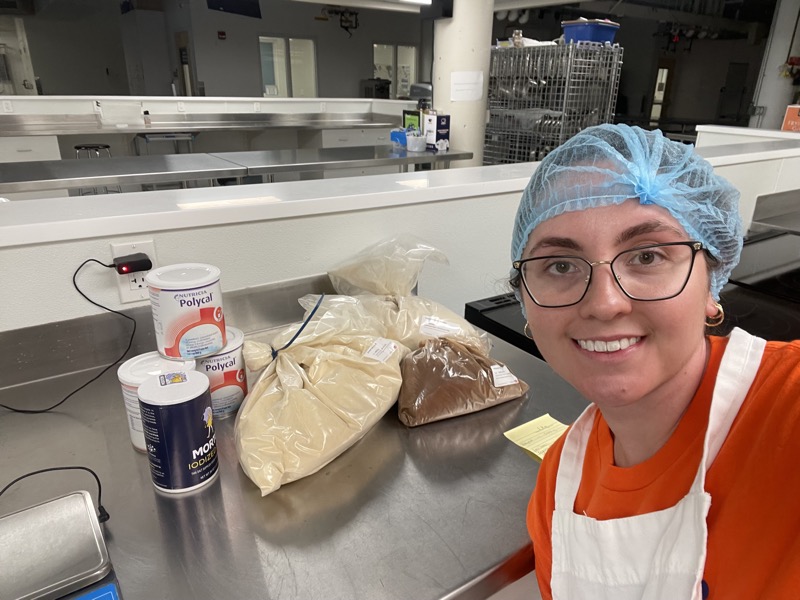
When we last heard from you, you were exploring the potential of olive oil to treat facial pain. How did your project go?
My master’s degree research project was researching the potential benefits of extra virgin olive oil (EVOO) in women with trigeminal neuralgia. I recruited women across the nation and conducted this study virtually. Over the course of performing research, I gained an immense amount of knowledge and experience for how to run a clinical trial.
This project was a 16-week nonblinded, parallel feasibility study. The first four weeks was a baseline period, and at the end, participants were randomized to consume either 60 mL per day EVOO or a control diet (usual diet and no supplemental EVOO) for 12 weeks. During the study, my participants completed a questionnaire on pain intensity and compliance daily, the Penn Facial Pain Scale weekly, the 36-Item Short Form Survey monthly, and a dietary assessment during baseline and intervention.
What did you discover regarding olive oil and facial pain?
We found that the group randomized to the EVOO group, with 90% intake compliance, showed significant decreases in the Penn Facial Pain Scale items of interference with general function, interference with orofacial function, and severity of pain from baseline, whereas the control group showed no improvements.1 EVOO benefit, compared with control, trended for the interference with orofacial function (P = .05). The 36-Item Short Form Survey, which evaluates role limitations resulting from emotional problems and physical health, favored the EVOO group.
The EVOO group also significantly improved their Healthy Eating Index 2015 component scores of fatty acids (primarily from increased oleic acid), sodium, and refined grains. These results suggest that EVOO intake of 60 mL/day was feasible for participants experiencing trigeminal neuralgia and may mitigate pain and improve quality of life.
My master’s degree project gave me experience in a variety of research areas. It encouraged me to appreciate the impact nutrition has on not only facial nerves but also the brain and its function. Our organs are interconnected, and as a result, the field of nutrition is multifaceted and relevant to everyone. Nutritional sciences research allows us to study how food impacts our health and well-being.
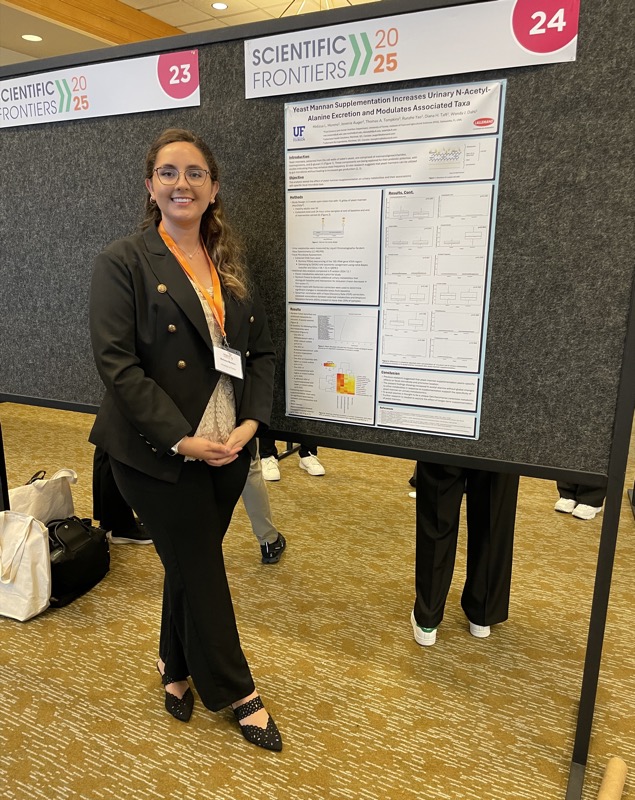
You are now pursuing your nutritional sciences PhD with Dr. Dahl—congratulations! Would you tell us about your current project?
Thank you! My family were very supportive and encouraging with my decision to pursue my doctoral degree. I knew this was another challenge I wanted to tackle.
My current project is working with a potential prebiotic that is derived from baker’s yeast and contains mannooligosaccharides called yeast mannans. We are looking to see the effects of yeast mannans on gastrointestinal symptoms and stool frequency along with the effects on the gut microbiome and microbial-generated metabolites in adults. In my recently published pilot study, I recruited twenty adults over 50 years of age. This three-week, open-label pilot study evaluated the effect of consumption of 15 grams per day of yeast mannans during the two-week intervention period on gastrointestinal symptoms, stool frequency, and fecal microbiome.2 In this study, individuals experienced very minimal gastrointestinal symptoms, and the data showed a trend toward significance in an increase in stool frequency.

What else did you find?
We also looked at a subset of individuals with one or fewer stools per day (n=8) where during the intervention period there was a significant increase in stool frequency. Constipation is common, and current research has shown that constipation is a prodromal symptom of numerous neurological conditions such as Alzheimer’s disease, Parkinson’s disease, and mild cognitive impairment.3,4,5 Many fiber supplements or non-stimulant laxatives provide support for constipation; however, they are often accompanied by uncomfortable gastrointestinal symptoms such as gas and bloating.
With my pilot study, we are seeing some promising results, which leads to my next study with a larger population. I have begun recruiting individuals for my randomized clinical trial and will be starting the next phase in the fall. This study will be a six-week double-blinded, parallel, randomized clinical trial designed to evaluate the effect of 12 grams of yeast mannans on stool frequency. The aim is to determine if 12 grams per day of yeast mannans will increase stool frequency in adults with a stool frequency of ≤ 1 per day (Study Details | Yeast Mannans and Stool Frequency | ClinicalTrials.gov).
How do you relax and recharge while working on your research?
Research is a non-stop constant thinking process. Every day you are working on something, whether that is reading current literature, writing about your own research, working on a protocol for another study your lab is starting (e.g., processing stool samples and preparing those for analysis), consenting and recruiting participants, or simply preparing for the next day. Some days it’s difficult to relax because your brain is constantly going, processing different aspects of research.
However, it’s absolutely important to give yourself a break. My most preferred way is to take a trip to the beach and soak in some sun and salt water. I love going to the beach with my family. Getting everyone together and going fishing with my uncle are times that I cherish. I also try to relax by getting some fresh air. My daily goal during the week is to get out of my office and enjoy a nice 15-minute walk around campus.
These [research] opportunities encourage my love for research and allow me to see the vastness of the nutrition field.
Other times I will make sure to have dinner with friends or make a nice dessert like cheesecake or no-bake cookies with chocolate and oats. I often enjoy getting away for the weekend to visit my boyfriend. We love to go to the beach, walk in a park, try a new restaurant or get sushi, make homemade bread, or simply watch a show. It’s important to take a breather to allow your mind to reset and refresh. Most nights I come home to my sister and our dog, and we have dinner and enjoy the evening. Sometimes, I’ll do a crossword puzzle to relax my mind before I go to bed.

What are the top three things you wish you had known going into your graduate program?
There are many things I wish I’d known. The top three things would be:
- The days can be very long, yet the time in your program goes by very fast!
- Graduate students have a lot of responsibility, such as juggling multiple tasks (including multiple studies), taking courses, and participating in other opportunities.
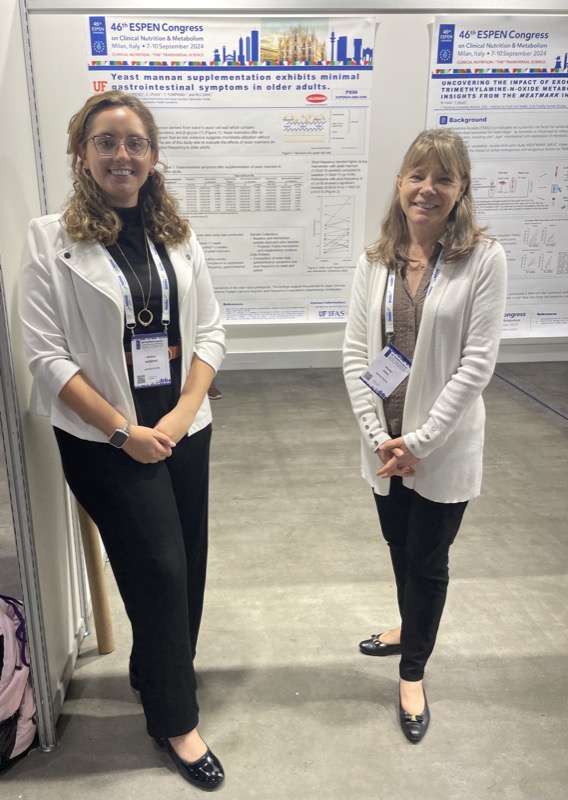
- A fun bonus: My program gave me opportunities for foreign travel! I had the amazing opportunity to travel to Milan, Italy to present some of my work on my pilot study at The European Society for Clinical Nutrition and Metabolism (ESPEN). This was a “pinch me” moment because never would I have thought I would be able to go there for research. I have also had the opportunity to travel to Montreal and Vancouver in Canada where I presented additional research. Additionally, traveling to Boston, Chicago, and Orlando were amazing opportunities to connect with fellow nutrition researchers at the American Society for Nutrition conferences.

What else would you add about your experience in the UF/FSHN graduate program?
My experience in the program has been very nice. I’ve met amazing mentors in the FSHN Department who have supported me from the beginning. To start, my main mentor Dr. Wendy Dahl has supported me since the beginning of my graduate program. She sees my hard work and dedication and therefore continues to expand my areas of research interests with a variety of learning opportunities. I have had the opportunity to work on other research studies collaborating with academic professionals on nutrition qualitative research and the USDA on the health effects of sweet corn. These opportunities encourage my love for research and allow me to see the vastness of the nutrition field.
In the department’s lipids course, Dr. Peggy Borum’s love for fatty acids rubbed off on me, especially while I was doing my master’s degree researching olive oil. She has continuously supported me in my research even while my PhD research changed to a more fiber-type product. I have had the pleasure of working with her and her lab for three years assisting her CURE courses and research related to Precision Ketogenic Therapy (PKT) in seizure patients. This experience allows me to see the benefit research has for those with this condition. It’s an opportunity to truly see how food can impact one’s life.
Additionally, I have gained experience from Dr. Diana Taft as she taught me the beginnings of microbiome analysis for parts of my pilot study. Through the many hours spent with her, I have gained a greater appreciation and understanding of microbiome data, and I am so grateful to her for that opportunity.
References
- Moreno, M. L., Percival, S. S., Kelly, D. L., & Dahl, W. J. (2024). Daily olive oil intake is feasible to reduce trigeminal neuralgia facial pain: A pilot study. Nutrition research (New York, N.Y.), 123, 101–110. https://doi.org/10.1016/j.nutres.2024.01.005
- Moreno ML, Van den Abbeele P, Baudot A, Tompkins TA, Taft DH, Yao R, Auger J, Colee J, Dahl WJ. Yeast mannans promote laxation and specifically modulate microbiota composition in older adults: An open-label pilot study. Nutrition Research. 2025;136:15-27. https://doi.org/10.1016/j.nutres.2025.02.004
- Nedelec, T., Couvy-Duchesne, B., Monnet, F., Daly, T., Ansart, M., Gantzer, L., Lekens, B., Epelbaum, S., Dufouil, C., & Durrleman, S. (2022). Identifying health conditions associated with Alzheimer’s disease up to 15 years before diagnosis: an agnostic study of French and British health records. Lancet Digit Health, 4(3), e169-e178. https://doi.org/10.1016/s2589-7500(21)00275-2
- Yao, L., Liang, W., Chen, J., Wang, Q., & Huang, X. (2023). Constipation in Parkinson’s Disease: A Systematic Review and Meta-Analysis. Eur Neurol, 86(1), 34-44. https://doi.org/10.1159/000527513
- Wang, F., Fei, M., Hu, W. Z., Wang, X. D., Liu, S., Zeng, Y., Zhang, J. H., Lv, Y., Niu, J. P., Meng, X. L., Cai, P., Li, Y., Gang, B. Z., You, Y., Lv, Y., & Ji, Y. (2021). Prevalence of Constipation in Elderly and Its Association With Dementia and Mild Cognitive Impairment: A Cross-Sectional Study. Front Neurosci, 15, 821654. https://doi.org/10.3389/fnins.2021.821654
Looking for more posts exploring graduate research projects in the Food Science and Human Nutrition Department at the University of Florida?
Revisit Melissa’s first year in the nutritional sciences MS program studying olive oil and facial pain here. She is currently pursuing her PhD in nutritional sciences under the mentorship of Dr. Wendy Dahl.
Dive into the Research Journeys of other graduate students below.
M.S. Food Science
M.S. Nutritional Sciences
Ph.D. Food Science
Ph.D. Nutritional Sciences
 4
4