Chrysanthemums
Traditionally this time of year we spend our money on lovely colorful blooming Chrysanthemums for fall décor. Please consider our pollinators when purchasing your next landscape seasonal plants. Here’s why: in cultivated mums, the breeding process creates double, and pompom type flowers where the petals (ray florets) are so tightly clumped together that they cover the reproductive parts. The disk florets are florets that have both male and female part. The ray florets commonly called petal, only contain female reproductive organs. Many chrysanthemums come in different numbers and arrangements of disk and ray florets, and hybridization has made it difficult or almost impossible for pollinators to access food. These types of flowers are called composite because they are made up of hundreds of tiny individual flowers called florets.
Most commercially available chrysanthemums are non-native cultivars that were likely developed in Asia, so they do not have the same ecological relationship with native pollinators. They are grown mostly for the decorative appeal than for their value to wildlife.
Asters
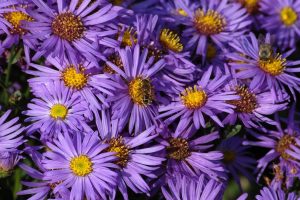 Asters on the other hand are native flowers, their disk florets are fully exposed, and are easily accessible to pollinators like bees and butterflies. Their flower head shape is more open exposing the pollen. Most asters are native to north America and have co-evolved with local pollinators, insects, native bees, butterflies and moths, that have adapted to forage on them. Asters provide the needed food source for bees and migrating butterflies in late summer and
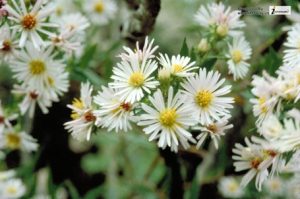 fall, when most other flowers have stopped blooming. This late-season fuel is essential for migrating monarchs and bees that are preparing for winter. Native Asters serve as host plants for the Crescents and Checkerspots butterfly species. Most types of Asters are perennials that are hardy and reliable plants that return to bloom year after year.
Florida native Asters include Climbing Aster, Rice Button Aster, Stokes Aster, Elliotts Aster and the Eastern Silver Aster. For more information on Asters go to link https://edis.ifas.ufl.edu/publication/FP056
 0
0