For over 80 years, Sarasota County Mosquito Management Services (MMS) has managed the surveillance and reduction of mosquito populations here in Sarasota County. To share more about their process, MMS generously offered a public tour of their facility as part of our ex•plore series.
The tour began at the main office, which is the center for communication and outreach for MMS. Here, interested members of the public met with the Community Outreach Specialist, who would proceed to lead the group through each section of the facility.
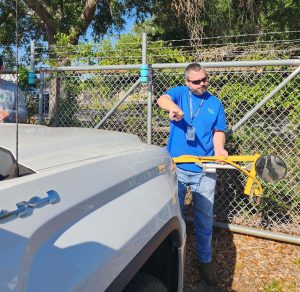
Treatment Truck
From the office building, the tour group moved to the first location, where one of the MMS technicians along with the department’s Skilled Trades fabricator gave an overview of the vehicles used to administer treatment and application techniques. One of the primary forms of treatment for managing mosquitoes involves the use of Bacillus thuringiensis israelensis, or Bti. Bti is a larvicide derived from a naturally occurring bacteria found in the soil that specifically targets mosquito larvae, which are in their active feeding stage.
When consumed by larvae, the Bti releases proteins that damage the gut, leading to paralysis and death. This particular strain of bacteria only targets mosquitoes, black flies, and fungus gnats, making it an environmentally-friendly option that does not affect people, pets, livestock, or wildlife.
Arms attached to the trucks used by MMS make it easy to precisely apply Bti larvicide treatments to ditches and other low-lying areas where rainwater may collect.
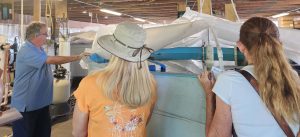
Aquaculture Lab
Next, the tour moved to the aquaculture lab, where MMS runs their mosquitofish breeding facility. MMS rears eastern mosquitofish (Gambusia holbrooki), a native species, in large outdoor pools. These pools are located under a roof for protection from the elements.
Mosquitofish eat mosquito larvae and pupae, preventing them from becoming adults that can fly, bite, and vector disease-causing pathogens. One adult mosquitofish has the ability to eat up to 100 immature mosquitoes per day, making it an incredibly effective biological control in the fight against mosquito-borne illness.
Fun fact: Out of all Floridian mosquito control districts, Sarasota County MMS has the largest mosquitofish breeding facility!
Less fun fact: Adult mosquitofish will eat juvenile mosquitofish, so young fry must be reared in separate sections of the pools.
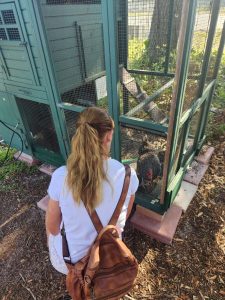
Bluey the Avian Outreach Specialist
Next to the mosquitofish breeding facility, the tour group met Bluey the Avian Outreach Specialist. Bluey is a Barred Rock chicken and represents the sentinel chicken surveillance program. Sentinel chickens are called so because of their ability to ‘keep watch’ and alert MMS of detected arboviruses, or viruses spread by arthropods such as mosquitoes.
These chickens are posted in coops throughout the county, and they possess the special ability to produce antibodies for certain arboviruses without getting sick. One staff member is tasked with taking a weekly blood draw from the 70-plus strong flock to detect antibodies for these arboviruses. Each draw takes less than one minute and only a half-teaspoon of blood, but it gives MMS a huge amount of helpful information in disease detection.
Using this process, known as sentinel seroconversion, they can detect West Nile Virus (WNV), Eastern Equine Encephalitis (EEE), and Saint Louis Encephalitis (SLE). If any of these arboviruses are detected, then the samples are sent to the Florida Department of Health (FDOH) for further analysis. To see if one of these arboviruses has been recently detected in your county, you can visit the FDOH website.
After antibodies have been detected in their blood, or after they reach one year of service, each sentinel chicken is given the opportunity to retire and gets put up for adoption. If you would like to own a retired sentinel chicken of your own, you can fill out the adoption application on the MMS website.
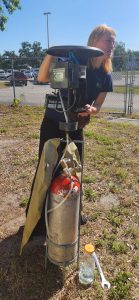
Trap Demonstration
Leaving the chickens, the tour group was shown an example of a route trap, another tool for mosquito surveillance. There are a few types of traps that MMS use for different purposes, many of which are housed in the trap room, along with other field collection equipment. Route traps, in particular, are set up in consistent locations to monitor mosquito populations over time.
The trap is baited with carbon dioxide, which is what warm-blooded animals exhale when they breathe. When mosquitoes detect carbon dioxide, it draws them in to take a bloodmeal. Instead of getting a bloodmeal, however, they are caught in collection bags located in the trap. Once trapped, they can be identified to species by trained specialists in the mosquito lab.
Mosquito Lab
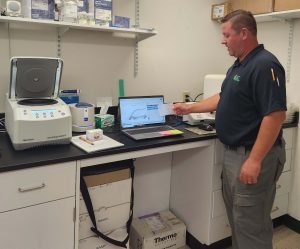
The next stop on the tour was the mosquito lab, where MMS staff perform several tasks with the goal of keeping Sarasota County residents safe. In one section of the lab, specialists sort through the collection bags from the traps demonstrated earlier in the tour.
Mosquito specimens are counted and identified down to species using microscopes and a special keyboard where each key correlates to a different mosquito species. During peak mosquito season, up to four biologists are on identification duty every day. The biologists are remarkably efficient, documenting hundreds of mosquitoes per day.
The mosquito lab also has a room dedicated to polymerase chain reaction (PCR) testing, where one specialist will prepare and run DNA samples from collected mosquitoes. PCR tests are used to determine the presence of pathogens in monitored areas throughout the county. If detected, then that information is shared with the FDOH and used internally for planning mosquito management missions.
Insectary
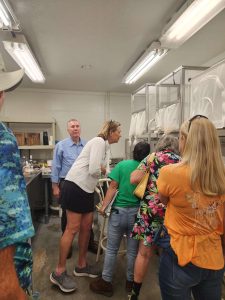
Attached to the mosquito lab is a small, warm room called the insectary. In this room, mosquitoes are reared for insecticide resistance research. Resistance occurs in pest populations when the same chemical treatment is used multiple times for treatment. By testing to see how mosquitoes respond to differing concentrations of certain chemicals, MMS can make sure they are using the right chemical in the right concentration when incorporating this treatment into their integrated pest management (IPM) efforts. Rearing containers are surrounded by netting to prevent escape.
Mosquito Management Services are an indispensable tool for public health in Sarasota County. To learn more about what they do, and see what services are available for Sarasota County residents, visit their webpage.
This ex•plore tour took place at the Pinkney Ave location. In November 2025, Sarasota County MMS will be relocating to a new facility located centrally to the county.
Resources:
- Sarasota County Mosquito Management Services website: https://scgov.net/mosquito
- Florida Medical Entomology Laboratory: https://fmel.ifas.ufl.edu/
- FDOH – Mosquito-Borne Disease Surveillance: https://www.floridahealth.gov/diseases-and-conditions/mosquito-borne-diseases/surveillance.html
- UF/IFAS – Eastern Mosquitofish, Gambusia holbrooki, for Control of Mosquito Larvae: https://edis.ifas.ufl.edu/publication/FA202
 3
3