At UF/IFAS Extension Sarasota County, we’ve been cultivating a “Food Forest” to showcase the most productive, unique, and often-underutilized fruits suited to our distinctive, Southwest Florida climate. Through this project, we aim to inspire and educate our community by offering a firsthand look at these remarkable trees and shrubs, allowing visitors to sample flavors before purchasing, and providing opportunities to gather seeds and cuttings.
To deepen community engagement, we’re launching a monthly blog series — Suncoast Grown and Gathered — to highlight the best edible plants to harvest each month. While some trees are still maturing and might take a few years to reach full production, we invite you to visit anytime and enjoy the fruits ready now. Come experience the abundance and potential of local, sustainable gardening that you can add to your landscape. Nothing will be fresher or more fulfilling than something you grow and pick yourself.
Jackfruit (Artocarpus heterophyllus)
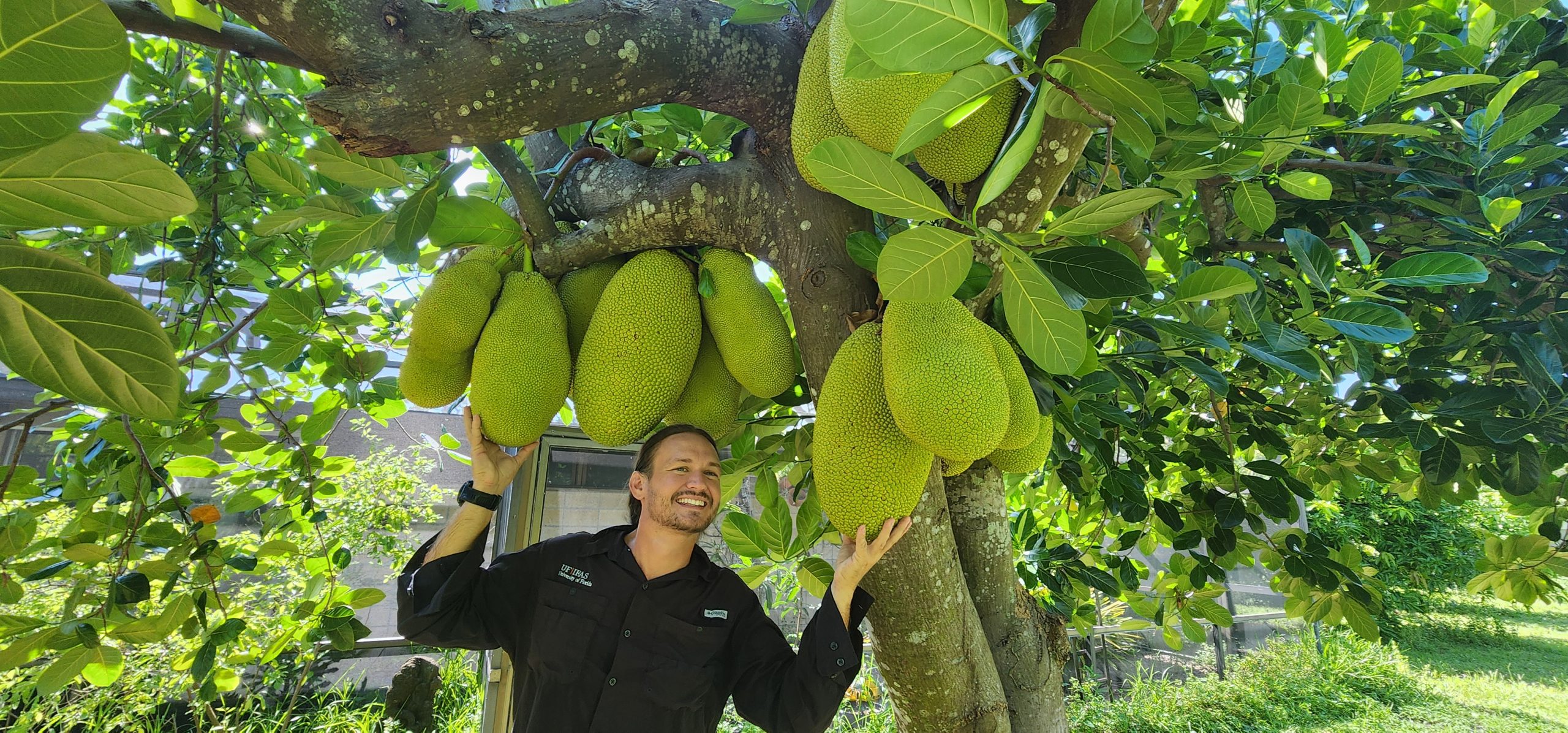
July marks the start of peak season for one of South Florida’s most productive—and most impressive—fruits: the jackfruit. Known as the largest tree-borne fruit in the world, individual jackfruits can tip the scales at over 100 pounds.
Native to India and Southeast Asia, this massive, aromatic fruit thrives in South Florida’s warm, humid climate and brings both tropical beauty and abundant harvests to the garden. With its striking size, distinctive fragrance, and incredible versatility in the kitchen, jackfruit is a true showstopper in any Zone 10a+ Florida landscape.
Recent Eye-opening Experience
This week we visited a retired homeowner along Fruitville Road, an avid fruit grower whose small farm more than covers his property taxes each year through fruit sales alone. While his orchard is his livelihood — home to around 40 mango trees and more than 100 fruit trees in total — it also provides all the fresh tropical fruit he can eat.
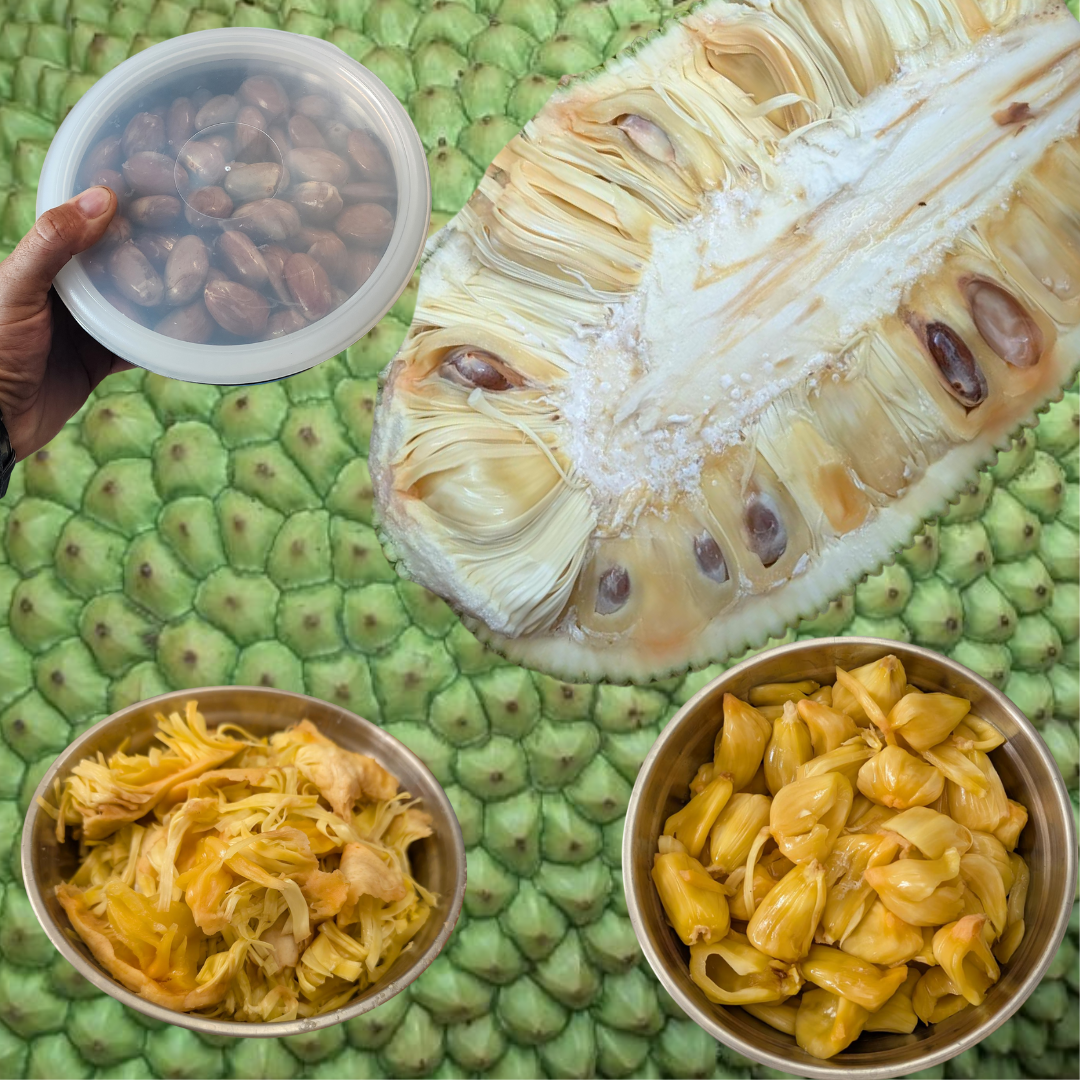
Among his collection are three jackfruit trees, each capable of producing around 1,000 pounds of fruit in a good year. Even in what he called a “bad” year, one tree still yields 400-plus pounds (see photo). He generously sent us home with a 25-pound jackfruit to process the next day. Inside the fruit, we found three distinct components: the sweet, aromatic flesh, with a flavor reminiscent of banana and mango; the fibrous rags, which can be cooked into the popular vegan “pulled meat” alternative; and the seeds, which can be roasted or boiled.
I was most surprised by the seed yield. We processed an entire bowl containing several pounds from just one fruit. That makes jackfruit one of the best nut alternatives we can grow in Florida, especially since pecans and macadamias are often a challenge to harvest before squirrels claim them.
Why Grow Jackfruit at Home?
- Quick growth: Trees can produce in as little as three years from seed. At our office we have three planted as seedlings, in two years they have all approached 9 feet tall.
- Tropical foliage: The large, dark green leaves definitely have a tropical element. But be warned with a cold winter they can drop their leaves and dieback.
- Impressive yield: Trees can reach 30–40 feet tall and yield 200–500 pounds (or more) per tree under optimal conditions.
- Unique fruit: Each jackfruit is actually a multiple-fruit cluster; mature fruits weigh anywhere from 10 to 60 pounds, though smaller cultivars produce 3–10 lb fruit with the same aromatic, sweet pulp.
- Myriad uses:
- The fleshy pulp can be eaten raw as a sweet and tropical fruity taste.
- The fibrous “rags” can be cooked as replacement meat. A core ingredient for many vegan restaurant dishes.
- The numerous large seeds can be boiled and roasted to create a tasty nut, or even turned into Jackfruit hummus.

Care and Cultural Calendar
Climate and Site Needs
- Full sun exposure: At least 6–8 hours daily. Avoid shaded areas for best fruit set.
- Spacing: Trees mature large; plant 20–30 feet away from structures or other trees. Pruned trees may be planted slightly closer at 20–25 feet.
- Temperature: Sensitive to col. Damage at 32 F, and trees can die at 28 F. Ideal for areas without frost.
- Flood and drought: Tolerates short dry periods but declines after 2–3 days of waterlogged soil.
Water and Fertilizer
- Irrigation: Young trees need frequent watering, especially in July. Mature trees benefit from irrigation during flowering and fruit development.
- Fertilization: Apply a balanced fertilizer (e.g., 6-6-6) for young trees every 8 weeks; increase volume as tree matures with 2–3 applications May–September.
Soil and Planting
- Soil types: Adaptable to sandy, loam, and high-pH soils commonly found in South Florida.
- Planting advice: Dig a hole 3–4 times the diameter and depth of the container. Do not add compost or topsoil to the planting hole; loosen original native soil instead. Avoid wire ties—use cotton string for staking.
- Mulch and weed control: Apply 2–6 inches of mulch around the base, keeping it 8–12 inches from trunk. Maintain a 2–5 feet grass-free zone to prevent trunk damage and nutrient competition.
Cultivation Insights
| Topic | Key Point |
|---|---|
| Propagation | Seed fruits in 3–4 years; grafting ensures predictable traits; semi-hardwood cuttings possible. |
| Pollination | Trees are monoecious; cross-pollination improves fruit set and yield. |
| Harvest Timing | Fruit matures roughly 150–180 days after flowering; typically ripens summer through fall. |
| Tree Maintenance | Annual or semi-annual pruning keeps size manageable; protect trunk from mechanical injury. |
Conclusion
Jackfruit has all the qualities that make it a standout choice for coastal South and Central Florida landscapes. It thrives in our warm, humid climate, tolerates sandy soils, and rewards growers with impressive yields. Even a single tree can produce hundreds of pounds of fruit annually.
Beyond its sheer productivity, jackfruit offers remarkable versatility: the sweet flesh is enjoyed fresh or in desserts, the fibrous rags are prized for savory, plant-based dishes, and the protein-rich seeds can be roasted or boiled for a hearty snack.
With its adaptability, resilience, and wide range of culinary uses, jackfruit is more than just an exotic addition—it’s a productive, multipurpose crop that can enrich both your diet and your landscape.
- UF/IFAS on Jackfruit Growing in the Florida Home Landscape: https://edis.ifas.ufl.edu/publication/MG370
- Growables on Jackfruit: https://www.growables.org/information/TropicalFruit/jackfruit.htm
During the preparation of this work, the author used ChatGPT to help build the blog post. After using this tool/service, the author reviewed and edited the content, and takes full responsibility for the content of the public
 3
3