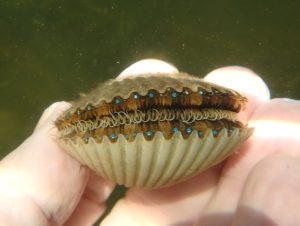
The Featured Gulf catch and cook species for July is the Bay Scallop!
Catching Bay Scallops is just as fun as eating them! The whole family can participate in hunting for the scallops in nearshore coastal waters. Read on to learn how to catch Bay Scallops and make a delicious meal.
Fun Facts
- Bay scallops have 30-40 bright blue eyes around the edge of their shells that help them detect movement and shadows.
- Scallops are capable of swimming for short distances by jetting water out of their shells!
Species Profile
The Bay Scallop (Argopecten irradians), is a filter-feeding bivalve that lives in shallow sea grass beds. They are a two shelled mollusk with bright blue eyes and can swim through the water column. Bay Scallops were initially native to the northeast Atlantic, from Cape Cod through the Gulf of America (formally the Gulf of Mexico). In Florida, the harvest of Bay scallops used to support a large commercial fishery in the Atlantic and the Gulf, however due to overfishing, habitat and water quality decline, populations declined and the commercial harvest of Bay Scallops was ended. In some Florida locations, small populations of Bay Scallops have recovered and stabilized, allowing for the recreational harvest of scallops in the Gulf.
Appearance and Biology
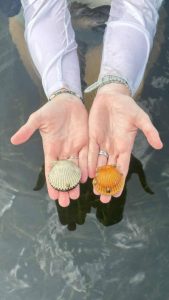
The Bay scallop has two hinged shells that protect the soft body inside. The thin shells are rounded with radial ridges that form a scalloped edge and they have two pointed ears or “wings” the shells hinge. The top shell is dark brown in color and the bottom shell is usually a grey-white. In less than 1% of scallops the bottom shell will be bright orange in color. The scallops have around 40 bright blue eyes located along the edge of the shell, which can sense light allowing the scallop to notice movement. Sensory tentacles growing next to the eyes are also used by the scallops to sense any near by movement, warning of predators. The gills located within the scallop shelled are used by the scallop for two main purposes. One, to bring oxygen into their body allowing them to breath and two, to filter plankton out of the water as a food source. Unlike other mollusks like oysters, they must breath regularly and cannot stay closed for long periods of time. Scallops usually cannot remain closed for greater than 2 hours, thus they are filtering water nearly constantly. They scallops may close their shells to protect themselves from predators or to keep sediments out of their gills. Another way to escape predation is by swimming. Scallops are one of the few bivalves which can swim through the water to move away from danger. They do this by clicking their shells open and closed to expel water and propel themselves backwards.
Growth and Life cycle

Bay Scallops can reach a size of up to 3.5 inches and live up to 2 years, however in the Gulf they typically only reach 3 inches in size and live 1 year to 18 months. The scallops have both male and female reproduction organs, where they can produce both sperm and eggs for reproduction. Scallops are broadcast spawners, where groups of scallops will sequentially release the spawning materials into the water column. This can mean that if there are not enough scallops nearby they will not have a successful spawn. For this reason low scallop populations can continuously struggle to grow, unless helped by neighboring populations. In the Gulf this typically occurs in the Fall, triggered by changes in water temperature and salinity. Scallops can release ~1 million eggs per spawn, however, it is estimated that only 1 in 12 million will reach adulthood. After fertilization, the scallop larvae will swim in the water column for around 2 weeks until it can begin to grow a shell and attach to the sea grass. Juvenile scallops (spat) rely on seagrass habitats to survive. The scallop spat produce a silk like filament to attach themselves to the seagrass blades away from predators, called Byssal threads, and will stay attached to the grass until they drop off and live in the grass until it is time to spawn (~1 year). Nealy 90% of scallop spat will die within the first 6 weeks of life. Spawning typically uses a majority of the scallops energy, where they will usually die or be easily eaten by predators after this time.
Habitat

Bay Scallops live in coastal marine waters, where seagrass meadows are healthy, typically in 2- 10 ft water depths. They require high water quality as they are very sensitive to pollutants and sediments. Ideal scallop conditions have a salinity range between 20 and 38 ppt (parts per thousand) and a temperature between 68-77 degrees F. The most common seagrasses for scallops in the Gulf are Manatee and Turtle Grass. These grasses help to hid the juvenile and adult scallops for predators. Scallops have many predators in the seagrasses around them, often targeted by crabs, whelks, octopus, stingrays, and of course humans.
Scallops serve as an indicator of water quality and ecosystem health, where declines in scallop populations serve as an early indicator of system declines. Heavy rainfall events can result in salinity changes that cause negative impacts to the scallops. Temperature fluctuations will also impact scallops, where cold waters can slow down scallops filter feeding and reaction to predators, while overly warm waters can lead to scallop death. High sediment loads in the water can clog the gills of scallops and prevent them from feeding efficiently. Another danger for scallops is algae blooms, where low oxygen levels and high algae toxins can lead to scallop death. This is primarily related to the need for scallops to continuously filter water, as they cannot shut out the algae like other bivalves.
Catch
To maintain a healthy scallop fishery, it is important to use sustainable scalloping practices. A Florida fishing license is required to land all saltwater species in Florida, including scallops, regardless of where they are caught (state or federal waters). Florida fishing licenses require a fee and you must register for the license on the FWC website which can be found here: https://license.gooutdoorsflorida.com/

Habitat
- Common in nearshore waters
- 2-10 ft water depths
- Seagrass meadows
Season and Regulations (Gulf)
The Gulf Bay Scallop recreational season varies by county, ranging from Gulf County through Pasco County. The open harvest season is different for each county or region and is typically updated every year. Similarly the harvest limit varies by county. Always check the regulations for the county you plan to harvest from before you go. No bay scallops can be harvested in the Gulf commercially. A Florida fishing license is required to land all saltwater species in Florida, including scallops. Purchase one here: FWC
Open Season:
In Pasco County, the 2026 recreational Scallop Season is open from July 10th through August 18th. The Pasco County region includes all state waters North of Anclote Key and South of the Hernando-Pasco County line. It also includes all waters of the Anclote river. If you are unsure of the area, check your maps before you go to ensure you are harvesting from the allowed areas.
Harvest limit:
Similarly, the daily harvest limit varies by county. Scallop harvest can be measured in two ways, as the whole scallop shell or as cleaned scallop meat.
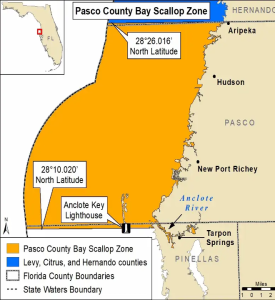
In Levy though Pasco County the harvest limits are listed below:
- Per person: 2 gallons of whole scallops in the shell or 1 pint of cleaned scallop meat*
- Per boat: Maximum of 10 Gallons of whole scallops in the shell or 1/2 gallon (4 pints) of cleaned scallop meat*
*Regulations must be follow to which ever amount is less. This means if you have 6 scallopers on a boat you are limited to a maximum harvest of 10 Gallons of whole scallops in the shell. Similarly, boat limits do not allow anyone to exceed their personal bag limit.
It is illegal to make multiple trips in a single day to harvest more then your legal daily limit. No “double dipping”.
Measurement:
When measuring whole bay scallops in the shell, it is common to use a 5 gallon bucket. While these buckets are often sold as 5 gallons, they can typically hold more than this. Thus a full bucket is often more than a true 5 gallons. Use a 1 gallon water jug to measure out the gallon marks on your bucket before you go to avoid over harvesting.
Transit through closed zones:
You are now allowed to travel though closed zones with harvested bay scallops, HOWEVER, you must follow all harvest rules from the harvest region and you must not stop anywhere in a closed region. This means you may go to a county with an open harvest season, collect scallops, but then you must return directly to the dock or ramp with your scallop harvest without stopping.
Bay Scallop harvesting regulations change frequently, always check current FWC regulations before harvesting. Bay Scallop regulations can be found here: Bay Scallops
Scallop Sorters
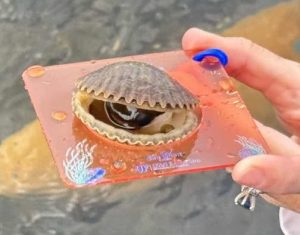
While there is no legal size requirement for Bay Scallops, UF/IFAS Extension Florida Sea Grant recommends the use of Scallop Sorters to help maintain future scallop populations. Scallop sorters are devices with a two inch hole in the center, which can be used in the water to measure the size of harvestable scallops. It is recommended that scallops that fit through the hole (less than 2 inches) should be thrown back, while scallops that are larger than the hole (>2 inches) can be kept.
Scallop less than 2 inches in size often have not had the opportunity to spawn yet. By letting them live, you are giving them a chance to spawn and supporting the scallop population for next season. Additionally, small scallops tend to have a small muscle, where very little meat can be harvested from the scallop. Returning them is a recommended best scalloping practice!
Learn more online or read about the sorters with Best Scalloping Practices.
Scalloping Methods
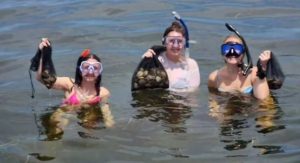
Harvesting of Bay Scallops is only permitted by hand or by using a landing or dip net. The harvest is typically done while swimming with a mask and snorkel to see into the water. Scallops can only be harvested recreationally, as all commercial harvest is prohibited. While the easiest way to get to scalloping grounds is often by boat you can access the scallop habitats by kayak or by wading in some locations.
Scalloping requires swimming and diving in open, sometimes deep water, with currents and tides. Please make sure you are comfortable with free swimming, holding your breath, and diving before attempting to scallop. Test out using your mask and snorkel in a pool before you go as practice!
Supplies:
Successful scalloping often requires swimming and using a mask to look into the water to spot the scallops. *Other supplies are recommended to help with comfort and success when scalloping.
- FWC Saltwater fishing license (Required)
- Dive Flag (Required)
- Mask and snorkel
- Closing mesh harvest bag
- Measurement Bucket
- Scallop Sorter
- Fins*

FWC dive flag rules: https://myfwc.com/boating/regulations/ - Gloves*
- Water*
- Sunscreen*
- Sun shirt*
- First Aid kit
- Lifejackets and boat safety equipment
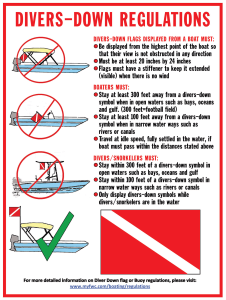
Dive Flag Safety:
Anyone swimming in open water in a way in which they are partially submerged, are required to display a dive flag from their vessel or attached to their person. This is for the safety of the diver and to help alter other boaters. Follow these rules to stay safe! Learn more!
- Purchas an approved regulation dive flag
- Flag must be up when anyone is in the water with mask
- Flag must be displayed at the highest point of the vessel
- Flag should be taken down when all scallopers are out of the water
- Swimmers must stay within a set distance from the boat and boaters must stay the same distance away from the dive flags:
- 300 ft max distance in open spaces
- 100 ft max distance in a river or channel
- If boats cannot stay this distance away they must use idle speed to pass
- Swimmers without a vessel should have an approved floating dive flag attached to them
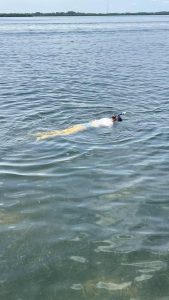
How to Scallop:
- Purchase your saltwater FWC Fishing License: FWC
- Find a shallow near shore seagrass meadow to scallop in.
- Before getting into the water display your dive flag.
- Put on mask and snorkel (if your comfortable using a snorkel).
- Grab your mesh bag and scallop sorter and jump in the water!
- Float on the surface looking down into the seagrass looking for scallops.
- Swim slowly and look for their shells, bright blue eyes, and open mouths.
- When you spot a scallop dive to the bottom and catch the scallop with your hands or a dip net.
- Use your scallop sorter to measure the scallop. If they fit through the hole let them go.
- Place the big scallops into your mesh bag and look for the next one!
- When you need a break bring the scallops back to the boat and measure how many you have in your pre-measured buckets.
- Keep scallops dry and on ice in a cooler or keep them alive hanging in a bag in the water until you are ready to clean them!
Keep Scallops Fresh
Scallops can die quickly when removed from the water or in the sun causing them to spoil. To avoid any food born illnesses, care should be taken to keep the scallops cool and prevent them from spoiling.
- Keep scallops on ice. The best way to store scallops is by placing them in a cooler
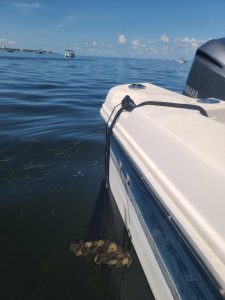
Hang scallops in the water until you’re done scalloping to keep them alive with ice. The ice will cause the scallops to die quickly and make them easier to open and clean. It is important that the scallop meat does not become contaminated by the melting ice water. To prevent water contamination keep the cooler water drained. You can also place a wet towel between the ice and the scallops to keep them cool, and away from the melt water. Keep them cool and dry until you are ready to clean them!
- Keep the scallops alive. You can keep the scallops in a mesh bag and hang them from the side of the boat in the water to keep them alive. If you don’t have any ice on the boat this is the best method to use until you are done scalloping. When you are done scalloping you will need to quickly cool the scallops. You can use ice or place them in the fridge until the shells open and they can be cleaned.
Check the next section to learn how to clean the scallops!
Seagrass Scarring
Scalloping is often done in shallow sea grass meadows and accessed by boats. Boat hulls, engines, and anchors can harm the seagrass causing scars, destroying the only habitat that scallops can survive in! Damage done to the seagrasses can cause ecosystem decline, lead to further erosion, and damage your boat. Within the Nature Coast Aquatic Preserve it is also illegal to damage the sea grass, resulting in a $1,000 fine for any damage.
Follow these 3 tips to learn how to be Seagrass Safe:
- Avoid: Stay away from Shallow Seagrass beds when the become to shallow for your boat to safely pass
- Trim or Troll: If you find yourself in shallow waters, trim your engine up and idle until the depth increases. Using a trolling motor can be a safe alternative in shallow waters.
- Push: If you do end up in shallow waters, turn your engine off, get out of the boat, and push the boat into deeper waters. If you cant push the boat wait until the tides rise before trying to move again.
If you are committed to protecting out seagrasses and scallop habitats sign the Seagrass Safe Pledge!
Successful Scalloping Tips
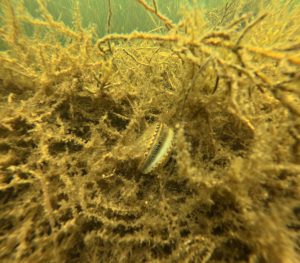
Scalloping is a fun and family friendly activity to enjoy in the summer. Below are a few extra tips to help you have a successful scallop harvest!
- Look for the scallops blue eyes and open shell
- Check the tides before you go
- Scalloping is easier in shallow water (2-4 ft)
- Avoid getting your boat stuck as the tide drops
- Slack tides (transition between high and low tide) will have less current
- If your not sure where to go, look for other scalloping boaters
- Swim slowly and swim in a grid pattern to cover more ground
- Search:
- Along edges of the seagrass
- In the muddy pits or paths near the seagrass
- In the brown algae patches
- If you aren’t finding any scallops move locations, scallops are often found in patchy groups
- Avoid driving your boat in shallow seagrass
- Only keep what you plan to eat!
Safety Tips:
Scalloping is fun but always take caution and be aware of your surroundings.
- Be Watchful!
- Stay near your boat at all times and keep an eye out for boats driving near you. Boaters may not see you in the water!
- Have someone in the boat at all times as a lookout. Keep an eye on the scallopers in the water and the boaters around you.
- Watch for storms. In Florida storms can form and move quickly. Check the radar and sky’s for incoming storms.
- Stay hydrated and take breaks. Swimming can use a lot of energy. Drink water and rest often to avoid exhaustions.
- Use sun protection. The sun intensity during summer can easily cause burns and lead to sun poisoning. Sunscreen is always good to use, but it can wash off in the water, make sure to reapply often. Wearing a sun shirts can help to protect your skin.
- Have a float plan. Let someone on land know where you plan to go and how long you plan to be gone for the day. If something happens you what someone to know to look for you!
- Keep safety equipment on your boat. Life jackets, first aid kits, whistles, flares, and more can save your life in the event of an emergency. While you hope nothing happens its always good to be prepared! Most of the listed safety equipment is also required for boats in the Gulf!
Pasco Water Access

The easiest way to access scalloping habitat is often by boat. If you have a boat on a trailer, Pasco have 4 main public boat ramps you can use:
Pasco Boat Ramps:
- Anclote River Park
- Sim’s Park Ramp
- Nick’s Park Ramp
- Robert J. Strickland Memorial
Scalloping can also be done from a kayak or by swimming/wading into the water. This method may be more difficult and we recommend boating as the safest and most efficient option. If you want to try kayaking or swimming, below are some areas where you can access the coastal waters in Pasco County. Not all locations have kayak launches or approved swimming beaches*
Pasco Public Water Access:
- Anclote river park
- Key Vista
- Eagle Point
- Robert K. Rees (Green Key)
- Port Richey Waterfront Park
- Brasher Park
- Werner-Boyce Salt Springs
- Robert J. Strickland Memorial
- Sunwest Park
Local Scalloping charters are also available with captains in the Gulf. Florida Friendly Fishing Guides are recommended though Florida Sea Grant, however they may or may not offer scalloping charters. Check here.
Clean
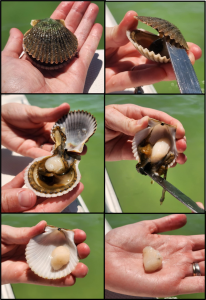
Cleaning scallops takes time and patience but is easy once you get the hang of it! The goal is to remove the shell and soft tissue, while collecting only the while clean muscle. It can take an hour or more for 2 people to clean a 5 gallon bucket so remember to only take the amount of scallops that you will feel like cleaning.
Not many tools are needed to clean scallops. Typically only a scallop shucker is need, however an oyster shucker, spoon, or butterknife can be be used as well! Before you start make sure scallops have been on ice long enough to relax their muscle and open. It will be very hard to clean them if the shells are still closed tightly.
Cleaning Steps:
- Wash hand thoroughly before starting.
- Use a scallop shucker or spoon to cut the muscle from the top shell (dark). Cut as close to the sell as possible to avoid loosing any meat.
- Scoop the guts away from the meat
- Use your fingers, a spoon, or another shell to pull the guts away from the muscle and discard
- Cut the muscle from the bottom shell and set aside in a bowl with ice.
- Discard of shells and guts in a separate bowl
- Repeat until all scallops are cleaned
- Rinse scallop meat and drain.
- Store scallops in a Ziplock baggie or Tupperware until you are ready to eat them!
Fresh scallop meat can be kept in the fridge for 2 days before cooking. Scallops can be frozen for up to 3 months. *Do not store scallops in water.
Learn how to Clean Bay Scallops a Florida Sea Grant Agent: Savanna Barry!
Proper Shell Disposal
Scallop shells and soft tissue should be disposed of properly. Shell thrown out in incorrect areas can cause environmental damage and safety issues. Scallop waste can degrade local water quality, fill in waterways, and be harmful to swimmers.
Do
- Discard shells and guts in open Gulf waters
- Spread the shells out
- Throw away in trash
Don’t
- Discard shells in shallow waters
- Dump on seagrass, in springs, near swim areas, ramps, or sandbars
Cook
In the Gulf in approved counties, Bay Scallops are considered to be a sustainable resource. Their harvest is limited to ensure sustainable populations and not open to commercial fishing. By following the recommended scalloping regulations, using the scallop sorters, and disposing of shell properly, scallops should remain a smart seafood choice in Pasco County.
Bay Scallops are delicious to eat, with sweet and tender meat. The scallop meat is the perfect size to be eaten on its own or added to other dishes! It can be prepared in a variety of ways, fried, grilled, sautéed, steamed, and more! If you are not able to harvest Bay Scallops on your own, other scallop types can often be purchased from the grocery store and cooked using the same recipe.
Below is a delicious recipe for cooking up your fresh catch:
Fried Bay Scallops
Serving Size: 1/4 pint scallop meat
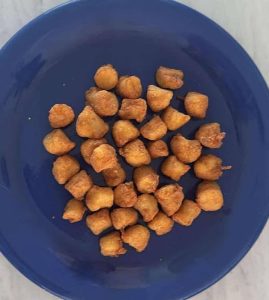
Ingredients:
- 1 pint raw bay scallops, shucked
- 1/2 cup flour
- 1 tbs blackened seafood seasoning
- 1/4 tsp Salt and paper
- 1 cup vegetable oil (enough to cover pan in ~1/2 inch of oil)
Instructions:
- In a deep skillet, heat oil on medium high heat.
- Mix flour, blackening season, salt and pepper in a bowl.
- Pat cleaned scallop meat dry with a paper towel.
- Add scallops to flour mixture and mix until the meat is coated.
- Shake any excess flour off scallops and add to hot oil.
- Cook until done (~2 mins), shake off any excess oil and place on a paper towel. Meat should be white and tender when cooked. *
- Add salt to taste and enjoy!
*If scallop meat is opaque (translucent) cook longer, if it is chewy cook for less time!
For and extra recipe, check out this scallop pasta recipe created by Florida Sea Grant Agent: Savanna Barry! Simply Delish Scallops
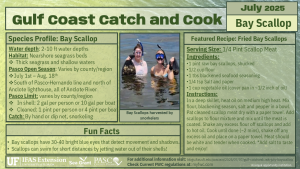
Next month sneak peek!
Our featured Gulf Catch for August is the Mangrove Snapper!
- Mangrove Snapper can change their color camouflaging into their surroundings.
- They have sharp canine teeth!
Do you have a favorite Scallop recipe or a photo of you with your catch? Share it with us for a chance to be featured as a photo or recipe of the month! Submit here
Check out the other Gulf Coast Catch and Cook blog posts!

Have a question? Ask the Author!
For more detailed information, contact your local University of Florida Extension Office.
Follow us!
An Equal Opportunity Institution.
 0
0