If you’re like many people, you will make a New Year’s resolution to eat better and exercise more. It might seem simple enough to start your diet and walking, but making those actions into habits can be a lot tougher.
Research indicates that nearly half of adults in the United States make New Year’s resolutions. Of these, only about 25% are still following their resolutions 30 days into the new year. According to a 2023 Forbes survey of 1,000 U.S. adults, only about 1% are still following their resolutions after one year.
Keeping a New Year’s resolution requires self-reflection, contemplation and action.

Consider “action” vs. “outcome” goals, says Laura Acosta, a University of Florida instructional associate professor of food science and human nutrition and a registered dietitian.
“For instance, someone may have a goal to lose 10 pounds. But when we fixate on the outcome, it’s easy to get discouraged when the scale doesn’t move,” said Acosta, a faculty member at the UF Institute of Food and Agricultural Sciences (UF/IFAS). “Instead try to think about specific actions you can take. For example, packing a healthy lunch, taking a walk around the neighborhood or going to a yoga class.”
Additionally, many people say they’ll avoid sweets, or they won’t eat after 8 p.m. But those are punitive, and you might feel guilty if you violate your goal, Acosta said.
“Instead, framing goals as what we will do and what we will move toward gives us a clear ‘North Star’ and creates a more positive aura around our goals as we build momentum through intentional action,” she said.
Actions should be specific, measurable, action-based, realistic and time-bound (SMART), Acosta said.
Here’s one step toward turning a New Year’s resolution about leading a healthier lifestyle into a habit: “Beginning Sunday, January 4, and continuing for a least two months, I will walk two laps around my neighborhood in the evening, after dinner, at least five nights per week,” Acosta said. “To facilitate this, I will place my walking shoes at the door as a visual reminder and motivator.”
Acosta and Heidi Radunovich, a UF/IFAS licensed psychologist and professor, both view the development of healthier lifestyles through the lens of the Stages of Change/Transtheoretical Model.
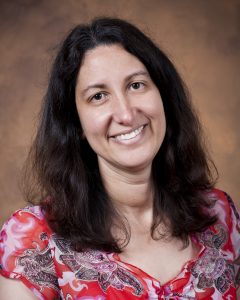
Steps in that model are precontemplation, contemplation, preparation, action and maintenance. If people understand where they are within the framework of the “Stages of Change” model, they can better recognize whether they’re more or less likely to attempt to change their behavior.
“We aren’t always in a place where we are really ready to make a change,” Radunovich said. “Perhaps we don’t even have an understanding that we need to make a change or are in denial that a change is important.”
You also need to recognize that you might relapse into your old ways of not eating as healthy as you’d like, and you might not exercise. That’s OK, said Radunovich, a faculty member in the Department of Family, Youth, and Community Sciences.
“It can take a lot of tries to make a permanent change, and we are all capable of falling off the wagon,” she said. “In the end, the more time we spend engaging in good habits — even if we have to start over again and again — the better it is for us.”
Radunovich adds that the Stages of Change/Transtheoretical Model isn’t perfect.
For example, not everyone goes through every stage, and people can go back and forth in the stages, immediately jump into “action,” bypassing other stages, etc.
“However, the idea is that the intervention that would help you the most could depend on where you are in the stages of change,” she said. “We also need to recognize that we’re not always ready to make a big change, and that’s OK. Finally, we need to plan for relapse and do our best to get back on track as soon as we can.”
###
Para accesar a este comunicado en español, por favor utilice este enlace.
ABOUT UF/IFAS
The mission of the University of Florida Institute of Food and Agricultural Sciences (UF/IFAS) is to develop knowledge relevant to agricultural, human and natural resources and to make that knowledge available to sustain and enhance the quality of human life. With more than a dozen research facilities, 67 county Extension offices, and award-winning students and faculty in the UF College of Agricultural and Life Sciences, UF/IFAS brings science-based solutions to the state’s agricultural and natural resources industries, and all Florida residents.
 1
1

