As Florida growers look for profitable alternatives that can compete with California and other global markets, persimmons are emerging as a strong option for those seeking reliable yields, consumer appeal, and steadily increasing potential. With UF/IFAS research and outreach guiding the way, interest and confidence in the crop continue to rise across the state.
“Persimmons don’t grow well up north because of the weather, but they grow very well in Florida,” said Nazneen Qureshi, a graduate student in the UF/IFAS Horticultural Sciences Department at the North Florida Research and Education Center. “Florida’s climate and soils are well suited for persimmon cultivation,” making it a competitive advantage for growers considering the crop.
Florida’s environment supports both astringent and non-astringent persimmons, including popular Fuyu types harvested from September through December.
California remains the top U.S. producer, but its commercial harvest begins later in the fall. Florida farmers can bring fruit to market several weeks earlier, capturing strong early-season demand before national supply increases.
“Some varieties here start harvesting in early September, so growers can sell their fruit earlier,” Qureshi said. “That gives them a head start because there is less competition during that time.”
While California maintains roughly 3,000 acres of production, Florida follows with about 250 acres. This smaller footprint creates open market space for growers who want to enter a high-demand specialty fruit industry without competing directly with large-scale operations.

Florida’s Production Advantage
Persimmons also offer environmental and management advantages that support diversification. Field observations across North Florida show that Japanese persimmons (Diospyros kaki) perform reliably under the state’s subtropical climate. They tolerate freezing temperatures better than many alternative fruit crops and typically face less pest and disease pressure. This leads to reduced production costs, saving growers money and simplifying orchard management.
“Demand for specialty and locally grown fruits continues to increase, and persimmons, especially non-astringent cultivars, offer a valuable marketing window in the fall when few other Florida fruits are available,” said Dr. Muhammad Adnan Shahid, UF/IFAS Assistant Professor of Horticultural Sciences.
“They fit naturally into direct-to-market channels, giving growers a profitable and sustainable alternative as they explore options beyond citrus,” Shahid added.
Florida growers are finding success through U-pick orchards, farmstand sales, and local markets, where early fruit allows them to tap into a consumer base eager for fresh, locally grown options during a seasonal lull in Florida produce. This is at a time when Florida persimmons reach the market earlier than fruit from major producing states.
Guidance Through Research and Field Days
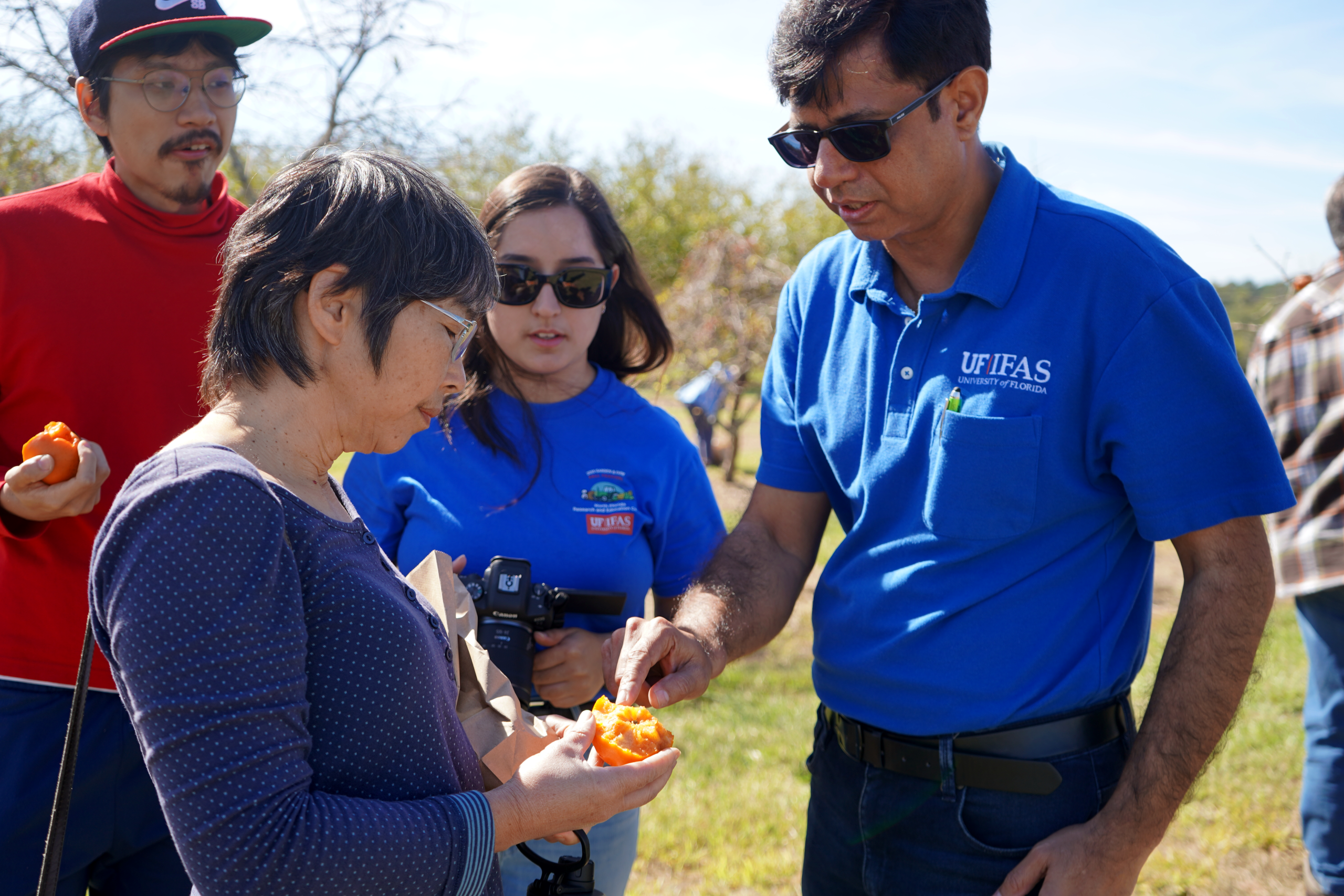
UF/IFAS research programs are helping growers with variety selection, orchard establishment, and integrated pest management. These are critical components for building a long-term, profitable orchard. Much of this support happens through hands-on learning at field days led by Dr. Shahid. His Stress Physiology of Fruit Crops program focuses on improving yield and addressing production challenges.
Events like this offer growers a comprehensive look at best practices. This includes establishing young trees to managing pests, disease, and fruit quality throughout the season. UF/IFAS also brings in collaborating experts to broaden the range of perspectives and research insights shared. This year, for example, Texas A&M horticulturist Dr. Tim Hartmann joined the field day. He discussed current approaches in persimmon propagation and disease management.
Seeing everything in the field – like the trees, the fruit, and the pests – helps growers understand how to manage their orchards. “Field day like this is very important for us,” Qureshi said. “Growers can tell us exactly what problems they are facing in their field conditions. We take their real-world obstacles back to our research so we can work on improving yield and simplifying the problems they deal with. The University of Florida can make an impact and provide real problem-solving.”
These conversations help breeders specializing in crops like persimmons better align future studies with growers’ needs, strengthening the connection between research and on-the-ground production.

A Niche Market for New Growers and Small Farms
Persimmons remain a small but steadily expanding crop in Florida. As growers diversify in response to shifting markets and consumer expectations, UF/IFAS experts see substantial room for growth. This is especially true for early-season fruit and local and regional sales channels. Persimmons also offer an advantage not found in many other fruit industries: less competition and more open market space for new growers to step into.
Dr. Shahid notes that this flexibility is a key part of its appeal. “Florida’s small and mid-sized farms are particularly well suited for specialty crops like persimmons,” he said. “Their ability to sell directly to local markets or through U-pick operations is something large-scale producers in other states can’t easily replicate.”
Qureshi believes interest will continue rising. “People can have a business here in persimmons,” she said. “[Florida] is a really good place to do it. There is not much competition for persimmon as compared to citrus. With citrus, everyone is growing it, but persimmons are still grown by very few.”
As Florida agriculture continues to adapt and diversify, persimmons may soon shift from a lesser-known fruit to a recognizable feature of the state’s fall harvest season.
 1
1