Student excellence is a pillar of University of Florida’s philosophy, molding students into those who will make a better future for society, culture, and the economy. The education program in Horticultural Sciences is dynamic, continually adapting to new technologies, the needs of farmers and other shareholders, and the concerns of consumers. Anandi Karn studies under Dr. Patricio Munoz for her doctoral degree, researching shoot regeneration in blueberry. She reflected on her time at UF and how she plans to leverage her expertise in future endeavors.
On Herself:
My name is Anandi Karn. I’m from a small city in India. My home state is not considered very developed, so I did not have any idea of coming to the US when I was a child. In my family, no one has moved away except me, and they are so happy for me to come here and learn.
I like to spend time with family and friends, hosting people at home, and cooking. I love movies, especially dramas. I also meditate for mindfulness and do yoga. I really like my work, so it is like a hobby in some ways. I often miss it if I do not go to the wet lab.

On Her Educational Background:
I did my undergrad at G.B.Pant University, India’s first agricultural university, from 2014 – 2018. It was there that I got so much exposure to plant diversity and crop knowledge. I also got interested in plant genetics at this time. The program, “Practical Crop Production,” gives students the opportunity to grow a crop from start to finish, literally from seed to selling the crop at market. This really helps give a complete perspective on agriculture. It was really tough at the time, but I have so much appreciation for it now.
I also got my master’s degree at this same university from 2018 – 2020, in genetics and plant breeding. I studied the pigeon pea, a crop known in India, Africa, and Australia. This plant has good nutritional value; it is a legume that is high in protein. I learned how to take wild relatives and improve the cultivated plant. After that, I worked for a year on chickpeas at the Indian Institute of Pulses Research. My work was focused on genome editing for early flowering. This could earn farmers a lot with early harvesting and taking advantage of a market shortfall.
On Her Studies at UF:
I moved to Gainesville in 2022 to begin my Ph.D. in the plant breeding graduate program at UF. I joined the Blueberry Breeding and Genomics Lab under Dr. Munoz. Here, my focus was initially on establishing a foundation for the application of genome editing tools for Southern Highbush Blueberries.
I have enjoyed my time here and have learned quite a bit while in the program. I’ve had many great classes; in particular, there was a class from Dr. Freddy Altpeter on molecular technologies, and another from Dr. Kevin Begcy on plant biotechnologies, that were immediately applicable in the blueberry lab.
In the initial year of my Ph.D., I was on the Plant Science Council. I was a plant breeding retreat co-chair. Because we managed the whole retreat, I worked a lot with outside groups, hotels and other conference venues, and other outside agencies, so it was a great way to learn some soft skills and to network. I also got to see what all the plant breeders on campus do.
On her Doctoral Work at UF:
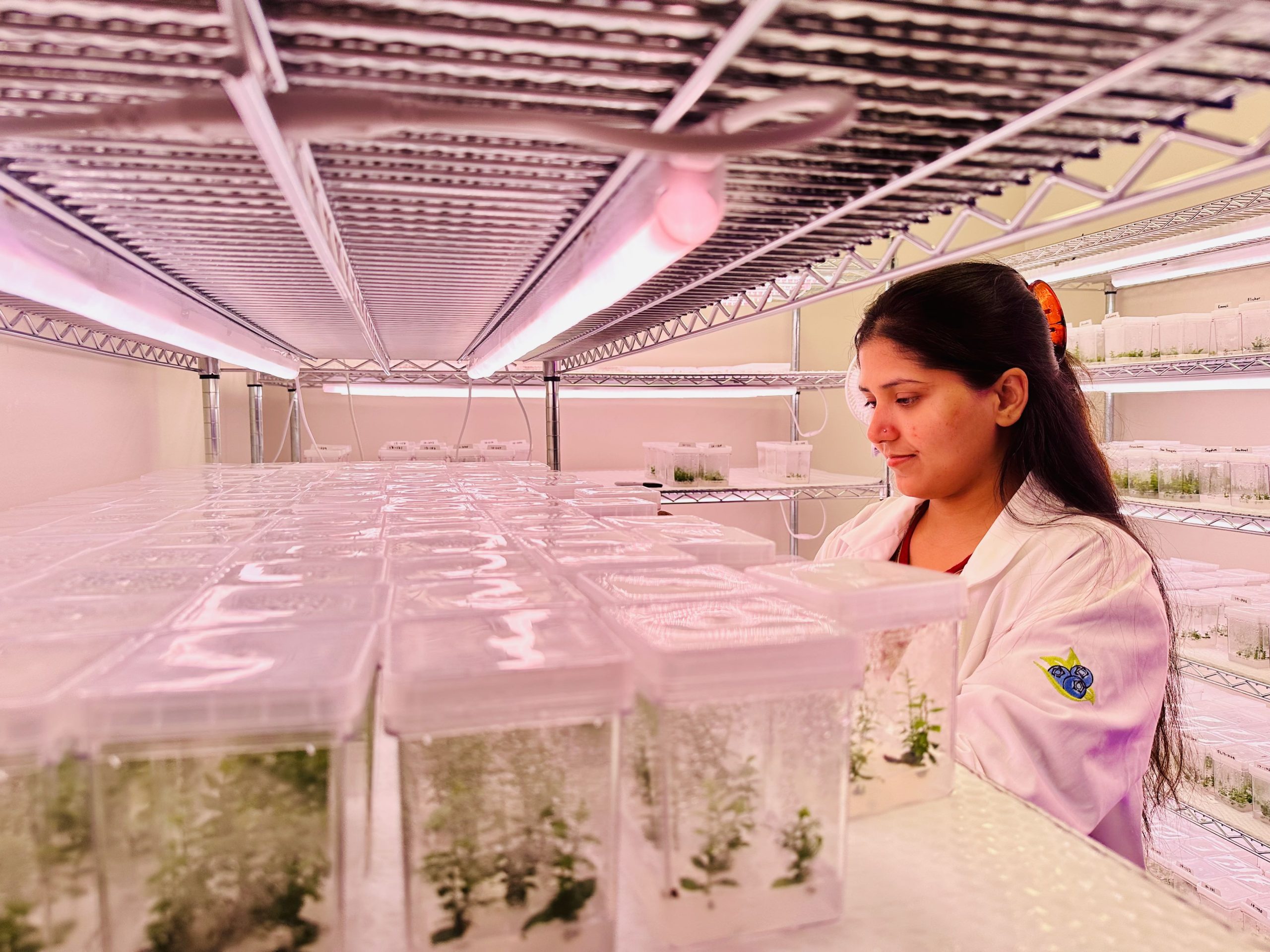
My Ph.D. studies in the blueberry genomics lab have been in shoot regeneration. This is the rate that new growth will come from a base portion of a plant. Plants have an amazing ability to grow an entire plant body from a small part. The new shoot portion that grows in our studies carries the new genes. This is important because, if we want to do genome editing, this is the most important factor in the efficiency of transformation or editing. It is much faster than traditional breeding methods, like cross-pollinating. I have worked a little with statistical modeling to study the shoot regeneration rate, which came from collaborations inside the lab.
In the blueberry genomics lab, we are using other tools and methods to improve overall transformation efficiency. For example, we are attempting to add developmental regulator genes (plant hormone genes) into blueberry plants. Our lab is big; there are about 40 people. I feel like this gives us real-life experience for working in larger teams, which is common in companies, and gives a lot of opportunities for cooperation and collaboration. I really like the social elements of the team, they celebrate birthdays and other events, making the lab feel welcoming and inclusive.
On Her Future:
I will finish my Ph.D. in the fall this year. I’m looking for opportunities to use my expertise that I have developed over my academic career, and to gain exposure to cutting-edge technologies. I generally think about a career in the private sector, but I am open to any opportunity. Really, this is a very big industry. In the end, what I want is to be able to materially improve the conditions of farmers. They are the ones who actually work with plants day-to-day and are the most vital part of the industry.
On Advice for Future Students:
I feel that growing your own food is an important and necessary skill that everyone should have, so to me, it is easy to recommend the plant sciences.
For a Ph.D., if you have the will and determination to work hard and to learn a lot, you should pursue it. Here at UF, there are many opportunities to get mentors, help from your peers, and to take advantage of other university resources to maximize your chance of earning a degree.
 5
5