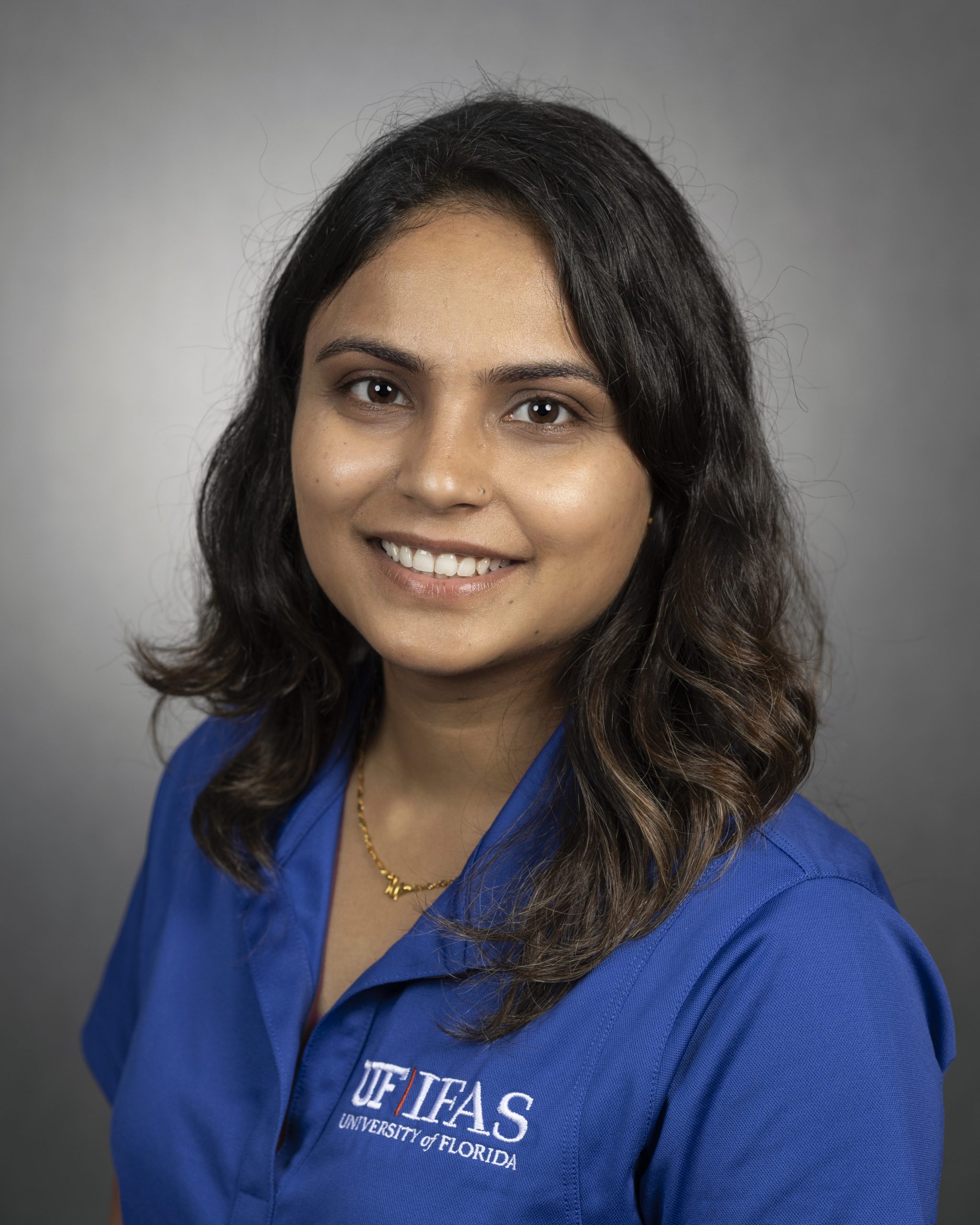
The University of Florida is dedicated to student excellence and helping to shape a better future for society, culture, and the economy. In Horticultural Sciences, this is done by making the education program dynamic, continually adapting to new technologies, the needs of farmers and other shareholders, and the concerns of consumers. Trishna Tiwari is studying for her doctoral degree under Dr. Carlos (“Charlie”) Messina, studying HLB (Huanglongbing or “citrus greening”) disease in citrus. She shared her thoughts on her education at UF and her contributions to studying this industry-critical plant pathogen.
On herself:
My name is Trishna Tiwari. I’m from Nepal, specifically from the southern part called Devdaha. I grew up in a farming family where we grew most of our own food. So, I was always around plants. I used to help my family in the fields, and I had a lot of fun doing it. That’s what got me interested in agriculture in the first place. I’ve been drawn to growing crops since I was a kid, and that’s why I decided to study agriculture for my Bachelor’s.
I love to be in nature; that’s what I enjoy the most when I have free time. If I’m not doing anything, I’m usually staring out the window, looking at the sky and imagining the different shapes of the clouds. I like hiking, it’s one of my favorite things to do. I used to go trekking to the mountains with my cousins back home. That was always so much fun. I also enjoy gardening and reading books. And I love organizing meditation and wellness events on campus.
On her education with UF:
I completed my undergraduate studies at the Agriculture and Forestry University in Nepal in 2017. After that, I worked as an agriculture instructor for two years before applying to UF. I completed my master’s under Dr. Manjul Dutt, assistant professor and citrus breeder at the Citrus Research and Education Center. My thesis focused on studying the role of CsNPR3 gene in HLB tolerance in Citrus. I finished my master’s degree in 2023, in the Horticultural Sciences Department. After graduation, I started working with Dr. Carlos “Charlie” Messina. I’ve been with Dr. Messina since that September, literally a month before the Crop Transformation Center (CTC) officially started.
Now, I’m in the first year of my Ph.D. program in Plant Breeding and the first student under CTC. The way my project is designed includes most of the steps in a transgenic breeding framework, from identifying genes all the way to field testing. Of course, the problem of citrus greening disease itself is already well known, but what we’re building is a complete pipeline: from discovery to validation. There’s a lot of logistics involved and coordination with researchers, citrus industry experts, and others. That makes me feel like I’m developing a skill set that includes both research and management, especially managerial skills and big-picture thinking.
On her extracurriculars:
I’m now with, and I’ll be serving as treasurer for, the Environmental Horticulture Graduate Student Association (EHGSA) in the upcoming committee. The group organized its annual Coleus Sale in March, where we grew and sold many varieties of Coleus plants. It was a fun and rewarding experience, and the sale was a huge success. The funds we raised are used to support student travel grants and an educational tour; this year, we’re heading to Alaska.
I’m also part of a group called SKY; I’m currently serving as president. It’s a wellness group. There are SKY chapters in over 100 universities in the U.S. and other parts of the world. Almost every month, we organize themed meditation events—like “Pizza and Meditation,” or “Chocolate and Meditation.”
There’s also a flagship program we organize each semester called “SKY Happiness Retreat”. It’s a three-day workshop focused on breathwork and meditation. We bring in meditation experts who lead it. We try to involve as many students and staff as possible since the techniques we learn are very helpful for managing everyday stress. It’s a big event for us, and I help organize it. It helps me a lot too—both by improving my communication and through the meditation itself.

On her current work:
Right now, I’m also working as part of Dr. Rosemary Loria’s “Dream Team”, and we have been working on identifying candidate genes using Alphafold, an AI tool that predicts 3D structures of proteins. It’s an amazing opportunity for me as a student to be a part of this team. It’s been exciting to explore how AI can help us predict protein structures and pinpoint genes that might play an important role in citrus tolerance to HLB. Alongside that, I’m also conducting a meta-analysis focused on various interactions in citrus, trying to understand how these factors influence plant response across different conditions.
When we get transgenic plants after transformation or editing, we want to minimize the resources used while maximizing the output. For that, we need a solid framework, a good experimental design where we use fewer plants but collect more meaningful data, test in multiple locations, and still use as few resources as possible. This is where the next steps in my research will be focused, to help create this framework.
On what inspires her and what the future holds:
I am most excited about being part of this collective effort toward solving HLB. It’s really inspiring to see how so many people are coming together to work on this problem. I believe that when so many of us are working toward the same goal, we are bound to find something meaningful. There’s a larger community even outside of UF contributing too. At first, there was some skepticism around this, but now I feel like people are really coming together at scale, from all different areas. It’s very encouraging to see. This gives me hope and as a student still in training, it reminds me that I’m preparing to take on real-world challenges that truly matter.
I don’t know yet if I will stay in academia or move into industry. Academia appeals to me because of the chance to conduct meaningful research, mentor students, and contribute to long-term solutions in agriculture. On the other hand, the private sector offers a dynamic pace, practical application of innovations, and potentially quicker impact. I’m currently exploring roles that would allow me to integrate both, maybe like applied research or industry collaboration within an academic setting.
Interview conducted by Eva Sailly, Communications Specialist, UF/IFAS Horticultural Sciences Department
 4
4