On himself:
My name is Gonzalo Casorzo. I’m originally from Chile, where I studied agronomy. I love to cook and share food with people. Last year, I started learning how to mix colognes and perfumes, which has developed into a hobby that I am passionate about.

I was never linked to farming and started my university studies to go into civil engineering. However, from one semester to the other, my interests completely changed. I was not comfortable with the idea of working in an office for my entire life. I started exploring alternatives and found that people in agronomy were happier. So, I thought, why not make a change and build my own future?
In the middle of my bachelor’s, I got the opportunity to do a professional internship with the breeding team of a big Berries company; I was able to work in blackberry genetics and travel to China to work in blueberry breeding and genetics for 3 months. I really liked the feeling of being able to plan and control the outcome of something in the real world, almost like Sim City, where you can plan out and then achieve a vision for a complete product.
On his academic career at UF:
After graduating from my undergraduate program, I had the opportunity to meet Dr. Patricio Munoz (who heads the blueberry breeding lab at UF). After a very long interview, I was offered a position in the lab. This was in 2020. I earned my master’s here in 2022, and I am now in my last year of my Ph.D.
Introduction to Quantitative Genetics with Marcio Resende and Felipe Ferrao was my favorite class here. There is a very practical and applied approach in this class. The weekly coursework was hands-on with real data and real problems, making it very easy to approach the material. It also included state-of-the-art techniques, making it immediately applicable. I learned a lot in this class. In fact, I was offered to be a teaching assistant of the course in the following period.
I appreciate that grades in my classes haven’t been the primary focus; instead, skills are front and center. Many of the professors are excellent, but I want to mention Esteban Rios, Marcio, Felipe and Patricio for the quality of their classes and their impact on my studies.
On his time in the Blueberry Breeding Lab:
Patricio is the “big picture” man in the lab and has been a great mentor regarding how to manage a breeding program. I really value his vision on doing research with a high impact on what we do. In our lab, all our research focuses on making blueberry breeding more effective and efficient, and our main goal is to release exceptional cultivars with a global impact. Due to the quantitative focus of my research, I have spent most of my studies under Felipe Ferrao. He has been my direct mentor and has taught me all my hands-on skills in genetics and statistics. I used to have meetings with Felipe during COVID where we played tennis to keep our distance but still connect in person. I really appreciate that commitment from him.
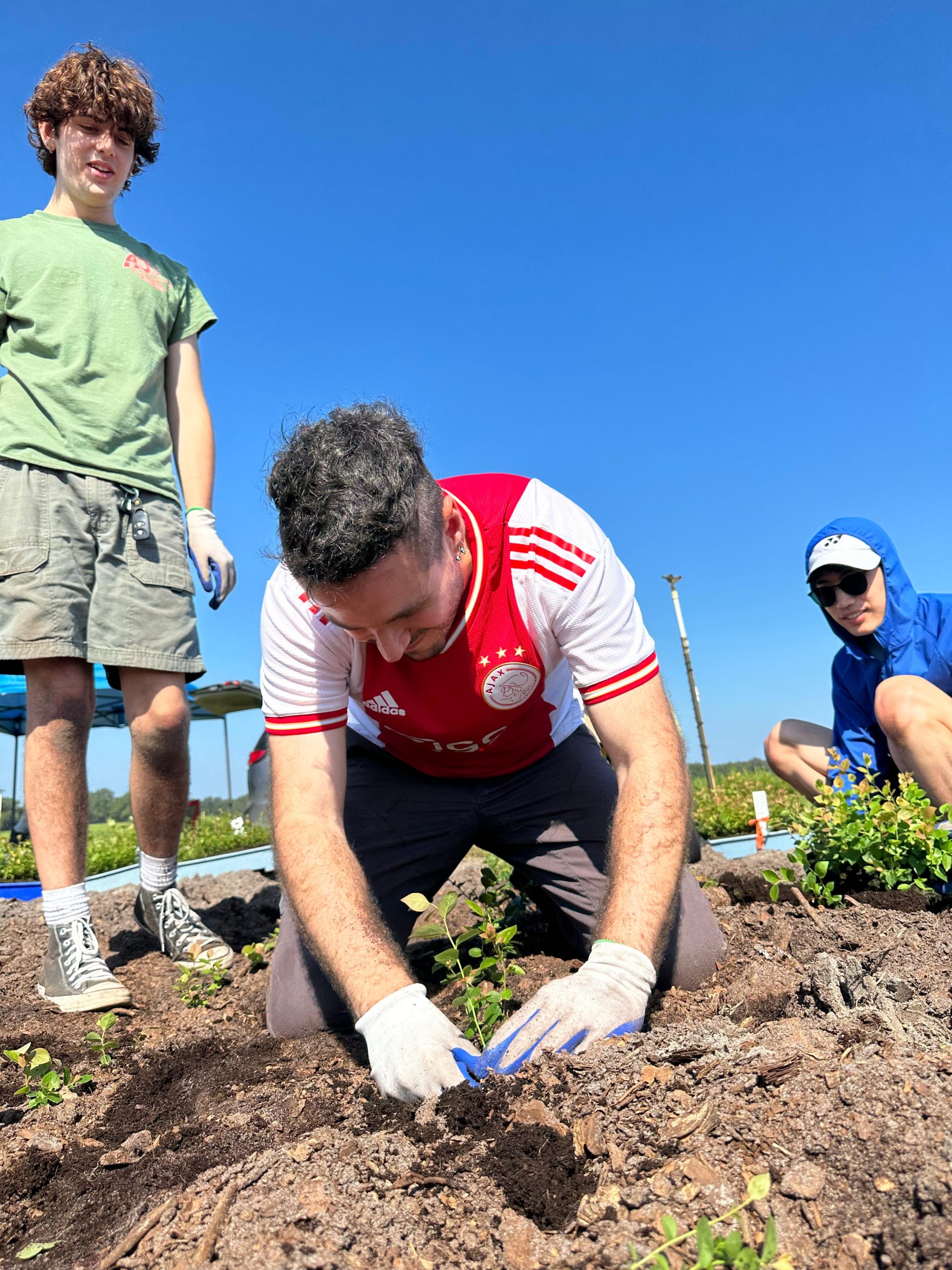
Really, everyone in the lab welcomed me immediately. There is a strong social, almost familial, sentiment in the lab. It was (and is) easy to feel like part of the team, to fit in. I was kind of surprised by that, because they are all exceptionally talented. When you think of getting a Ph.D., you think that everyone will be very work-focused and lab-oriented, but the blueberry breeding lab has a much more open feeling, where everyone collaborates and helps each other, even outside of work.
On his Ph.D. work:
The main goal of my Ph.D. work is to understand and improve the genetics involved in the shelf life of blueberries. Shelf life affects the entire supply chain, because more fruits last longer for sale and distribution, minimizing food waste and improving overall quality for consumers, and thus sales. When people see a fresh product with consistent quality, they remember it and buy it again.
Fruit softening is the primary factor in shelf life, which is mainly caused by cell wall degradation, dehydration, and physical damage. Fruit softening is an extremely complex trait involving many genes. Individual genes for these characteristics have a small impact, so we want to accumulate many contributing genes into a single line. So, how do you start this? First, you screen a population, in this case, we evaluated more than 600 genotypes. For blueberries, we put fruit in a cooler and measure the quality of each genotype at multiple time points. The genetic improvement is achieved by selecting the individuals with the longest shelf-life, evaluating their genetic merit, and crossing them to develop a new population with improved postharvest quality. In a breeding program, this process is repeated annually, including most traits of interest.
On the application new technologies in his research:
This is a long and labor-intensive process, so we have also developed predictive models to be able to make selections without phenotyping them (i.e., the screening process mentioned). These models are based on known genetic and phenotypic data of a training population.
These models can predict post-harvest softening with around 40% accuracy. This allows us to make earlier selections in the field, reducing the time needed to go from crossing to cultivar release by several years. With traditional methods, it can take up to 15 years to develop a new cultivar; with molecular-assisted breeding, we estimate that we can reduce this to 5-7 years. These models can be combined with others to predict and develop several traits simultaneously.
On his future career goals:
I will finish my Ph.D. next summer. After that, I would like to move to a position in product development. I would still like to be involved in the genetics component, but I’d like to expand my work into commercialization. There is a gap in the market for premium products, which are developed but not necessarily branded as such. For example, when you buy some fruit, the content of a package is poorly differentiated. With strawberries, this has started to change with the white-fleshed varieties. Compare this to mandarins, with “halos” or “cuties,” where consumers are willing to pay more for the name and associated quality.
The same could be done with blueberries, raspberries, kiwis, peaches, and many other fruits. The consumer does not really know what they are buying with these. My work with shelf life contributes to the sense of quality and consistency that consumers would need for this association. This is likely going to be in the private sector, because the public sector lags in this area. But I would prefer to work in the public sector and implement this commercialization strategy to maximize the profitability of public breeding programs.
On advising future Ph.D. students:
A lot of people think that Ph.D.’s are for geniuses, but that is not the case in my experience. The willingness to learn and participate matters a lot more than natural talent. If you are willing to learn and to develop new skills, you can earn a PhD. UF is an amazing environment for this.
 3
3