GAINESVILLE, Fla. — Sometimes it doesn’t pay to trust your instincts. That’s one of the lessons learned by researchers as they witnessed small, juvenile Caribbean spiny lobsters make their way to areas that would be advantageous if not for the presence of predatory red grouper.
“The catalyst (for the study) was the observation that red grouper — lobster predators — use the same large solution holes that lobsters use for shelter but that the lobsters observed there are usually only large lobsters,” said Don Behringer, Ph.D., a professor and graduate programs director at the UF School of Forestry, Fisheries, and Geomatics Sciences (SFFGS).
“This was compared to smaller shelters where lobsters also shelter but the size range of lobsters is much greater, including small lobsters. We wondered if the lobsters were avoiding those big shelters or were they still being lured there by their conspecifics and then preyed upon by the grouper — a trap if you will. The latter appears to be the case from our research.”
Solution holes are areas where acidic water wears away rocks like limestone. Flora and fauna come into these areas to live or otherwise go about their business. The solution holes observed in the study functioned as ecological traps.
“Ecological traps occur when behaviors that guide animals to advantageous habitats instead lead them to areas where fitness is reduced,” according to the study’s significance finding. “Ecological traps are rare as compared to evolutionary traps, a similar phenomenon but one in which habitat quality is diminished due specifically to human activities.”
Usually the small juveniles’ instinct is to use their senses to be closer to larger lobsters. Grouper in these solution holes aren’t eating the larger lobsters, it appears, because they’re simply too large for the grouper’s mouth. The smaller juveniles are bite-sized, however, and they can’t appear to detect that a red grouper is near, as opposed to their recognition of other predators like octopuses.
“As a consequence, mortality of small juvenile lobsters was 30% higher near solution holes occupied by grouper, as compared to larger lobsters that are invulnerable to the gape-limited grouper predator,” according to the study abstract. “By preying on small lobsters, grouper negatively skewed lobster size distributions up to 16 m away from the solution hole lair that they patrol.
“Our results provide one of the clearest examples of a natural ecological trap, in which the normally advantageous social cue of large conspecifics lures young lobsters to what is a predatory death trap.”
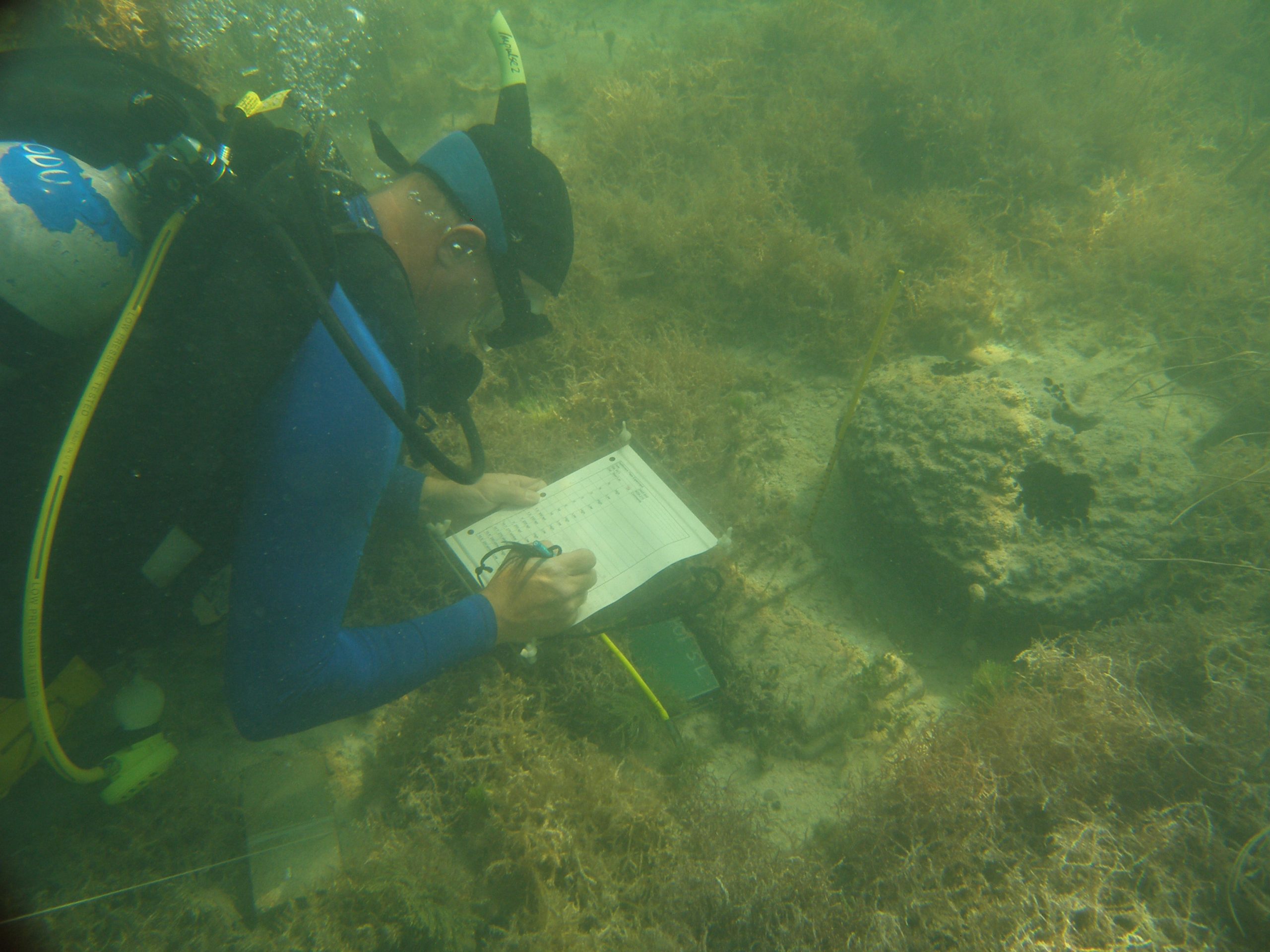
Mark J. Butler IV, Ph.D., of the Newfound Harbor Marine Institute, served as the lead author on the study, working with Behringer and Jason Schratwieser of the International Game Fish Association. Behringer and Schratwieser collaborated on the field work, while Butler and Behringer conducted the following lab experiments with grouper to test the lobsters’ chemosensory response to the fish. The study, “Social attraction to a predatory black hole: A natural ecological trap for lobsters,” published in the Jan. 6, 2026, edition of the Proceedings of the National Academy of Sciences.
While Florida has spiny lobster sport and regular harvest seasons, the Florida Fish and Wildlife Conservation Commission bans harvesting them from Everglades National Park, Dry Tortugas National Park, and no-take areas in the Florida Keys National Marine Sanctuary, in the Biscayne Bay/Card Sound Lobster Sanctuary, and in the five coral reef protection areas in Biscayne National Park.
 0
0