A Practical Guide for Columbia County Growers
Blueberries have become one of the most promising specialty crops in North Florida, especially for s mall- and medium-scale growers looking to diversify. Thanks to the region’s mild winters, acidic soils, and strong local markets, Columbia County is well-positioned to support profitable blueberry production—whether you’re planting one acre or expanding an existing operation.
Below, we break down why blueberries thrive here, along with practical guidance on varieties, spacing, irrigation, planting layouts, and pest management to help you establish a healthy, productive patch.
Why Blueberries Work Well in North Florida
Much of Columbia County naturally has the sandy, acidic soils blueberries prefer. With soil pH often ranging from 4.5 to 5.5, the area provides a good foundation for both Southern Highbush and Rabbiteye varieties with minimal modification. Our county generally receives between 300–500 chill hours, which is perfect for many low-chill Southern Highbush cultivars and well within the ideal range for Rabbiteyes. This helps winter dormancy and spring bloom timing be more consistent year to year. Between the Lake City Farmers Market to U-pick opportunities, residents are actively looking for local product. They’re a staple crop that consumers recognize and value, making profitability more reliable than with lesser-known fruits. With good management, a single acre can support 600–1,500 blueberry plants, depending on spacing. Many beginning growers in Columbia County start with one acre and scale up as needed.
Which Blueberry Variety Should You Plant?
Southern Highbush Blueberries
Best for: Early-season fruit and higher market prices
Examples: ‘Emerald’, ‘Jewel’, ‘Meadowlark’, ‘Suziblue’
Pros
-
Ripen early (late March through May)
-
Command higher prices at local markets
-
Large, high-quality fruit
Cons
-
Require consistent irrigation
-
More sensitive to heat and drought
-
Higher disease and frost risk
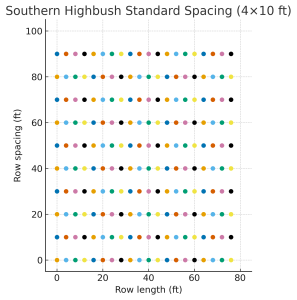
Recommended Spacing
-
4 ft between plants × 10 ft between rows
-
Approx. 1,000 plants per acre
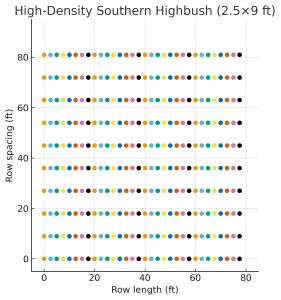
High-Density Southern Highbush
Best for: Intensive production on well-managed irrigated acreage
Spacing: 2.5 ft × 9 ft
-
Up to 1,900 plants per acre
This system produces early, high yields—but only if irrigation, weed control, and fertility are tightly managed.
Rabbiteye Blueberries
Best for: Low-input growers or sites without irrigation
Examples: ‘Climax’, ‘Brightwell’, ‘Powderblue’
Pros
-
Much more drought-tolerant
-
Thrive with or without irrigation
-
Far less prone to root rot and heat stress
-
Perfect for beginners
Cons
-
Ripen later (May–July)
-
Slightly lower market price due to season
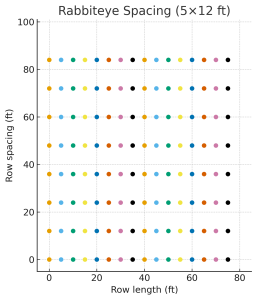
Recommended Spacing
-
5 ft between plants × 12 ft between rows
-
Approx. 600–700 plants per acre
Irrigation Considerations
For Columbia County’s unpredictable dry springs, microjet or drip irrigation is strongly recommended, especially for Southern Highbush. while Rabbiteyes can survive on rainfall once established, irrigated rows are still ideal considering the changing precipitation we’ve experienced over the past few seasons. Drip irrigation allows reliable establishment and early fruit production and Supports fertigation for optimal nutrition.
Final Thoughts
Whether you’re a beginning grower or adding a specialty crop to an existing farm, blueberries offer:
-
Strong local demand
-
Adaptability to North Florida soils
-
Good returns on small acreage
-
Options for both low-input and high-input systems
With thoughtful planning, good spacing, and proper variety selection, blueberries can become a reliable and profitable crop for years to come.
 0
0