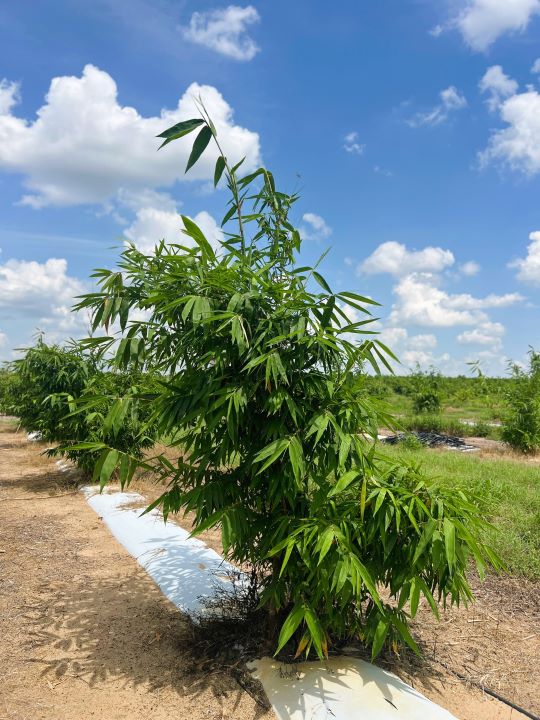
Bamboo is emerging as a promising new specialty crop for Florida. It offers opportunities for edible shoots, timber, biomaterials, and carbon storage. But until recently, growers lacked clear, science-based guidance on how to fertilize bamboo efficiently and sustainably in the state’s climate.
A new study from the UF/IFAS Department of Soil, Water, and Ecosystem Sciences (SWES) fills that gap. The research identifies an optimal nitrogen (N) fertilization range for Dendrocalamus asper, one of the most commercially valuable bamboo species. These findings could help Florida producers improve yield potential while also avoiding excessive fertilizer applications that waste money and threaten water quality. This research is especially timely as some Florida growers explore alternatives in response to citrus disease pressures and changing markets.
“Our results provide a starting point for sustainable bamboo production,” said Davie Kadyampakeni, an associate professor in SWES and a co-author of the research article.
The study is based on the thesis work of SWES graduate student Cyrus Januarie. “My goal was to help growers make informed decisions using real data rather than guesswork; as you know this is a new crop in the state,” he said.
Bamboo Nutrient Needs

Bamboo’s rapid growth creates a high demand for nutrients, particularly N. Before this study, little information existed on how much Florida conditions require. Too little limits growth; too much threatens plant health and the environment.
“Bamboo has to have nitrogen, but we wanted to know the most effective rate,” Januarie said. “There were no localized guidelines Florida growers could rely on.”
The researchers evaluated four N rates applied to one-year-old bamboo plants (0-, 112-, 224-, and 336-kilograms N per hectare). They measured the bamboo growth responses over two years. This included plant height, culm (stem) diameter, and biomass. Then they modeled optimal N levels under each year’s weather patterns.
The greenhouse study took place at the UF/IFAS Citrus Research and Education Center in Lake Alfred. Scientists there are studying bamboo as a potential alternative crop.
Results and Implications
Nitrogen significantly increased bamboo height, culm thickness, and biomass, as expected. However, very high N rates inhibited growth.
“We found that bamboo responds strongly to nitrogen, but there’s a threshold where adding too much is not useful,” said Januarie. “Identifying that amount is important for sustainable production.”
“Our study found that the 224 kilograms per hectare (200 pounds per acre) rate was best for biomass accumulation and moderate nutrient use efficiency,” Kadyampakeni said. “But even half that amount (100 pounds per acre) was enough to reach a desired culm diameter.”
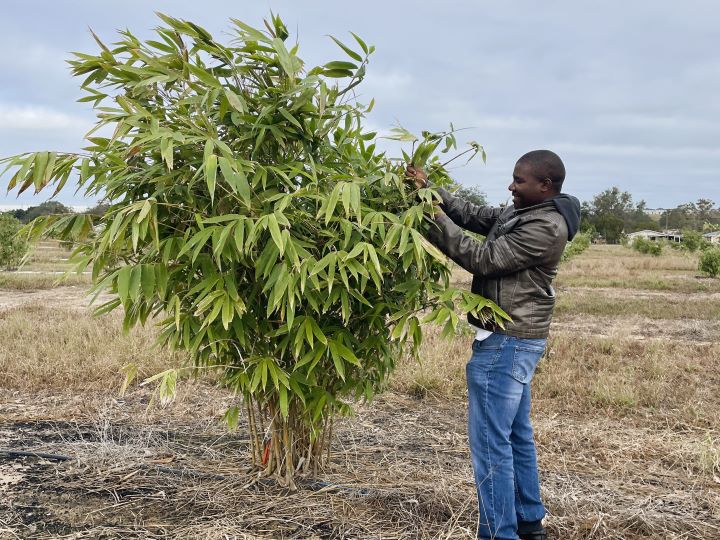
The modeling they performed came to nearly the same conclusion. Predicted biomass accumulation peaked at 241 kilograms per hectare (215 pounds per acre) in the first year and 258 kilograms per hectare (230 pounds per acre) in the second year. Furthermore, it showed more N than that caused biomass to decrease.
The study provides the first science-based N recommendations for bamboo in the Southeast United States. It also highlights opportunities for future research, including:
-
- Larger field-based studies to validate greenhouse results
- Determining optimal N rates for mature bamboo plants
- Long-term effects of different N application rates on bamboo growth and sustainability
- How nutrients can be transported between branches and culms
“We’ve taken an important first step,” Januarie said. “More multi-year studies across different sites will help growers benefit from tailored recommendations.”
As interest in bamboo expands, it could become a valuable addition to Florida’s agriculture. With its versatility and rapid growth, it offers new opportunities for producers to explore other markets.
The full study, “Nitrogen Fertilization Dynamics on One-Year-Old Dendrocalamus asper (Schult. & Schult.f.) Backer Bamboo in Florida,” is published in Advances in Bamboo Science. You can read it online here.
Featured image from UF/IFAS.
 1
1