Banner Photo Credits: UF/IFAS Photo by Camila Guillen
Introduction
During my internship, I had the pleasure of joining a sea turtle walk along Manasota Beach. The walk was a permitted walk. Sea turtle walks help scientists tag, measure, and monitor female sea turtles that return to shore to lay their eggs.
We arrived at 8:30 pm for an educational and safety presentation. Under a pavilion with red lights, we learned the following.
– Sarasota County has the highest nesting density of sea turtles on the Gulf Coast.
– Loggerheads are the most abundant of Sarasota County scientists’ observations. They have observed 2,169 this nesting season alone. They have also seen 76 green turtles and one Kemp’s Ridley so far this season.
– There are 7 sea turtle species, of which 6 swim in Florida’s waters (1).
Measurements
The research officials taught us that there are different sea turtle-measuring tools. They use calipers to measure the length and width of the sea turtle. They also have a device that scans the turtle and tells them if there is a PIT tag. Sea turtles receive three tags once found. Individual metal tags are pierced into the right and left flipper. A PIT tag is placed in the right rear flipper. PIT tags (passive integrated transponder) are more permanent tags. While the pierced tags can help scientists identify the turtle, they could fall out over the course of the turtle’s life. A PIT tag remains. Every time a turtle with a PIT tag is found, researchers can look up the file number and see information about the turtle and when it was last seen.

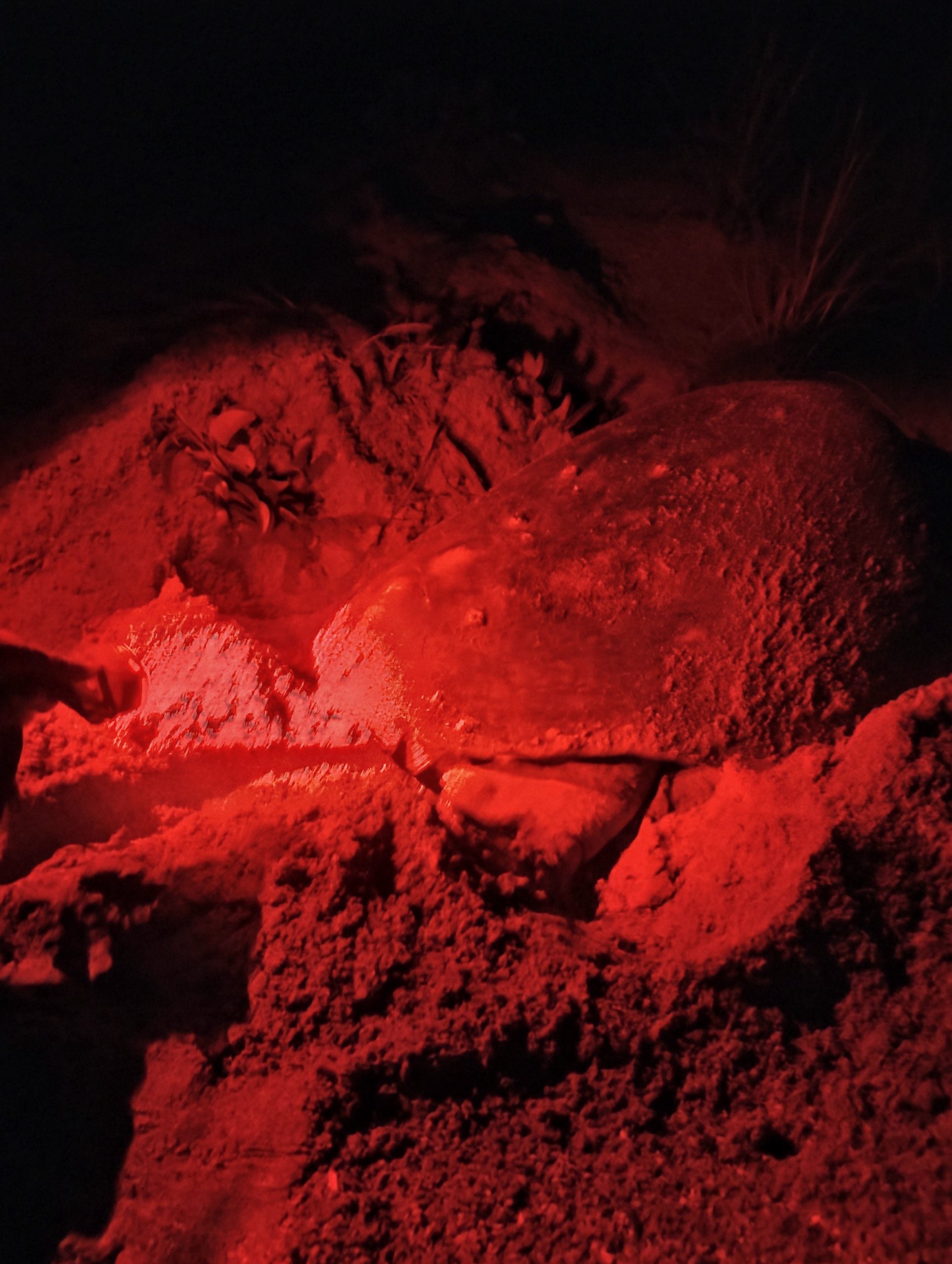
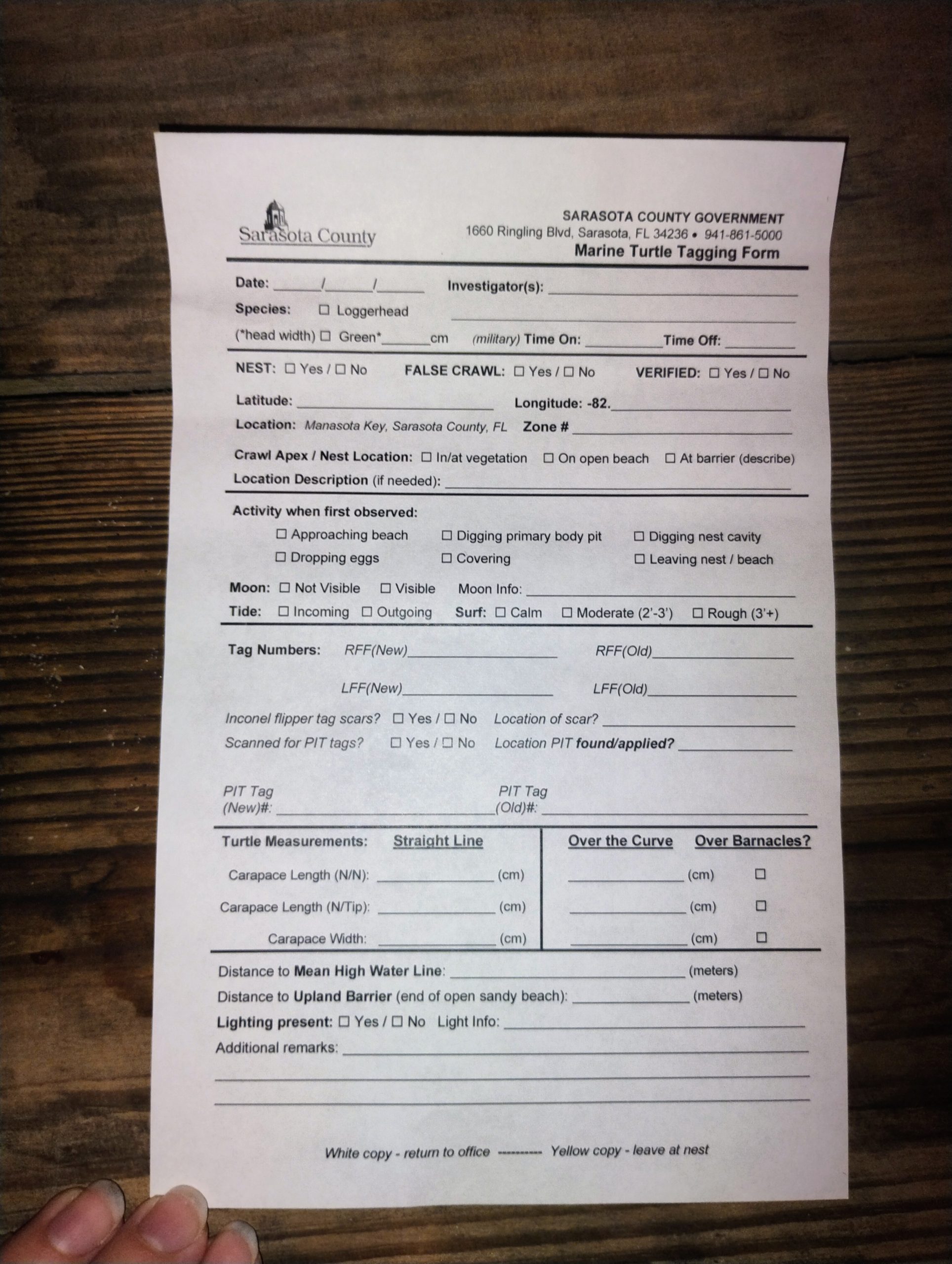
PIT Scanner Loggerhead Sea Turtle Data Sheet
Seeing as that loggerheads are in higher numbers than greens, we could only monitor a loggerhead sea turtle. We began our trek down the beach. Nothing prepares you for the type of darkness to be encountered on a dark beach. Looking out to the ocean, I could barely make out the horizon line. Everyone’s features were fuzzy, difficult to make out. Patches of seaweed lined the beach, making it hard to distinguish between sea turtle and sea mush. Luckily, the experts with us could distinguish tracks and movement many steps ahead.
As we walked, we stopped to jump across tracks of sea turtles that had already crawled up the beach that night. We saw tracks of a false crawl, which is when a mother crawls up the beach, but does not give birth, returning to the water.
Sighting
Finally, we spotted on! A loggerhead just beyond the seaweed barrier.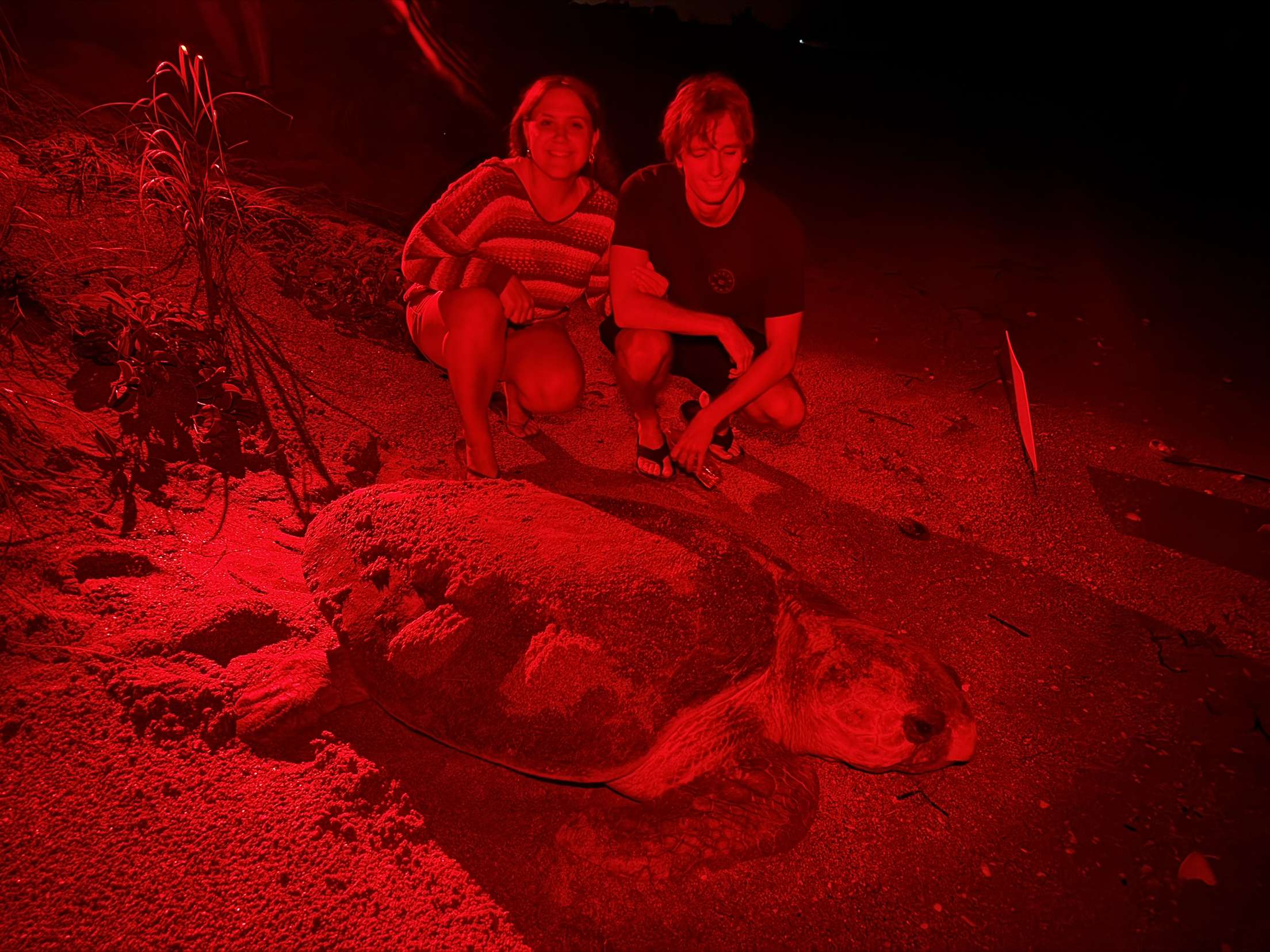 We held still for 40 minutes so she would not be scared away. We slowly watched her make her way up the sand dunes. Once we saw her stop, we stayed still until we were sure she had begun to dig her nest. Then, one of the researchers slowly approached her. After the loggerhead gave birth to 75% of her eggs, the researcher signaled us to approach in groups of 2-3 with a red light from across the beach.
It was amazing! I got to see her lay her eggs and bury them. Using the PIT scanner, we found out that the turtle had last been seen 10 years ago on the same beach. With this information, we were able to determine that she was most likely 30 years old. After a total ordeal of about 2 hours, she made her way back to the water. Moments like these remind me why protecting these animals is so important.
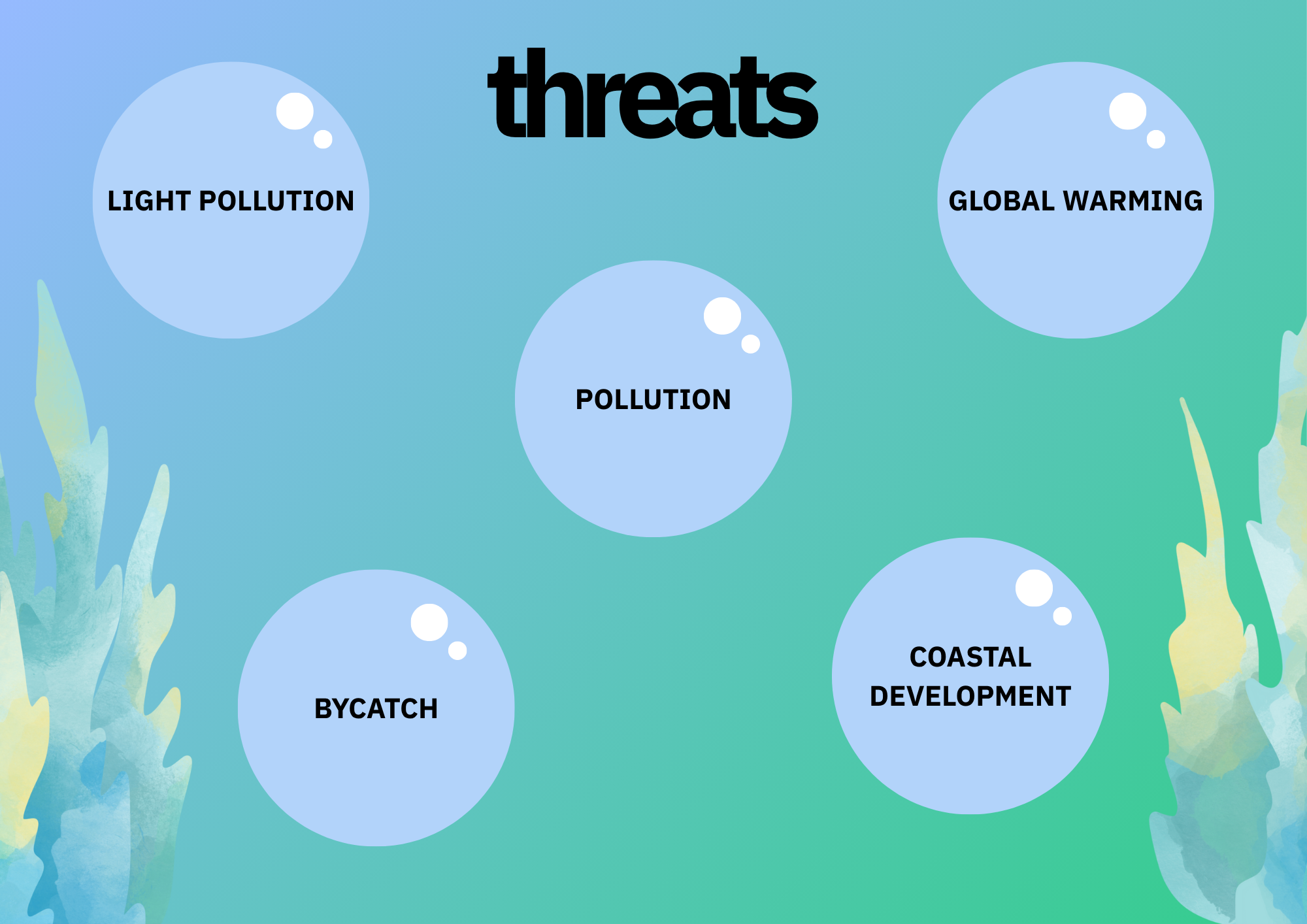
Sea turtles are in danger due to human actions.
Light pollution from cities lights up the night sky, confusing sea turtles about which way the water is. Hatchlings especially rely on the glow of moonlight on the water’s surface to know how to get to the ocean. Similarly, laws exist regulating beach lighting. Some of the regulations that exist are that beach lights need to be red, amber, or orange and directed down.
Pollution is a huge problem for sea turtles. Not only does it contaminate their water, but it can also confuse them when searching for their food source. The age-old example of this is that leatherback sea turtles, which eat jellyfish, will confuse them for plastic bags. We need to make sure our oceans are clean so this doesn’t happen!
Global warming is not only causing the oceans to heat up, but also the sand. The temperature of sea turtle eggs will determine the sex of the hatchlings. Boys are cold and girls are hot. Scientists have seen a skewed number of females being born due to this issue. If this continues, sea turtles could go extinct. Global warming also contributes to stronger storms and raised sea levels, which both worsen beach erosion. The more beaches erode, the less space for sea turtles to lay their eggs.
Bycatch occurs when fishermen accidentally catch sea turtles in their nets. These turtles often die after being seriously harmed in these nets. According to the World Wildlife Foundation, “The single greatest threat to most sea turtles is fishing gear.” So, clean up after you are done fishing!
Finally, coastal development near the coast contributes heavily to habitat loss for these animals. Developed beaches have many obstacles like beach chairs, rocks, and walls. These obstacles make it more difficult for the mother to ascend the beach, leaving her to lay her eggs closer to the water. The eggs are more likely to be swept away.
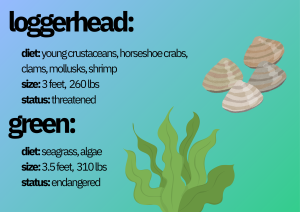
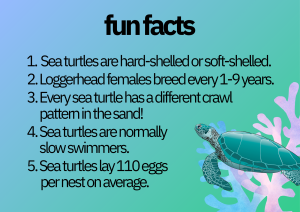
Source 2 Source(s): 1, 3, 4
4-H Connection
One of the core program areas of 4-H is STEM. 4-H helps connect kids with their scientific mind and supports interest in the natural world. Sea turtle monitoring helps support this very idea. If your child wants to one day help monitor sea turtles, have them engage in 4-H STEM Programming! Some Sarasota clubs that do this are:
- All Star Lucky Clovers
- Booker Middle School 4-H Club
- Heron Creek MS 4-H Club
Can’t participate? Your child can complete science-related projects during the year. Click here to learn about all the different project types offered! Contact our 4-H Agent to obtain the record book for the project you want to complete. At the end of the year, you can submit your completed record book to Sarasota County’s 4-H Agent at Sarasota County’s UF/IFAS Extension Office. We judge them and hold an end-of-year award ceremony where your child will receive awards!
Contact: Sarah Davis, sarahdavis@ufl.edu
Sources:
- McGuire, M., Francis-Floyd, R., & Larkin, I. (2024, October 28). A guide to nesting sea turtles in Florida. Ask IFAS – Powered by EDIS. https://edis.ifas.ufl.edu/publication/FA235
- Sea Turtle Conservancy. (2025, February 26). Green – Sea turtle conservancy. https://conserveturtles.org/species/green/
- ORP. (2020, April 19). How fast can a sea turtle swim? Olive Ridley Project. https://oliveridleyproject.org/ufaqs/how-fast-can-a-sea-turtle-swim/
- ORP. (2025, March 14). How many eggs does a sea turtle lay? Olive Ridley Project. https://oliveridleyproject.org/ufaqs/how-many-eggs-does-a-sea-turtle-lay/
 3
3