When you think of tea, your mind probably jumps to green or black tea from Asia. But did you know the only caffeinated plant native to North America grows right here in Florida? Meet Yaupon Holly (Ilex vomitoria), a resilient evergreen shrub that’s making a comeback as a sustainable tea crop.
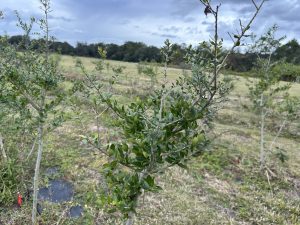 What Is Yaupon Holly?
Yaupon Holly belongs to the Aquifoliaceae family, the same family as other hollies. Unlike traditional tea (Camellia sinensis), which hails from Asia, Yaupon is uniquely American. Its leaves naturally contain caffeine and antioxidants, making it a healthy, energizing beverage that Native Americans enjoyed for centuries. Indigenous tribes brewed Yaupon leaves into a strong tea for ceremonial and everyday use. Today, this heritage plant is gaining popularity among tea enthusiasts looking for local, sustainable options.
Where Does It Grow?
Yaupon thrives in the southeastern United States, from Texas to Virginia, but Florida—especially sandy, well-drained soils—is prime territory. In Putnam County and northeast Florida, Yaupon loves our warm climate and tolerates drought, making it an excellent low-maintenance crop.
Sandy soils in North Florida offer:
- Excellent drainage (Yaupon hates “wet feet”).
- Low fertility tolerance (it doesn’t need rich soil).
- Drought resistance once established.
This makes Yaupon a great fit for growers looking for a hardy, native crop that doesn’t require heavy inputs. Yaupon Holly is dioecious, meaning male and female flowers grow on separate plants. While both produce usable leaves, male plants are preferred because the female plants produce bright red berries that are toxic and must be removed before processing the tea leaves. The berries do add ornamental value and they are attractive and festive, especially during the Christmas season when the berries are on full display.
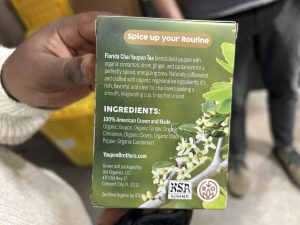 Harvesting for Tea
- Timing: You can harvest year-round, but spring and fall flushes give the best tender leaves.
- Method: Snip young stems and strip the leaves. This can be done by hand or by a machine as shown in this video https://www.youtube.com/shorts/CyeLjxyoyYw
- Drying: Spread leaves in a single layer and air-dry or use a dehydrator.
- Roasting (optional): Light roasting enhances flavor and aroma.
- Brewing: Steep 1–2 teaspoons of dried leaves in hot water for 3–5 minutes. Enjoy!
Eagles Nest in Crescent City
Bryon White of the Yaupon Brothers started a commercial production operation growing yaupon trees in rows with improved irrigation to maximize their tea potential. He purchased the Eagles 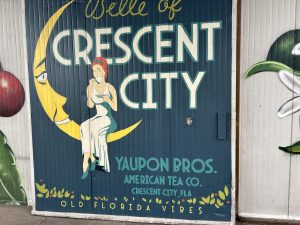 Nest Farm located at 470 Old Highway 17 in Crescent City, Florida. Eagles Nest was formerly a 50-acre organic citrus farm operated by L. P. DeWolf since the early 1900’s.
 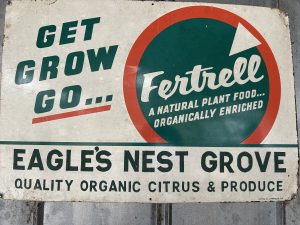 According to an article in the Florida Times Union dated December 7, 1976, DeWolf prided himself on growing organic citrus without the use of chemical fertilizers, sprays, or dusts. He used an organic 3-1-2 fertilizer, plowed deeply around the root base on a consistent basis and planted legumes as cover crops that were chopped and tilled into the soil for nitrogen.
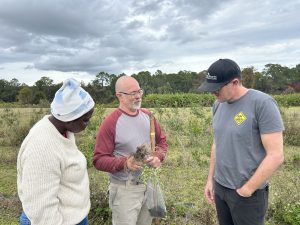
Bryon planted just over an acre of Yaupon Holly approximately one year ago and he keeps the trees pruned to promote excessive foliage on a short, manageable bush ideally 5 to 7 feet in height. A commercial harvester is used to separate the leaves from the stem and then they are dried out packaged into individual tea bags. The UF/IFAS Extension Team (Dr. Billy Crow and his graduate assistant, Dr. Wendy Mussoline, and George Laibl) visited the farm to explore for nematodes in the soil and roots of the yaupon crop to determine if they were impacting this young crop. Although a few root-knot and lance nematodes were detected in the root system of one of the yaupon plants, the counts were very low and do not appear to be causing any stunting. Since this crop is grown on organic certified land, we will continue to monitor the nematodes in both the soils and root systems of these hardy plants to ensure that nematodes are not contributing to yield loss over time. As with any organically grown crop, the weed pressure is a challenge as no spray is used on the trees. Bryon planted mimosa as a ground cover within the rows to serve as a nitrogen source for the trees and to hopefully outcompete the weeds.
Bryon also has creatively restored the old citrus packing barn into a quaint venue perfect for a wedding, fund raiser or community celebration. He rents the facility for $2200 on Fridays and Saturdays or $800 on weekdays.  The character of the farm has been preserved and the original signage and barn construction is authentic. Come tap into some of the most pristine agriculture land and sip a cup a yaupon tea produced regeneratively and locally right here in Putnam County, Florida https://www.eaglesnestfarms.com/.
Portions of this blog were written with assistance from Copilot 365
 4
4