Disclaimer:
This blog contains information about poisonous plants found in Florida and is intended for educational purposes only. Florida is home to many toxic species, and it is strongly advised that you do not touch, taste, or interact with any plant unless you are absolutely certain of its identity. When in doubt, admire from a safe distance.
Enter the Flora of Fright
As summer gives way to autumn and nature begins to settle into dormancy, people around the world turn to traditions that celebrate the harvest and honor the dead. Alongside these commemorations are cultural events with more sinister and spooky undertones—like the Ghost Festival, Walpurgis Night, and Samhain, just to name a few.
To add to this seasonal theme, I thought I’d highlight six wild plants that carry spooky, strange, or surprising stories. Whether through folklore, toxic traits, or ghostly appearances, these plants offer a chilling twist to Florida’s natural landscape.
The Ghost in the Tees- Spanish Moss

Our first spooky plant is Spanish moss. Spanish moss can create a very creepy scene by draping like ghostly veils and represents the duality of beauty and death found in Southern Gothic storytelling. Folklore states that a Spanish conquistador chased a Native woman into a tree. She jumped from a limb to freedom, but when the conquistador jumped, his beard got caught in the tree, and he died. His beard remained, and that is what became Spanish moss.
The National Park Service mentions that French explorers referred to it as “Spanish Beard,” comparing it to the beards of Spanish explorers. Over time, the name evolved into Spanish moss, even though it is neither Spanish nor a true moss.
Interestingly enough, Spanish moss is actually a type of epiphytic bromeliad. Its scientific name, Tillandsia usneoides, places it in the same genus as air plants we often see growing on trees. Since it is a bromeliad, it does produce a small flower, usually in the spring. While it may look burdensome to trees, breakage is rare on healthy trees. Spanish moss also plays a vital role by providing bird nesting material and offering insect shelter and food. Historically, it was also harvested and used as stuffing for mattresses, insulation for homes, and even padding in the seats of early automobiles.
Phantom of the Understory – Indian Pipe
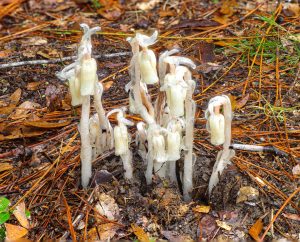
Our next plant’s legend comes from Cherokee tradition. Two tribal chiefs were locked in a long-standing quarrel. They met and smoked the sacred peace pipe, but refused to make peace. Displeased by their actions, the Great Spirit turned them into bowed white flowers. These flowers serve as a reminder of the sorrow caused by conflict. This story is associated with Indian Pipe (Monotropa uniflora), a pale plant often found in shady forest understories. Cherokee storyteller Lloyd Arneach shared this legend in American Indian Magazine (Smithsonian Institution, 2010).
Indian Pipe is a very unusual plant. It is a mycoheterotroph. What does that mean? Mycorrhizal fungi form partnerships with trees and shrubs, helping them absorb nutrients and water. Mycoheterotrophic plants, like Indian Pipe, steal energy from these fungi. They act like botanical vampires. Because they do not photosynthesize, they lack green chlorophyll and appear white. If you come across one, take a photo. The flowers fade and turn brown quickly.
Tiny Carnivorous Terrors- Sundews

Attack of the Killer Tomatoes, The Happening, and Little Shop of Horrors are all movies with one thing in common—plants that are out to get humanity. While our next thrilling plant isn’t out to end the world, it is carnivorous. Well, more accurately, it’s insectivorous, and it’s one of my favorite plants.
Sundews (Drosera sp.) are small but deadly. Their leaves are covered in tentacle-like structures that produce a sticky mucus. These glistening droplets look like nectar and attract unsuspecting insects. When they land, they become trapped in the sticky fluid and cannot escape. The mucus contains digestive enzymes that break down the insect, allowing the plant to absorb nutrients directly through its leaf surface. These sticky death traps can be found in bogs and wet pinelands, where nutrient-poor soils make carnivory a clever survival strategy.
Deadly Beauty – Spotted Water Hemlock
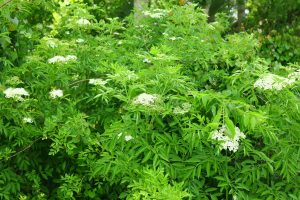
Our next plant doesn’t have ghost stories or legends, but it is no less chilling. Hemlocks have been used since ancient times as fast acting poisons. In Ancient Greece, poison hemlock was used to execute prisoners, including the philosopher Socrates. What’s even scarier is that Spotted Water Hemlock (Cicuta maculata) is more toxic than poison hemlock.
This plant is often mistaken for edible lookalikes such as wild parsnip, Queen Anne’s lace, and elderberry. Ethnobotanist H.D. Harrington called it “the most poisonous plant in the North Temperate Zone.” Its toxin, cicutoxin, can cause seizures, vomiting, and death within an hour of ingestion.
Spotted Water Hemlock is commonly found in wet areas like ditches, stream banks, marshes, and wet meadows throughout Florida and much of North America. Its delicate white flowers and fern-like leaves make it deceptively beautiful. When it comes to foraging, if you don’t know for certain, don’t eat it.
Florida’s Ancient Survivor – Coontie

Our next plant may not look spooky at first glance, but its story reaches deep into Florida’s past. Coontie (Zamia integrifolia) is a native cycad and a true living fossil, with ancestors dating back over 300 million years. Its palm-like appearance hides a toxic secret. The roots contain cycasin, a compound that can cause serious illness if consumed without proper preparation.
Indigenous tribes such as the Seminoles developed complex methods to detoxify Coontie’s starchy roots, turning them into a valuable food source. Early settlers also used it to produce flour and even stuffed animal crackers with its starch. Despite its usefulness, Coontie nearly disappeared from Florida landscapes due to overharvesting and habitat loss.
But this ancient plant helped revive something else from the edge of extinction. The Atala butterfly (Eumaeus atala), once thought to be lost, depends entirely on Coontie as its host plant. Thanks to native plant gardening and conservation efforts, the Atala has returned to Florida gardens. While Coontie is not a ghost species itself, it played a vital role in bringing one back.
Its quiet resilience, toxic past, and connection to a ghost species make Coontie a fitting addition to Florida’s flora of fright.
Florida’s Tree of Death – the Manchineel Tree

While the Manchineel tree (Hippomane mancinella) cannot be found in Putnam County, it is native to Florida and is considered one of the most dangerous trees in the world. This is because all parts of the tree are toxic—from the roots to the fruit. Exposure to the sap can lead to severe skin blistering and burns. Even standing under the tree while it is raining can cause injury, as water carries the toxic sap from the leaves onto the skin. The sweet-smelling fruit may look inviting, but it can cause intense pain, blistering, and even death if consumed.
Folklore states that Indigenous people used the sap to poison arrows, and it is believed that Juan Ponce de León may have died from one of these arrows. The tree’s toxicity led to widespread removal in Puerto Rico during the nineteenth century, following reports of illness and death linked to its fruit and sap.
Despite its deadly reputation, the Manchineel tree plays a role in coastal ecosystems. It helps prevent erosion with its strong root system and provides nesting sites for certain bird species that appear unaffected by its toxic sap.
The End of the Trail… Or Is It?
Florida’s wild plants are more than just beautiful—they’re mysterious, powerful, and sometimes downright eerie. From ghostly blooms and carnivorous traps to ancient survivors and deadly trees, these species remind us that nature has its own kind of fright. Whether tied to folklore, toxic to the touch, or simply strange in appearance, each one plays a role in the ecosystem and in the stories we tell. So as the season shifts and shadows grow longer, take a moment to appreciate the spooky side of Florida’s flora. Just remember, not everything that grows is safe to touch.
Further Reading
Spanish Moss (Tillandsia usneoides)
Indian Pipe (Monotropa uniflora)
Sundews (Drosera spp.)
- UF/IFAS Lake County – Carnivorous Plants of Central Florida
- USDA Plant Profiles – Drosera capillaris, D. intermedia, D. filiformis
Spotted Water Hemlock (Cicuta maculata)
Coontie (Zamia integrifolia)
- UF/IFAS Gardening Solutions – Coontie
- USDA Plant Guide – Coontie (PDF)
- UF/IFAS EDIS – Atala Butterfly Profile
Manchineel Tree (Hippomane mancinella)
- UF/IFAS EDIS – Manchineel Tree Profile (PDF)
- U.S. Fish and Wildlife Service – Manchineel Tree Fact Sheet (PDF)
Edited with help from Microsoft Copilot to improve clarity and flow.
 7
7