Functional movements are movements that mimic activities of daily living. Incorporating functional movements into your daily routine can help you lower your risk of injury and increase your ability to perform activities of daily living. This is one blog in a series that will cover the importance of functional movements, and their role in maintaining quality of life.
The prevalence of back pain in the American public has been steadily increasing over the decades. Approximately 39% of all American adults have experienced back pain in the past three months, and of those 65 and older, 45.6% have reported back pain (Lucas et. al., 2019). Back pain has been associated with health risks such as diminished quality of life, reduced activities of daily living, increased sedentary behaviors, and increases in healthcare spending nationally (Chang et. al., 2024). While back pain can have many causes, poor body mechanics and lifting form can contribute or exasperate back pain.
What is the hip hinge?
The hip hinge is a body movement involving flexion of the body at the hips. If done correctly, this movement can stretch and strengthen the posterior chain muscles and lead to a more effective lifting method. The posterior chain muscles are the muscles located along the posterior (backside) of the body. These muscles include the trapezius, the deltoids, and the erector spinae of the upper trunk, and the gluteus maximus and hamstrings (semimembranosus, semitendinosus, biceps femoris) of the lower trunk and legs. The hip hinge is a functional exercise which can help individuals lift objects off the floor by using the legs and hips to avoid rounding of the back which can contribute or exasperate back pain. Rounding of the back happens when the upper body curves downward during trunk flexion transferring the force of the movement from the hips and lower legs to the upper and mid-back which can lead to back pain and an increased risk of injury. The hip hinge is also fundamental to performing exercises such as the deadlift, bent-over-row, and kettlebell swings correctly.
How to perform the hip hinge:
- Stand with the feet shoulder-width apart.
- Engage the core by pulling the abdominal muscles towards your back/spine. Hold the core engagement throughout the movement.
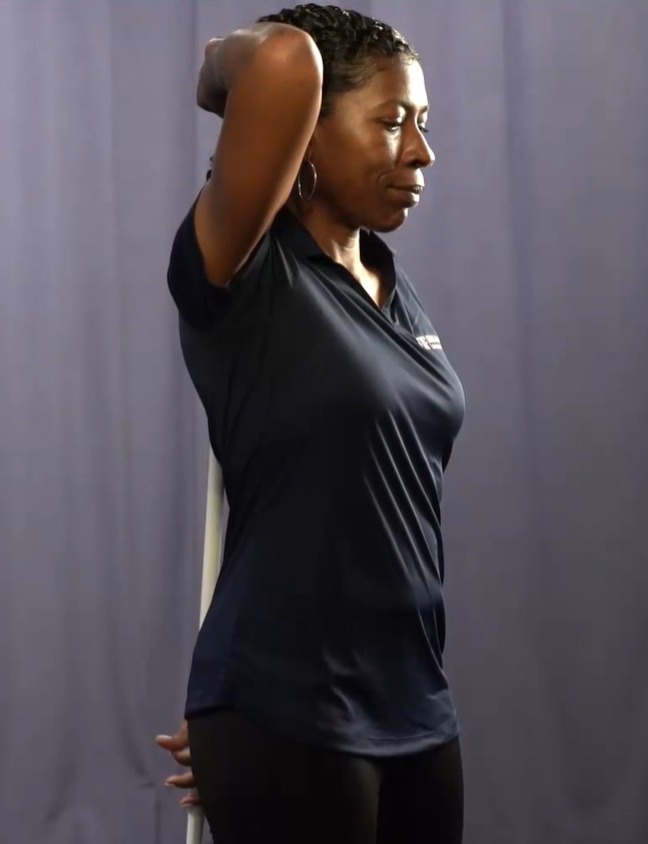
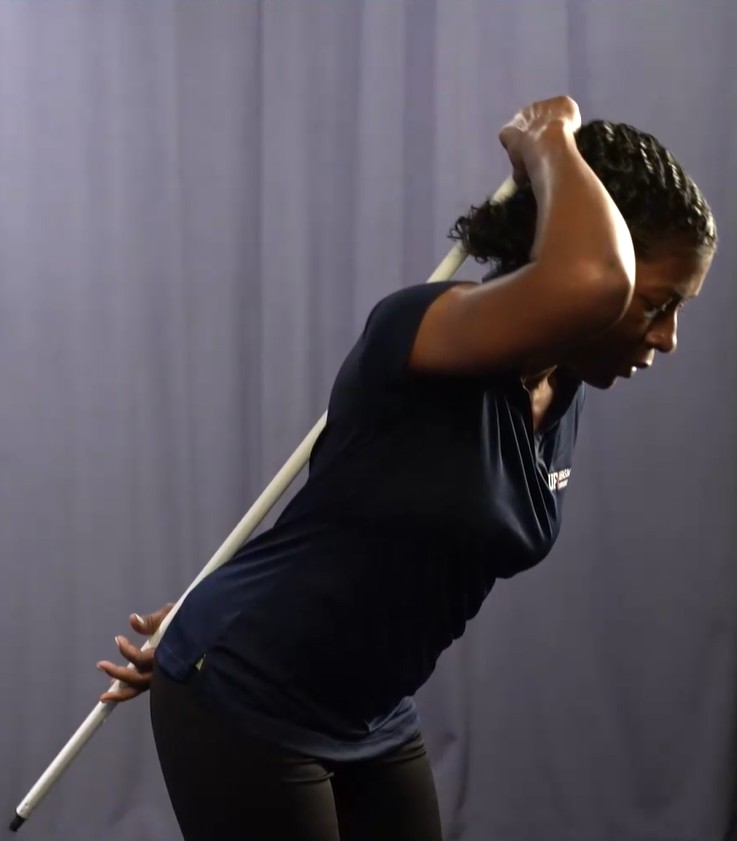
- First, move the butt backwards while flexing the hips.
- Keep a neutral spine. A neutral spine is often referred to as a flat back. If using a dowel or broom, maintain three points of contact (back of the head, upper back and butt).
- Stretch the hamstrings and hips – By doing this motion correctly, you should feel a stretch along the lower back, back of the legs, and hip muscles (hamstrings and glutes). Once the stretch reaches it limit return to starting position in a slow, controlled manor.
Tips to help perform the hip hinge:
To practice the hip hinge, stand about one foot in front of a wall and practice moving the hips and butt back first until you feel the wall behind you, then return to standing upright. This will help cue you into the correct way to start the movement.
Initially, the flexibility of the hamstrings and gluteus muscles will affect the depth of your hip hinge. Performing the hip hinge regularly will increase flexibility of the hamstrings and allow for a greater range of motion.
A dowel, broom or other long stick can help you prevent rounding of the back through the movement. Hold the dowel with one hand on the lower back and the other on the head to maintain the neutral spine. You should always feel the dowel on three points of the body, the back of the neck, the mid-back and the buttocks.
Chang, D., Lui, A., Matsoyan, A., Safaee, M. M., Aryan, H., & Ames, C. (2024). Comparative review of the socioeconomic burden of lower back pain in the United States and globally. Neurospine, 21(2), 487–501. https://doi.org/10.14245/ns.2448372.186
Lucas JW, Connor EM, Bose J. Back, lower limb, and upper limb pain among U.S. adults, 2019. NCHS Data Brief, no 415. Hyattsville, MD: National Center for Health Statistics. 2021. DOI: https://dx.doi.org/10.15620/cdc:107894.
 0
0