Walk through almost any Florida neighborhood and you’ll probably spot a few invasive plants without even realizing it. Many were originally planted for their beauty, drought tolerance, or easy care—but those same qualities make them quick to take over, crowding out native species and upsetting the balance of our landscapes. Invasive plants spread in many ways, sometimes without us even knowing it.
This is the first post in a two-part series on invasive plants in Florida yards. In Part 1, we’ll highlight species such as Mother of Millions, Wandering Dude, Mimosa Tree, Chinese Wisteria, and Common Lantana, explaining why they’re problematic and what you can plant instead.
 Mother of Millions (Kalanchoe sp.)
 Mother of Millions
 - This succulent definitely adds a pop of color to any landscape, but unfortunately, once you see it, you’ll never be able to get rid of it! This plants unique ability to self-propagate dozens of new plants on each leaf in a short time frame is where it gets one of its common names, “Mother of Millions.” When working with a plant like this, you want to prevent knocking off any of new leaflets when you remove it. One way to do this would be to place a plastic bag over the plant, and pull up from the bottom to try to prevent any propagules from dislodging in the process. This is a plant that we want to ensure doesn’t make it to the compost bin to prevent further spread.
- There are many non-invasive succulents that are suitable for landscaping! You can check them out here: Low-Maintenance Landscaping: Succulents – UF/IFAS Extension Sarasota County
Wandering Dude/Inch Plant/Oyster Plant (Tradescantia sp.)
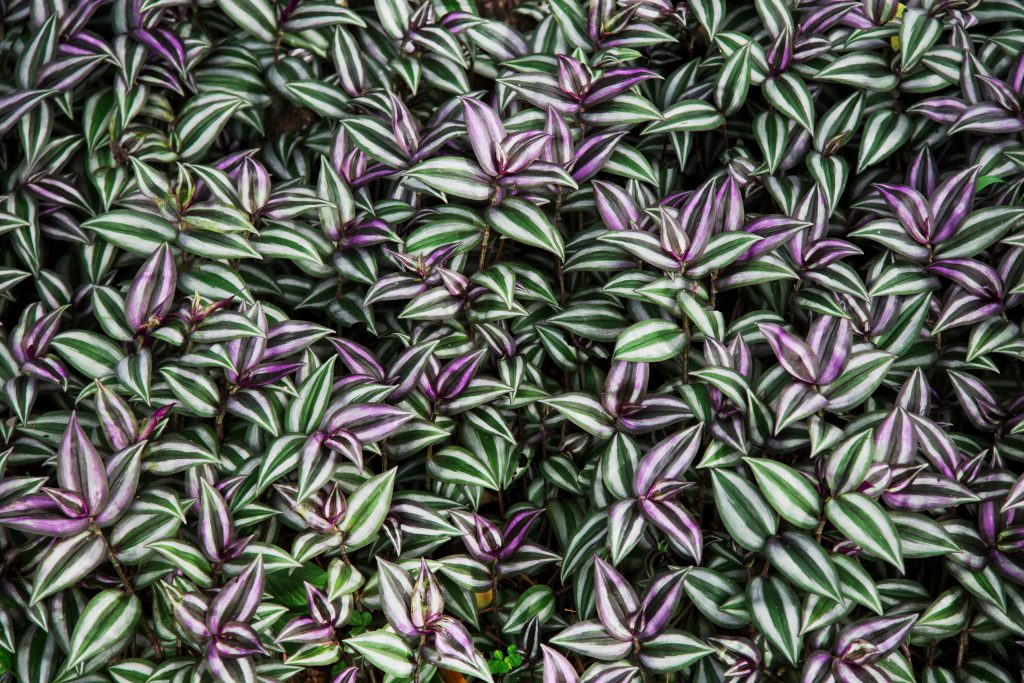 Wandering Dude/Inch Plant/Oyster Plant (
- There are many plants within the Tradescantia family that are listed as invasive (Tradescantia fluminensis, zebrina, T. spathacea.) This family of plants is known for their purple leaves, and while they are only listed as invasive in South Florida, they are a plant to keep an eye on if you have them in your yard. They are a trailing plant that spreads through seeds and propagates by fragments. Similar to Mother of Millions, when hand pulling this plant you want to ensure you remove the full plant, because any portion left behind can self-propagate into a new plant.
- A good alternative to Tradescantia sp. are native ground covers. You can check them out here: Low-Maintenance Landscaping: Groundcovers – UF/IFAS Extension Sarasota County
Mimosa/Silk Tree (Albizia julibrissin)
 Mimosa/Silk Tree (
- Mimosa/Silk Tree has distinct pink, fluffy, and fragrant pom-pom flowers that add a dash of color and texture to any landscape. Because this tree produces an abundance of flowers, it also creates a hefty number of seed pods. Each seed pod will naturally break open when they are most viable, and the seeds can fly or float away (if they land in a body of water). These trees can take over natural areas such as forests, or even vacant lots, if left unmanaged. With an Integrated Pest Management approach you always want to implement the least toxic methods first, but if that doesn’t work, there are chemical solutions to manage Mimosa Tree.
- Interested in replacing your Mimosa Tree with a different flowering tree? Check out this blog: Flowering Trees of Central Florida – UF/IFAS Extension Orange County

Chinese Wisteria (Wisteria sinensis)
-
- Chinese Wisteria has long clusters of flowers that can range from shades of purple to white. This woody vine can grow high up into a tree’s canopy, making it hard to manage. Over time, Chinese Wisteria can form dense canopies blocking light flow, and it can potentially girdle the tree it is climbing.
- If you are in North Florida and are interested in a similar plant, consider the native cultivar, American Wisteria (Wisteria frutescens) instead. American Wisteria can attract pollinators and is the larval host for silver spotted skipper and long-tailer skipper butterflies. This plant is suitable for USDA zones 8-9, and may not thrive in central and southern Florida.

Common Lantana (Lantana strigocamara)
- Lantana is another invasive shrub that is abundantly available at retail nurseries throughout the state. There are many cultivars of Lantana, but Lantana strigocamara is listed as invasive. It can often be confused for native or sterile cultivars, so it is important to ensure you know what you are purchasing. If a plant doesn’t have the scientific name listed on the plant, it is best to avoid purchasing. To learn more about native and sterile varieties of Lantana, you can check out this Gardening Solutions page.
- Common Lantana is easily spread by birds and can be troublesome when it makes its way to agricultural land or other natural areas. Common Lantana is also toxic to livestock, pets, and humans, which is yet another reason to remove these plants from your landscape.
This list only scratches the surface of invasive plants that can show up in Florida yards. For a more complete resource, explore the UF/IFAS Assessment of Non-Native Plants in Florida’s Natural Areas to see which species are listed as invasive, prohibited, or “plants to watch” for potential invasiveness. Be sure to read Part 2 of this series, where we cover additional invasive ornamentals including Tropical Milkweed, Britton’s Wild Petunia, Nandina, and Wild Taro/Elephant Ear—plus Florida-Friendly alternatives to consider for your yard.
 1
1