A Family Rooted in Agriculture
Nestled alongside the Suwannee River in Branford, Florida, Riverbend Farms spans nearly 200 acres that have been passed down through four generations, since 1865. Today, Kyle and Tera Kelley lead the operation, balancing full-time careers while dedicating themselves to preserving their family’s agricultural legacy. Their efforts are strengthened by the support of their children and extended family, each playing a vital role in the farm’s
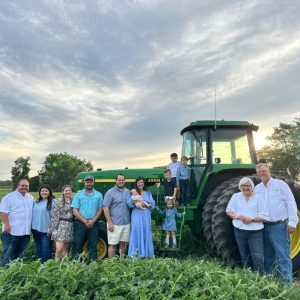
success. Kyle’s father, Kevin, oversees weed control and daily operations, while the kids pitch in by pulling nutsedge from the fields. Kyle’s brother, Kaleb, focuses on protecting crops from deer damage, and his sister, Katelyn, manages the operation’s bookkeeping, finances, pesticide and fertilizer applications, and food safety records. Katelyn’s husband, Trey, contributes on the marketing side as Chief Operating Officer of Melon 1, helping connect Riverbend Farms’ melons to consumers. Together, their teamwork allows Riverbend Farms to continue thriving and carrying on the family tradition.
Over the years, the farm has shifted from row crops to cattle to pine trees, but in 2025, the Kelleys made the leap into vegetable production by planting 45 acres of watermelons. This crop was part of a Controlled Release Fertilizer (CRF) demonstration program that not only offered cost-share incentives through a pilot program funded by Florida Department of Agriculture and Consumer Services, Office of Agricultural Water Policy and Suwannee River Water Management District, but also gave the family an opportunity to explore more efficient ways of managing nutrients and water. Working closely with UF/IFAS Extension agents, the Kelleys are embracing several modern farming practices while continuing to build on their family’s deep agricultural roots.
Learning and Implementing BMPs
Working with UF/IFAS Extension has introduced the Kelleys to a wide range of Best Management Practices (BMPs) that are helping them make informed decisions about crop fertility and irrigation. One key practice is the use of controlled-release fertilizer, which is a coated fertilizer designed to release nutrients gradually over time based on the crop stages, providing crops with a steady supply of essential nutrients. The nutrients released are available to the plants while the nutrients still inside the coating are protected from leaching. This helps reduce nutrient losses to the environment and ensures that plants receive the right amount of fertilizer throughout the growing season. For new or transitioning growers, CRF can simplify nutrient management by reducing the need for frequent applications, improving efficiency, and potentially increasing crop quality and yield. Because this fertilizer is less likely to result in nitrogen leaching, it also helps protect nearby water resources, an important consideration for farms along the Suwannee River and other sensitive water resources.

Soil moisture sensors are another critical BMP the Kelleys implemented. Introduced through UF/IFAS Extension programs such as Florida STEPS, these sensors use probes in the soil to monitor soil moisture levels in the root zone and send real-time data to the grower. This information helps farmers apply the right amount of water, conserving resources while ensuring nutrients move efficiently to the plants’ roots. For growers new to vegetable production, soil moisture data provides key insight into the relationship between water and nutrient availability, helping optimize fertilizer applications and plant growth while minimizing leaching.
The Kelleys have also taken advantage of petiole-sap testing, a type of tissue analysis offered by UF/IFAS Extension agents. These services provide a snapshot of the nutrients that are available to the plant in real time, helping the family fine-tune fertilizer applications that day, and during the growing season. By combining these tools with soil moisture sensors and CRF, growers like the Kelleys are able to make more precise, data-driven decisions about fertilizer timing and amounts, improving efficiency, reducing waste, and protecting water quality. The 2025 watermelon crop gave Riverbend Farms the chance to put these practices into action, with Extension staff supporting weekly field visits for sampling and monitoring plant health throughout the season.
Looking Ahead with Sustainability in Mind
Looking ahead, the family hopes to increase their watermelon acreage somewhat and even reintroduce cattle into a rotation of pasture, livestock, and crops. With their farm located near the Suwannee River, the Kelleys recognize that protecting natural resources must remain at the center of their plans. By blending their family’s long-standing farming traditions with modern agricultural practices, including CRF, soil moisture sensors, and plant tissue monitoring, the Kelleys are creating an operation that is both productive and sustainable, ensuring Riverbend Farms continues to thrive for generations to come.
Authors: Sydney Williams, Bob Hochmuth, and Taite Miller
University of Florida, Institute of Food and Agricultural Sciences; North Florida Research and Education Center – Suwannee Valley
 1
1