Even though daily deluges of Florida’s summer rains are in the rearview mirror, your lawn still can look lush, even with less water.
Irrigation accounts for more than half the average U.S. water bill, but you can preserve this precious commodity. What better place to start than your landscape, University of Florida Extension agents say.
Experts with the UF Institute of Food and Agricultural Sciences (UF/IFAS) recommend watering your lawn less often because turfgrass grows more slowly with shorter days and cooler temperatures.
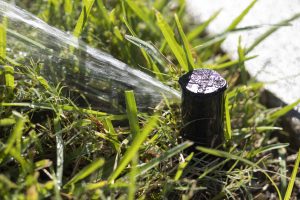
“This way, you are not just relying on the calendar to tell you it’s fall, but you can start paying attention to how your grass is responding to the change in temperature and length of day,” said Julie McConnell, a regional specialized horticulture agent for the UF/IFAS Extension Northwest District.
Specifically, apply about ½ to ¾ of an inch of water at a time when the grass shows signs that it needs water. How can you tell? Here’s one hint: If you can see a footprint in your lawn, it’s probably time to irrigate, UF/IFAS experts say.
“Ideally, let the plants tell you when it is time to irrigate,” said Don Rainey, water resources regional specialized agent for the UF/IFAS Extension Southwest District. “Look for visual signs — such as wilting — and probe the soil to determine sufficient moisture availability.”

Your irrigation frequency depends on many factors, including plant and turfgrass species, shade, fertilization and your location in Florida. For example, when weather conditions are conducive to actively growing turfgrass, typically from mid-spring to early fall, lawns generally need regular irrigation if rainfall is inadequate.
The UF/IFAS Gardening Solutions website says watering appropriately often will encourage the roots of your grass to grow down into the soil. Deep roots help turf survive stress such as drought.
That makes winter an excellent time to walk your property and inspect your irrigation system, Rainey said. Taking the time now will help you prevent over-watering, and you will help sustain plant health and protect the environment.
Rainey also advises residents to calibrate their irrigation systems. That will help conserve water by maintaining appropriate water volume.
Looking a few months ahead to this winter, Jackie Lebouitz, the chemicals in the environment agent for UF/IFAS Extension Sarasota County, points to “Skip a Week” as another way to preserve water.
This initiative by the Southwest Florida Water Management District encourages residents to consider skipping the occasional week of irrigation during fall and winter.
In Southeast Florida, during the fall and winter, lawns typically require only one inch of water per week, thanks to cooler temperatures and reduced evapotranspiration – the combined process of water moving from the land to the atmosphere as vapor (from soil and water) and transpiration (from plants).
“Our South Florida soil drains quickly, but that doesn’t mean your lawn needs more water,” said Laura Vasquez, urban horticulture agent for UF/IFAS Extension Miami-Dade County. “During this time of year, one deep soak a week is enough to keep roots strong and conserve our most precious resource – water.”
UF/IFAS research says about half of Floridians are unaware of water restrictions in their area. Extension agents encourage you to check with your water management district.
###
Para accesar a esta comunicación en español, por favor utilice el siguiente enlace.
ABOUT UF/IFAS
The mission of the University of Florida Institute of Food and Agricultural Sciences (UF/IFAS) is to develop knowledge relevant to agricultural, human and natural resources and to make that knowledge available to sustain and enhance the quality of human life. With more than a dozen research facilities, 67 county Extension offices, and award-winning students and faculty in the UF College of Agricultural and Life Sciences, UF/IFAS brings science-based solutions to the state’s agricultural and natural resources industries, and all Florida residents.
 1
1

