Florida’s strawberry fields may look vibrant and abundant this time of year, but beneath those glossy leaves, a quiet battle is raging. At the very moment growers hit peak production, two long-established but relentless adversaries surge onto the scene: the twospotted spider mite and the chilli thrips.
These tiny pests don’t just nibble at profits – they can overwhelm plants in tandem, draining vigor, deforming fruit and leaving farmers staring down the possibility of losing more than half their crop.
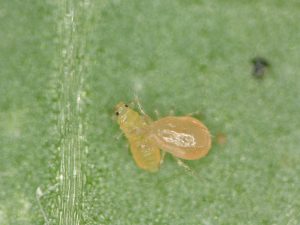
Growers usually use sprays to try to control the pests, but both bugs are growing increasingly resistant to most common pesticides, said Sriyanka Lahiri, an assistant professor of entomology at the UF Institute of Food and Agricultural Sciences (UF/IFAS).
“Farmers urgently need information regarding feasible solutions such as predators that can eat both these pests,” Lahiri said. Protection against pests is critical for the $500 million-a-year Florida strawberry industry.
New USDA-funded, UF/IFAS research has uncovered good news for strawberry growers as they try to prevent the bugs from damaging their crop.
The predatory mite known as Neoseiulus californicus feeds on both the twospotted spider mite and chilli thrips, according to the study. Allan Busuulwa, a doctoral student in Lahiri’s lab at the UF/IFAS Gulf Coast Research and Education Center (GCREC), led the study at GCREC.
Busuulwa conducted a series of laboratory-scale tests, using petri dishes as feeding arenas to release prey species and predatory mites. He also trained undergraduate student Abigail Campos Gutiérrez to record their interactions and feeding rates.
“Neoseiulus californicus can feed effectively on both these pests, therefore, it offers a single solution for managing both pests,” Busuulwa said.
If strawberry growers release this predatory mite, it will reduce their need to use pesticides to control the mite and the thrips, Lahiri said.
“More specifically, this study will empower Extension agents and crop consultants with scientific backgrounds to recommend the release of this specific predatory mite species,” she said. “There are several predatory mite species commercially available, but we have limited information about their host range. As a result, it often becomes overwhelming for growers to decide which predatory species to release in their fields.”
Lahiri sees the new research as a helpful step as strawberry growers battle chilli thrips and the twospotted spider mite.
“This helps farmers produce more of the strawberries that consumers love to eat, growers can help preserve the environment and save money by using less chemical spray,” she said. “Using an augmentative biocontrol agent like this predatory mite will also slow down the pesticide resistance development in thrips and spider mites.”
Chilli thrips, found globally, but particularly in Asia and the southeastern United States, feed on all above-ground parts of the strawberry plant. The twospotted spider mite, another global pest, originated in Europe and Asia. Like chilli thrips, it has migrated to the United States.
###
ABOUT UF/IFAS
The mission of the University of Florida Institute of Food and Agricultural Sciences (UF/IFAS) is to develop knowledge relevant to agricultural, human and natural resources and to make that knowledge available to sustain and enhance the quality of human life. With more than a dozen research facilities, 67 county Extension offices, and award-winning students and faculty in the UF College of Agricultural and Life Sciences, UF/IFAS brings science-based solutions to the state’s agricultural and natural resources industries, and all Florida residents.
 0
0

