An invasive grass found on almost every continent and considered a pest in 73 countries isn’t just weeding out native plants, it is creating a haven for disease-carrying ticks and raising public health risk concerns.
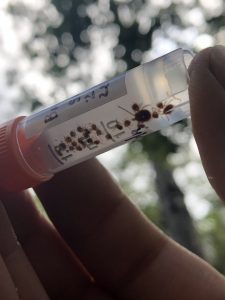
A new University of Florida study, published recently in Ecology, demonstrates how cogongrass, an invasive grass common across the Southeast United States is enhancing tick survival. Researchers at UF’s Invasion Science Institute (ISI) found that lone star ticks, a species common in the Southeast and known to bite humans, survive more than 50% longer in areas dominated by invasive cogongrass than in native plant communities.

Photo by ISI
“The direct effects of invasive plants are well known, but these finds show that invasions can also indirectly impact human health by prolonging tick survival” said Luke Flory, professor and associate chair of the agronomy department at UF’s Institute of Food and Agricultural Sciences (UF/IFAS) and director of the UF Invasion Science Institute (ISI).
Longer tick survival means more opportunities to feed on hosts like deer, and more opportunities to spread disease to people and wildlife.
Click here to find out more about this pivotal research.
###
By Lourdes Mederos, rodriguezl@ufl.edu
ABOUT UF/IFAS
The mission of the University of Florida Institute of Food and Agricultural Sciences (UF/IFAS) is to develop knowledge relevant to agricultural, human and natural resources and to make that knowledge available to sustain and enhance the quality of human life. With more than a dozen research facilities, 67 county Extension offices, and award-winning students and faculty in the UF College of Agricultural and Life Sciences, UF/IFAS brings science-based solutions to the state’s agricultural and natural resources industries, and all Florida residents.
ABOUT ISI
The mission of the University of Florida Invasion Science Institute (UF/ISI) is to facilitate interdisciplinary research that advances our understanding of the causes and consequences of invasive species; generates innovative approaches to reduce invasions and their impacts on natural, agricultural, and urban systems; and train the next generation of invasion scientists. UF/ISRI has over 190 affiliates and collaborators with a variety of backgrounds and expertise.
invasionscience.ufl.edu | @invasionscienceuf
 0
0

