Written by Jake Rosner, 2025 undergraduate summer intern hosted by Dr. Marc Hensel of the UF/IFAS Nature Coast Biological Station (NCBS)
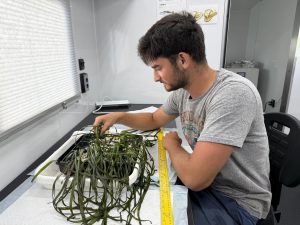
About My Summer
Seeking a career in researching marine ecology, I applied to be a Nature Coast Biological Station intern to gain experience and mentorship in studying our natural world. What I have seen and learned during this past summer has exceeded my already high expectations. I work on a daily basis with the Hensel and Thomas labs here at NCBS on a wide variety of projects. While in many ways I am a research assistant, helping to set up experiments and collect data, I also act as an independent researcher. I ask original questions, make careful observations in the field, figure out unique ways to solve problems we encounter, and seek out conclusions based on the knowledge I have been taught. And of course, I am also a member of a team. This means taking care of equipment, organizing our lab’s gear, and making sure the mobile lab is protected from the many pounds of mud working in the marsh brings in.
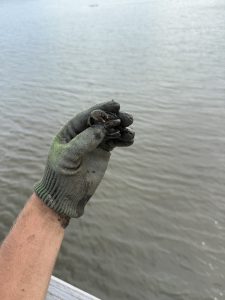
Everything and Everywhere
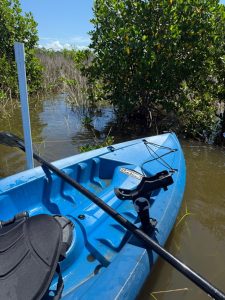
The term “variety” can’t be understated when describing my experience this summer. I have worked in salt marshes, oyster reefs, and seagrass beds with species ranging from red mangroves to marsh periwinkle snails. Modes of transportation have included boats, kayaks, and walking across dense fields of marsh grass. On the first day of the internship, I already began setting up a snail+bird exclusion experiment on an oyster reef, and I have set up another 5 experiments since that one. Productivity is never lacking at NCBS, and my internship has placed me at the forefront of learning about the unique coastal ecology of Cedar Key during the busiest field time of the year.
What I Have Done and What I Have Learned
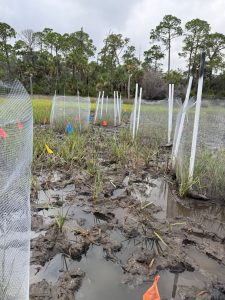
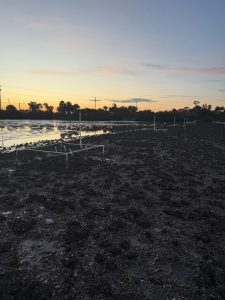
Many of the experiments I have worked on are exclusion experiments, which are designed to exclude certain variables from a plot in order to assess how those variables impact dependent variables, such as vegetation growth or invertebrate density. Examples of these experiments are excluding birds and snails from oyster reefs to assess the impact on oyster growth and excluding crabs and snails from marsh to examine impacts on grazing. Designing and collecting data from these experiments has taught me amazing things about the ecology of the environments we work in, many of which are observations that may have been previously unknowns. Do snails get predated more heavily in mangroves than in marsh grass? Will crown conchs of different sizes react differently to changing tides? The more observations I make, the more questions I have. Oftentimes the original questions behind the experiment will turn into entirely new ones halfway through.
An experiment I have especially taken the lead in is our ongoing tethering experiment. We are using tethers, baits tied to fixed objects, to measure how structural complexity in different habitats (ie differing seagrass lengths, oyster cover, marsh/mangrove dominance) affects predation pressure. I have prepared the tethers, deployed them, and collected data in the field, and interesting results are already appearing. For instance, noticeable differences in predation rates between baits and differing impacts of complexity on bait consumption. I am looking forward to continuing to grow and develop this rewarding research.
In addition to the experiments I have been involved in, I have learned many practical skills this summer. I have learned to trailer a vessel, to tie a bowline knot, and how to create efficient data sheets among other things. I also have learned, from my many mentors, the creative and open-minded thought process of an ecologist. Perhaps the most fascinating knowledge I have gained is how complex and multifaceted the marine ecosystems and organisms we work with really are.
Special Thanks
At NCBS, I work with many different people from a variety of career backgrounds, ranging from professors to graduate students to fellow interns. This team-based environment has really allowed me to maximize what I have learned, and everyone involved has been extraordinarily friendly, helpful, and passionate about the work we do. I would like to give a special thanks to Marc Hensel, Alex Walus, Shea Husband, and Miranda Mays for guiding me through this internship and being excellent mentors. I would also like to thank my fellow interns, Madison Konash and Amelia Gomez Uribe, for learning and working alongside me during this amazing experience.
| Follow the link to learn more about the UF/IFAS NCBS Undergraduate Summer Internship program. Read more intern blogs here. |
Featured image credit: UF/IFAS Photo by Tyler Jones
 0
0