What is a derelict trap?
Florida hosts numerous recreational and commercial fishing opportunities. These include trap-based fisheries, which use structures made of wood or plastic to attract and trap shellfish species such as lobster and crab. These traps are required to be marked by a surface buoy, indicating their position on the seafloor and making it easy for the fisher to locate. For a number of reasons including hurricanes and boating activity, these traps may lose their marker buoys or be moved around, leading to their becoming lost and perhaps derelict.
A trap is considered derelict if still in the water during the closed season, or if in the water during the open season is missing two or more of the following: surface buoy, line, current Florida Fish and Wildlife Conservation Commission (FWC) trap tag, or current fishing license (FWC 68B-55.001).
Why are derelict traps a problem?
Derelict traps present two major impacts:
1) Ghost fishing, when the trap continues to catch both target and non-target species. Fish and invertebrates can enter the trap and become stuck inside, limiting their ability to feed which can lead to mortality. Ghost fishing can have negative impacts on fisheries species (Butler & Matthews 2015, Matsuoka et al. 2005).
2) Habitat destruction. For example, commercial spiny lobster traps are constructed of six wooden sides with a cement slab that weighs about 50 lbs. If the traps become derelict and remain in the water, they can move around during high wind or wave events, causing injury to coral reefs and seagrasses (Chiappone et al. 2005, Uhrin 2016, Uhrin et al. 2014). Th 50-lb cement slab (called ballast) can crush reef-building stony corals and other sensitive organisms.

Photo: National Park Service/Sarah Van Hoene
What can be done about derelict traps?
Derelict traps are a challenging management issue. Most fishers do not want to lose their traps, but sometimes, traps become derelict despite all best attempts to prevent this phenomenon. It is important to recognize that it is illegal to tamper with or remove any traps, whether they are thought to be derelict or not. If you spot a trap that you think is derelict, please take a GPS coordinate and call 1-888-404-FWCC to report it.
Removing derelict traps is a permitted activity through FWC. The Derelict Trap and Trap Debris Removal Program works with authorized organizations and groups to remove traps and trap parts, following specific criteria. Additional permits may be required depending on whether the proposed removal is to take place in a local, County, State or National Park.
What are we doing about derelict traps?
For many years, I have partnered with Biscayne National Park (BNP) to perform underwater derelict trap removals. Performed on SCUBA, this delicate process entails careful underwater analysis of the trap/parts, especially during the fishery’s open season. If the trap is decided to be derelict, we carefully extract the trap and attach lift bags to it, sending the trap up to the surface. Team members on the boat will remove the trap from the water, placing it and any associated debris on the boat and capturing all relevant data. Any usable parts are salvaged, otherwise, the debris is disposed of upon return to land. Late in 2024, I received a grant from the Virginia Institute of Marine Science to continue this critical derelict trap removal work in BNP. The project commenced earlier this year and I’m looking forward to seeing the results.
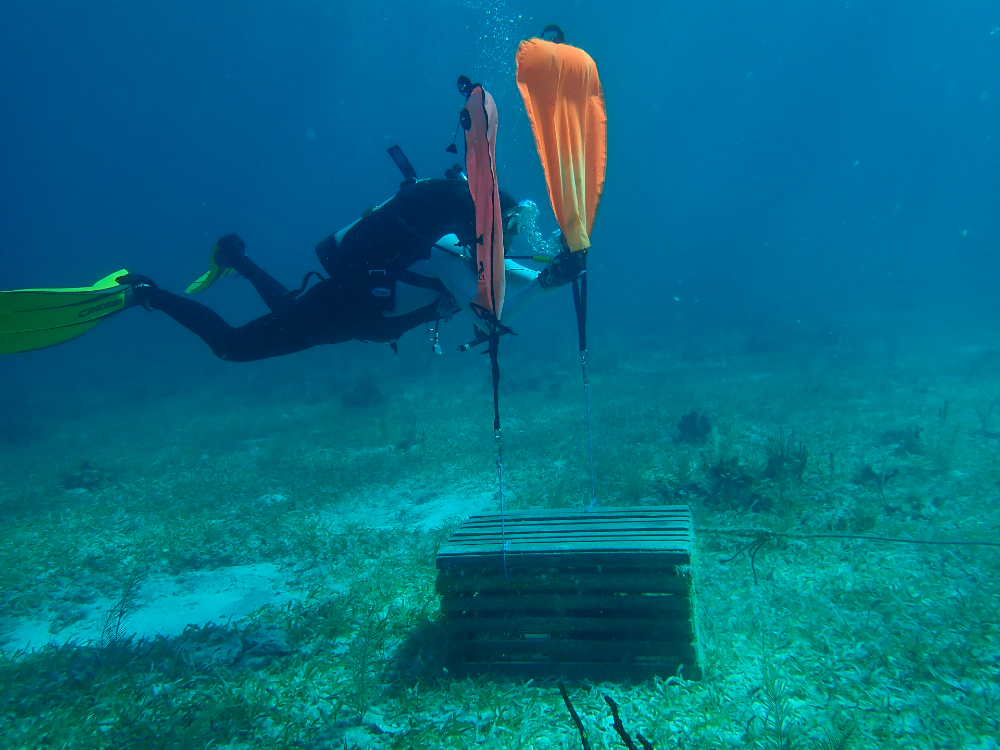
Photo: University of Florida/Delaina Ross
For more information on the FWC Derelict Trap Removal Program, go here.
References
Butler, C., Matthews, T. 2015. Effects of ghost fishing lobster traps in the Florida Keys. ICES Journal of Marine Science, 72, p. i185-i198.
Chiappone, M., Dienes, H., Swanson, D., Miller, S. 2005. Impacts of lost fishing gear on coral reef sessile invertebrates in the Florida Keys National Marine Sanctuary. Biological Conservation, 121, p. 221-230.
Florida Fish and Wildlife Conservation Commission (FWC) definitions: https://flrules.org/gateway/RuleNo.asp?title=TRAP%20RETRIEVAL%20AND%20TRAP%20DEBRIS%20REMOVAL&ID=68B-55.001, Florida Administrative Code 68B-55.001
Matsuoka, T., Nakashima, T., Nagasawa, N. 2005. A review of ghost fishing: scientific approaches to evaluation and solutions. Fisheries Science Research, 71, p. 691-702.
Uhrin, A. 2016. Tropical cyclones, derelict traps, and the future of the Florida Keys commercial spiny lobster fishery. Marine Policy, 69, p. 84-91.
 2
2