Ryan Cantrell, an undergraduate student at the University of Florida’s Institute of Food and Agricultural Sciences (UF/IFAS) in the College of Agricultural and Life Sciences, hasn’t been spending his summer soaking up the Florida sun. Instead, he has been hard at work as a summer intern at the Indian River Research and Education Center (IRREC) in Fort Pierce, Florida. Under the supervision of Assistant Professor Liliana Cano, Cantrell has been learning the intricacies of citrus greening, a devastating bacterial disease spread by the Asian citrus psyllid that has crippled Florida’s citrus industry, reducing production by more than 90% since its first detection in 2005.
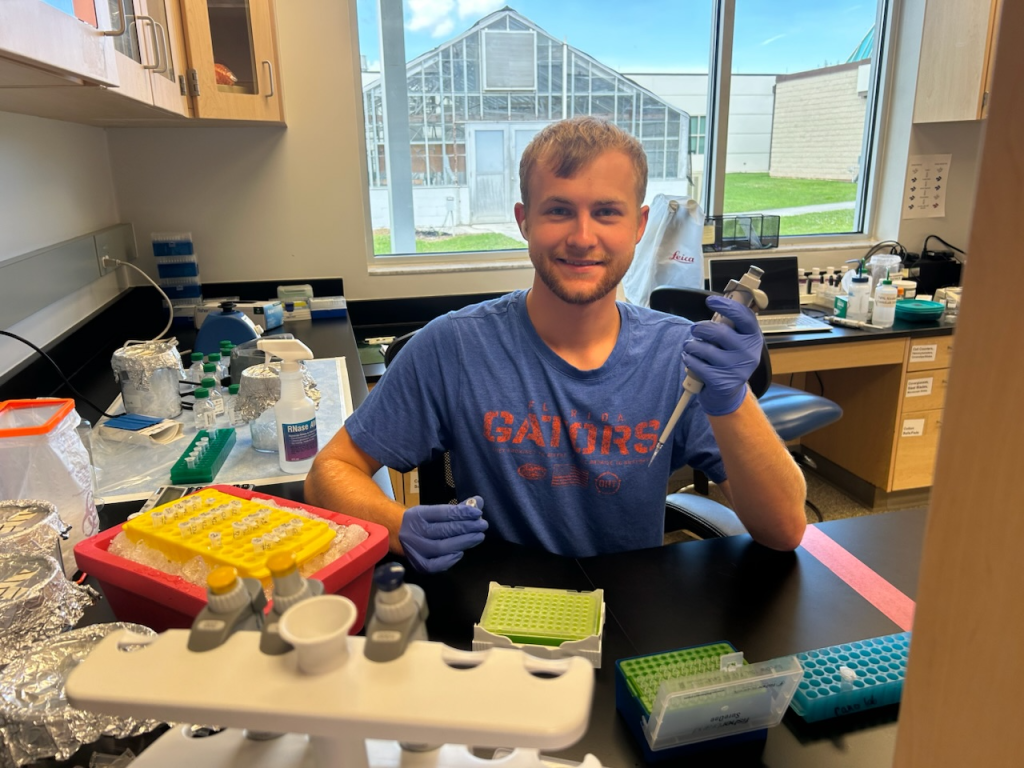
Under the guidance of Biological Scientist Edinson Diaz, Cantrell has been blending his classroom knowledge with hands-on training in the Plant Pathology laboratory at IRREC. At IRREC, Cantrell contributed to field and lab efforts by collecting citrus leaves from candidate tolerant rootstocks through projects supported by the National Institute of Food and Agriculture (USDA NIFA) and the Emergency Citrus Disease Research and Extension Program (NIFA-ECDRE). These samples were used to monitor Candidatus Liberibacter asiaticus (CLas), the bacterium responsible for citrus greening, through DNA-based molecular detection methods.
Cano’s lab focuses on applying genome-based tools to develop improved diagnostics and innovative disease management strategies. Her primary research targets economically important crops in Florida, particularly citrus affected by bacterial citrus greening and fungal diseases impacting grapefruit fresh fruit production.
“In the Cano Lab, Cantrell used with key microbiology and molecular biology techniques, including DNA extraction from infected leaf tissues, DNA quality assessment, gel electrophoresis, quantitative polymerase chain reaction (qPCR) and gene expression data analysis. His results suggest that several of the evaluated citrus rootstocks showed no detectable presence of CLas.
To build on these findings, follow-up studies using root tissues, along with greenhouse and field material, will be carried out in the lab. This promising project aims to advance the development of citrus greening–tolerant rootstocks for nursery production in the United States, Cano said.
I’m pleased to have a highly motivated undergraduate intern who recognizes the importance of citrus to our region and understands how his work in the lab can support growers in the long term,” Cano said. “IRREC is proud to foster young researchers and train the next generation of problem-solvers.”
A microbiology and cell science major, he is also pursuing two minors in Spanish and bioinformatics. Demonstrating a strong commitment to expanding his research skills, he has sought opportunities across wet-lab work, field studies and computational analysis through past internships in the UF/IFAS Department of Horticultural Sciences and in the Department of Biological Sciences at Florida Atlantic University (FAU). His initiative and dedication earned him the 2025 Summer Undergraduate Fellowship awarded by the College of Agricultural and Life Sciences (CALS).
Cantrell’s hard work extends far beyond the classroom and lab: Throughout his high school and college years, he’s spent about 740 hours volunteering. Going forward, he hopes to take his experience back to his hometown of Jupiter, Florida, and maybe savor a glass of grapefruit juice while he’s there.
###
ABOUT UF/IFAS
The mission of the University of Florida Institute of Food and Agricultural Sciences (UF/IFAS) is to develop knowledge relevant to agricultural, human and natural resources and to make that knowledge available to sustain and enhance the quality of human life. With more than a dozen research facilities, 67 county Extension offices, and award-winning students and faculty in the UF College of Agricultural and Life Sciences, UF/IFAS brings science-based solutions to the state’s agricultural and natural resources industries, and all Florida residents.
 0
0