Summer vegetable-garden weeds can be a problem for gardeners. It’s too hot to check weed growth every afternoon. And we really only have a few vegetable plants which will survive the heat of a Florida summer. Deciding to let the garden beds go fallow for the summer of 2022, I watered the stronger perennial herbs and ignored the spent vegetable beds. A good cover crop would be great, if I only had the time.
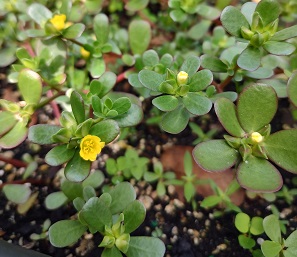
The Happy Accident
In early July, 2022, I discovered a “happy accident” in my garden. It was not the spent jalapeno pepper plants nor the lettuces from which I wanted to save the seeds. These vegetables were ready to be pulled. I kept putting off the task till evening or early morning when it would, hopefully, be cooler. Several days of afternoon thunderstorms hindered my evening gardening. Early Saturday morning I finally headed out to conquer the task. And I noticed a happy accident.
My old beds of spent vegetables had been taken over by a highly nutritious, drought tolerant, beautifully blooming batch of tasty, tender young greens. I did not plant these greens, nor did I fertilize or water them. These plants volunteered, showing up all on their own. Enjoyment of these free, healthy, organic delicacies was made more so for their will to flourish. This plant thrived in the full hot summer sun and copious rainwater. And there was enough of this vegetable for two different culinary preparations.
By now you’re asking, “What is it and where can I get some?”
This nutrient dense food plant which sowed itself into my garden and waited to sprout till the veggies were expired is… Purslane, Portulaca oleracea. The Latin name alone has culinary meaning. Port meaning “gate” referring to the seed covers and oleracea meaning “kitchen vegetable”. This Plant is common all over Florida and may even be found in parks, roadsides, neighbor’s yards, parking lots, and sidewalk cracks.
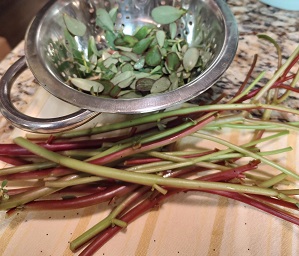
Purslane
Purslane is highly nutritious and even contains Omega-3 fatty acids and antioxidants. This ubiquitous herb has been prized all over the world as a panacea, or “cure-all”, for hundreds of years. And no wonder. The plant is high in vitamins A and E, with high levels of many important and necessary minerals for human health.
Eating Purslane
And purslane tastes great! The flavor is much milder than many of the summer greens. All parts of the plant are edible. I use purslane leaves as I would use fresh spinach in salads, smoothies, stir-fries, and omelets.
To add purslane to an omelet, saute a few mushrooms (if you like them) or chopped onions in a bit of coconut oil. Add the washed fresh purslane leaves to the pan once the mushrooms are golden, right before adding the beaten eggs to the pan. When the eggs are just about ready, lightly sprinkle with sea salt and ground black pepper and serve. It is my favorite breakfast on a July Saturday morning, with a side of fresh mango, of course.
Pickled Purslane
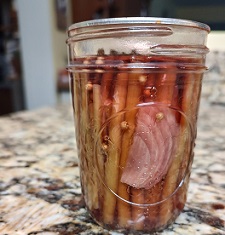
While I was trimming the purslane leaves off of the stems for use in my omelet, I set the stems aside to pickle them later. The purslane stems are cut into 2-inch long pieces and packed into a couple of sterilized, half-pint canning jars. I add some slivered red onions to fill in any gaps, packing them in tightly. Pour the hot, homemade pickle brine over the fresh stems in the jar. I then seal each jar with a canning lid and ring, and water-bath can them by boiling for 10 minutes. My brine will be vinegar and water, lightly seasoned with honey and spices for a pickle just the way I like it. There are many variations of this recipe on the internet.
Getting to know your weeds
The University of Florida Institute of Food & Agricultural Sciences (UF/IFAS) Electronic Data Information Source (EDIS) has a 2024 publication entitled, “Purslane: The Reigning Champion of Vitamins A and E among Vegetables and a Potential Crop for Home Gardens”. It is available on the Ask ifas website.
Years ago, after reading about edible purslane on a blog called, “Eat the Weeds“, I got very excited. This website by “Green Deane” is a wealth of very detailed botanical information on edible plants. I had not really thought there were Florida weeds which I could eat. His website of the same name, eattheweeds.com, highlights the wonderful abundance of wild edibles, and seasons of availability, and is very organized by topic. “Green Dean” Jordan published his book, Eat the Weeds, in 2023. This handy reference book is full of nutritional charts and details on 274 edible plants. It is available online where books are sold.
Foraging wild edible foods has been an interest of mine for most of my life. However, as a child, that interest usually revolved around peppermint gone wild and the sweet alpine strawberries, Huckleberries, and blackberries which were abundant in the summer in the woods where I grew up. What child doesn’t know a good sweet when it catches them by the sleeve? But I had never thought about eating the leaves of the weeds in my yard.
NOTE: Never eat anything from the wild unless you can positively identify it as the correct edible species.
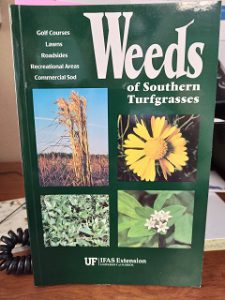
The book, Weeds of the Southern Turfgrasses, by the University of Florida Institute of Food & Agricultural Sciences (UF/IFAS) Extension, is a good resource to positively identify most of our common Florida lawn weeds. Though this book will NOT tell you if a plant is edible, it has detailed photos of how these plants look in the Florida lawn and roadside for identification purposes.
What is a WEED?
But what is a weed? A weed is a “plant out of place”. Basically any plant which is where it is not wanted is a weed. My not-plant-loving husband would consider rose bushes and Bouganvillia to be weeds. However, my volunteer Purslane is definitely wanted.
Want to collect purslane from your neighborhood? Here are a few things to consider:
- Ask permission first if you want it from a property that is not your own
- Take purslane from a place where no chemicals have been sprayed or spilled
- Be sure no dogs or cats use the space where it is growing
- Do not take purslane from the edge of a busy road– carcinogenic tire leachates, exhaust fumes, cigarette butts, oil, and leaking automotive coolant are all common toxic chemicals along roadsides. Plants may take these toxins into their tissues, negatively affecting the healthfulness of your freely foraged vegetables.
Purslane Care
A bit of knowledge: When we apply only nitrogen fertilizer to plants we get more leaf growth and no flowers. This is desirable for turfgrass, and leafy green vegetables. This is NOT something we want when we grow flowers and fruits. However, This is exactly what we want when grow leafy green vegetables for their leaves. A bit of nitrogen fertilizer during the growing season will give your purslane more leaves and will prevent them from “bolting”, flowering too soon. Although purslane as a weed needs very little care to thrive, it should be fertilized with a bit of Nitrogen for more leaves and less flowers if you want to eat the plant.
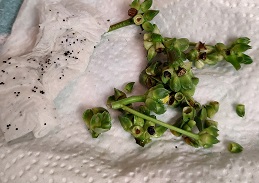
If you can only find purslane plants near a busy roadside, consider taking just the seed capsules home and planting them in your garden. You may have to wait till next summer to see it grow enough to harvest some leaves. Don’t worry, purslane seeds can remain viable in the soil for 2 to 4 years. The progeny of your rescued vegetable will come up every year once you have them established with no more effort than it took to crush the seed capsule over your soil (see photo, above, right for size of capsules and tiny black seeds on the left in that photo). It may be worth the time to get to know this and other free edible weeds vegetables in your neighborhood, or in your own back yard. They might just surprise you for lunch. And may my fellow neglectful gardeners have many such pleasant surprises.
If you would like to learn more about canning your own pickles, please, do your research. The best place to start for beginners is the National Center For Home Food Preservation website. This site is the go-to place for all fully-researched home canning information.
UF/IFAS Extension research based publications on related to edible weeds:
- “Purslane: The reigning champion of Vitamins A and E among vegetables and a potential crop for Home Gardens“
- “Common Poisonous Weeds and Invasive Plant Species in Florida Residential Landscapes”
 11
11