Gabriella Dickinson, our student spotlight, is a fourth-year Ph.D. student in the Plant Molecular and Cellular Biology (PMCB) program at the University of Florida. Working in Dr. Gilles Basset’s lab, she studies the biosynthesis of prenylated quinones, compounds involved in photosynthesis and cellular respiration that also play a role in stress tolerance and human nutrition. In this Q&A, Gabriella talks about her path into plant science and her current research.
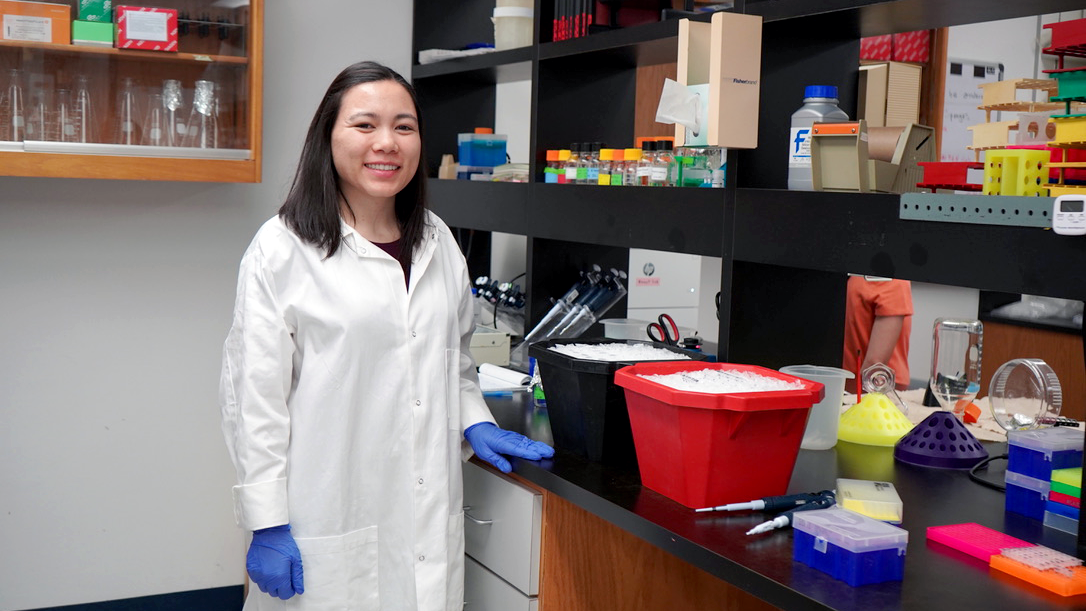
What led you to pursue a Ph.D. in Plant Molecular and Cellular Biology and where are you now in the program?
I did science extracurriculars in high school, and I knew I liked biology and chemistry, so I ended up majoring in biology at the University of Alabama. At the time, I wasn’t sure exactly what I wanted to do with my degree. I just knew I enjoyed biology and wanted to develop that further. I had a sense that I might want to pursue something beyond a bachelor’s, but I didn’t know if that meant taking a pre-professional track or doing research.
Eventually, I decided I wanted to go into research. I kept thinking about what I wanted to study, and I ended up settling on plants, which was kind of surprising to me, because I had never really considered it before, and my university didn’t have any plant-focused programs. But I chose plants because they seemed like a sustainable solution to a lot of the problems I was noticing, especially around pollution and other environmental issues. I also saw a trend where people were searching for more natural or sustainable alternatives to things like medications, materials, and so on. It seemed like a field where I could use what I like – biology – and apply it to something useful.
I’m finishing my fourth year now in the PMCB program, so I’ll be in my fifth year in the fall. I’m hoping to graduate this December.
I’d really like to have a teaching component to my job. That was actually one of the reasons I wanted to pursue a Ph.D. – because I enjoyed teaching so much during undergrad.
What is your research focus and contributions to Dr. Basset’s lab?
We study a class of molecules called prenylated quinones. These are electron carriers used in photosynthesis and cellular respiration, and they’re also strong antioxidants. We’re interested in how plants make them, which was largely unknown until the past ~20 years. Work in our lab has contributed to this.
These molecules are nutritionally important like phylloquinone, which is vitamin K1. Plants are the source of that. Ubiquinone, also known as coenzyme Q or CoQ10, has become more popular recently as a supplement because of its antioxidant properties. Prenylated quinones are also thought to support stress tolerance in plants. There’s interest in bioengineering these molecules in crops, but for a long time the biosynthetic pathways weren’t understood well enough to do that. That’s why we’re working on it.
My project builds on work from a former postdoc who studied a step in prenylated quinone biosynthesis involving a methyltransferase. This methyltransferase acts on several different quinones, but she noticed that in photosynthetic organisms, like plants, there’s a version that specifically avoids acting on a quinone called plastoquinone. That’s important, because if it did act on plastoquinone, it would produce a toxic molecule that interferes with photosynthesis. This substrate specificity only occurs in photosynthetic organisms.
Our lab used that discovery to help develop a new herbicide and algaecide called duroquinone, which was recently patented. It works by poisoning photosynthesis, so it’s specific to plants and algae, like those in water systems, but doesn’t significantly affect other organisms.
My project is about digging deeper into how this substrate specificity evolved. I’m looking at the molecular features in the protein that prevent it from acting on plastoquinone, and how those features might have developed in earlier organisms like cyanobacteria. This work could help inform the design of more targeted enzymes or biotechnologies in the future.
What impact could this deeper understanding of enzyme behavior have for plant science?
It’s mostly about gaining a better understanding of how proteins choose their substrates, like how they “decide” what to act on. We hope that knowledge can be applied to other proteins. For this project, I’m especially focused on how this function originated in cyanobacteria, and how it developed into what we now see in plants.
What do you find most fascinating about your area of research?
Understanding how things function at the molecular level is really interesting to me. I like that we get to find things that are totally new. It’s exciting to discover something that no one’s identified before and figure out how it works. The ultimate goal is to generate new solutions and apply this knowledge.
What are some of the biggest challenges?
Working with proteins has been one of the biggest challenges for me. Predicting what makes a protein active or inactive is surprisingly hard. Even if you have the sequence and structure, the protein might not be active when you make it. We just don’t have a reliable way to predict that yet.

Have you had any cross-disciplinary or collaborative experiences during your time at UF?
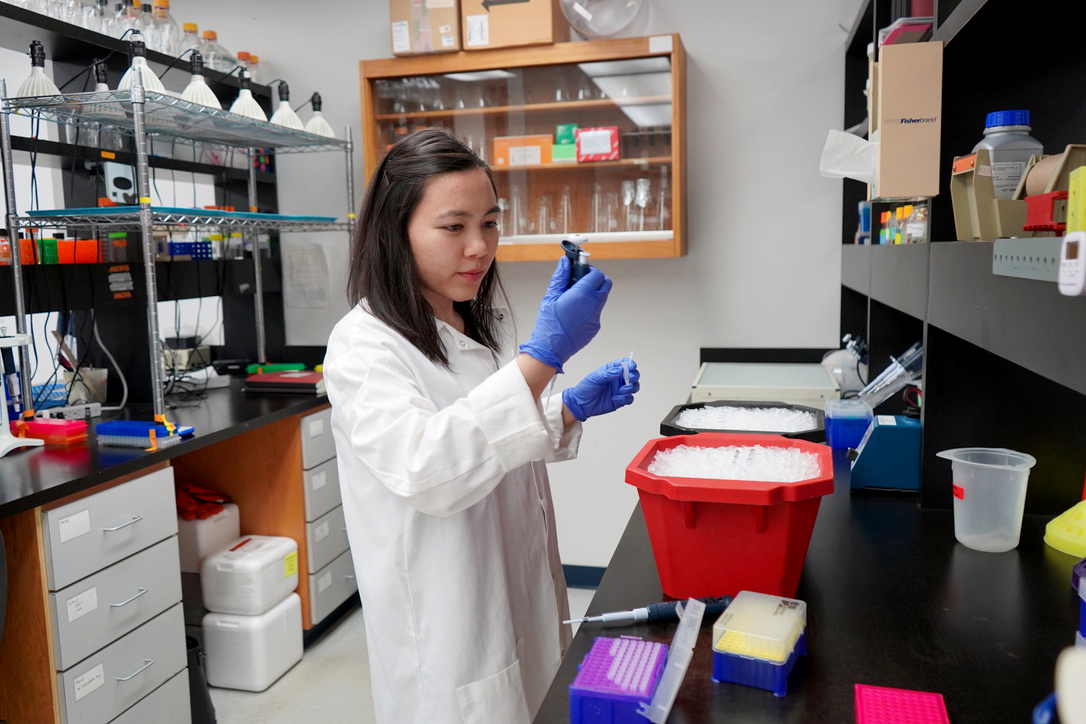
We’ve collaborated with other universities like the University of Nebraska–Lincoln and UCLA. Both of those collaborations are with groups that study proteins from different angles. It’s been really helpful to work with people who do different types of protein work and to learn from their expertise. Right now, we’re collaborating on a paper – sort of going back and forth helping each other with different parts of the project.
We’ve also collaborated with Dr. Jeongmin Kim’s lab, the Biochemical Genetics Lab here at UF. We both study phenylpropanoids, so there are areas where our work intersects, particularly in ubiquinone and flavonol biosynthesis. In plants, about 20% of ubiquinone is derived from a flavonol called kampferol so the two pathways influence each other. So there’s definitely some shared ground between our labs.
Do you think synthetic biology will play a bigger role in plant improvement in the future?
Yes, I think so. In general, I’d love to see synthetic biology applied to help with environmental challenges, especially to improve sustainability and reduce agricultural and industrial pollution. I also look forward to the day when we develop AI that can more accurately predict protein function, not just structure.
What advice would you give to students interested in plant biology or biotech?
It’s okay if you don’t know exactly what you want to do when you start out. There are so many directions you can take, so just try things and follow what you’re drawn to. Even if you start a project and realize it’s not for you, that’s fine – people change projects all the time. You can always go in a different direction later, even during a postdoc. Just be open and flexible and focus on gaining skills.
 2
2