It can be a tough gig to get anglers on board with new fishing policies, and fishery management is lousy with such examples, but that’s not the case with the Florida Friendly Fishing Guide (FFFG) program.
The journal Ocean & Coastal Management recently published a study authored by researchers with the UF School of Forest, Fisheries, and Geomatics Sciences (SFFGS), UF/IFAS Extension, the UF/IFAS Nature Coast Biological Station and Florida Sea Grant that shows success at increasing “short-term objective knowledge and self-reported confidence and knowledge” among fishing guides participating in the program.
Program participants also came away feeling they had more influence in the direction of current and future fishery management decisions.
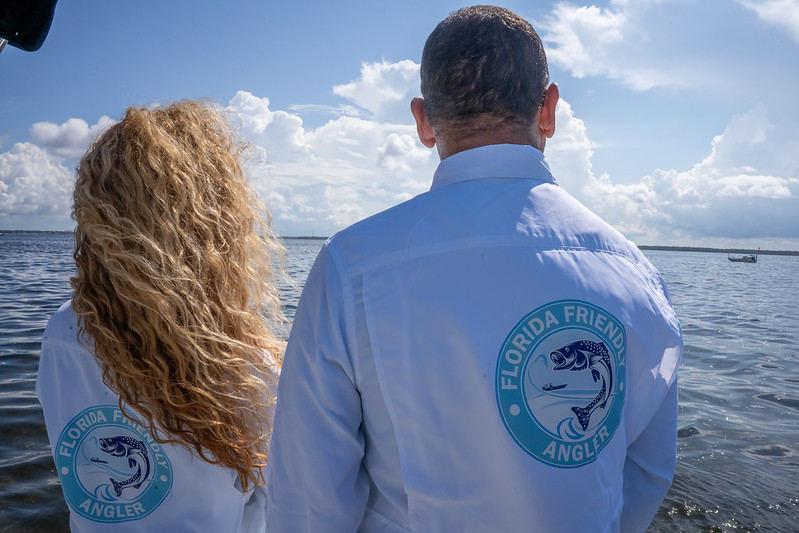
By engaging and making progress with opinion leaders, the idea is that these best practices will filter down to the average recreational angler. An effort to do that, the Florida Friendly Angler program, spun off from the FFFG program in 2022. Demonstrating that perhaps the success did translate over, the FFA received the 2024 Superior Outreach Programming Team Award from the Sea Grant Extension Assembly.
“I think the results affirm the value in fisheries education programs and demonstrate how such programs may positively alter expert knowledge, confidence and, potentially, willingness to engage in management,” said Will Casola, Ph.D., a former postdoctoral research associate within SFFGS. “The hope would be that these positive attributes and actions are then passed down to their clients, expanding the positive impact of the program. However, we didn’t specifically investigate that phenomenon.”
The FFFG program first put its lines in the water in 2019, so with some years behind it, there was an opportunity to measure its effectiveness.
“We thought the best way to study the program’s effects would be assessing outcomes in two ways,” said Savanna Barry, Ph.D., a coastal ecosystems extension agent with the Nature Coast Biological Station. “First, assessing longer term — 1-3 years — fishing guide attitudes, confidence, and knowledge gain within the group of guides who took the program, and second, assessing similar metrics for guides who had completed the FFFG program against a set of guides who had not.”
The need for FFFG, and later FFA, came from the knock-on effects of actions by recreational anglers who may not be properly informed of the best methods of fishing and handling fish.
“Recreational fishers often release captured fish whose post-release mortality largely depends on handling …, they can directly affect ecologically important aquatic habitat like seagrasses, salt marsh grasses, and riparian areas when operating vessels or fishing from shore …, and they can influence the broader environment via behaviors that may exacerbate invasive species spread or pollution …,” according to the study.
Prior research revealed that “influencing recreational fisher opinion-leaders may be particularly effective because fisher behaviors — and the mental models behind them — have been shown to be sensitive to perceived group norms….”
In assessing the effectiveness of the FFFG program, study researchers found 90% of participants reported higher confidence and 93% reported higher knowledge.
People can pursue certification in the FFFG program or FFA program by visiting the Florida Sea Grant website. If you’re not sure or would like to read more, check out posts by Barry on the FFFG and what it’s like to fish with a certified FFFG program guide.
 1
1