Stewardship involves caring for something today and ensuring it remains curated for future generations.
In urban forestry, it can involve how we responsibly manage our trees with sustainability in mind. Sustainability involves maintaining an equitable balance between broader economic, social, and environmental goals.
Among our membership at the UF/IFAS Urban Forestry Extension Council (UFEC), we’ve been talking about stewardship a lot over the past year. One of our members, Duval County Extension Agent Larry Figart, shares with us how he helps foster a stewardship mindset in his community.
Meet the expert: Larry Figart, UF/IFAS Duval County Urban Forestry Extension Agent
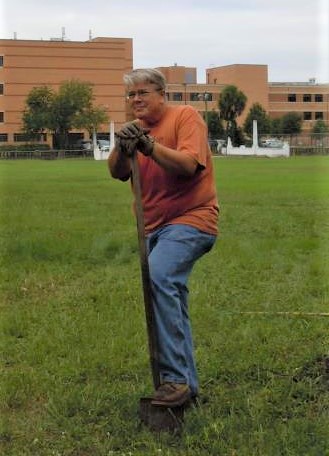
Figart graduated from the University of Florida. He began his forestry career as a forester/ranger with the Florida Division of Forestry.
After 19 years, he became a senior forester. And in 2004, he joined UF/IFAS Extension.
Figart plans, delivers, and evaluates educational programs in urban forestry, arboriculture, natural resources, and horticulture in Duval County.
Through his programs, Figart works with Master Gardener Volunteers to improve proficiency in tree care and maintenance as well as public education. He also provides tree care education to residents and landscape professionals and works to increase overall natural resource awareness and education.
Creating stewardship groups to support urban forestry
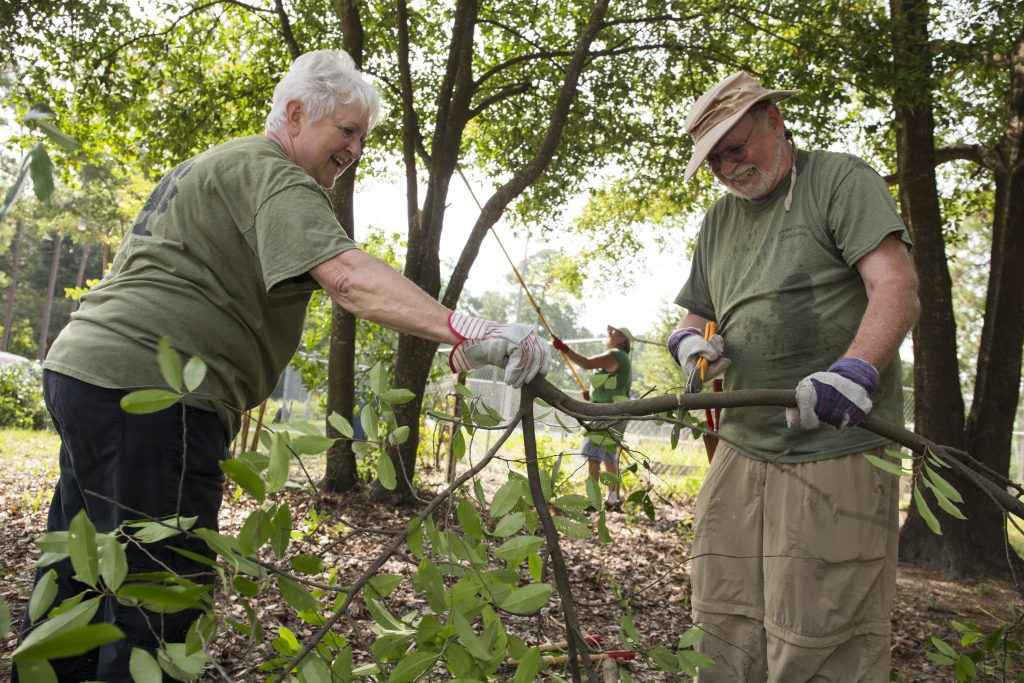
A big part of Figart’s work involves training Master Gardener volunteers as Duval County Volunteer Tree Stewards. For 11 years, this special group has worked on pruning smaller trees in Duval County parks twice a month.
Figart, along with volunteers, has completed 160 workdays performing structural pruning on over 4,500 trees in Jacksonville’s parks.
“The Duval County Tree Stewards have improved public safety in public parks and increased the likelihood that the trees will grow structurally sound by removing or mitigating defects,” he says.
How stewardship can address the big issues
Figart tells us that one challenge for urban forestry is the growth of urban sprawl. It can be difficult to balance and preserve the benefits of urban tree canopies while promoting urban growth. But research demonstrates there are ways to integrate trees into our cities to help make them more livable and sustainable.
Just including more trees is not always enough, however. Providing support for tree care, especially young tree care, can ensure that trees survive after planting—research shows this can be achieved through collaborations with communities.
Stewardship, like the work done by Figart and the Duval County Volunteer Tree Stewards, can greatly improve conditions and outcomes for urban trees, allowing them to mature and provide benefits such as cooling communities, helping to manage stormwater, and providing habitat for other species.
Getting others involved
Beyond tree care and maintenance activities, stewardship involves educating others. It includes creating a bridge that connects trees and their benefits to everyone in the community, including those who see themselves as uninvolved.
For Figart, stewardship, “Would not only include careful and responsible management, but also ‘the latest science’, [and relating the] urban forest to the inhabitants that live there.”
Larry sees this as an opportunity. “When folks ask me why I do what I do, I often answer, ‘because I think trees can save the world’.”
Larry shares the importance of building awareness about urban forests and urban forestry.
“While that may seem pretty naive, I firmly believe that the societal, health, and environmental benefits provided by trees can help to make communities a better place,” he said. “If explained properly and in a way that most folks can understand, there is a huge opportunity to get the general public to understand those benefits as well. When they value the urban forest, they can elect public officials to do the same.”
It is also important to ensure that urban forestry programs are equipped to plant trees but also have the resources necessary for long-term management of those trees, too.
Volunteer Tree Stewards – our local superheroes
Tree stewards are an asset to communities. They are knowledgeable and accessible to local populations. To support tree stewardship across Florida, UFEC is preparing to publish a manual that increases statewide awareness and engagement with urban forestry and urban trees, public knowledge about urban forestry, and improves public understanding of the benefits of trees for Florida’s communities. Look for that later this year.
Figart says anyone can be a good volunteer tree steward.
“The key is to recognize how to bring out the different strengths that they can use to help the program.” He said.
“For instance, I have a volunteer who can do magic with a pole saw, and I have another who helps by keeping track of attendance and participation of the group.”
Figart tells us that when community stewardship groups are involved in urban forestry management, they can help impact public perceptions and actions surrounding trees.
“I see that they start to see trees as living things, and we have management options that can irreparably harm the urban forests, or they can support sound urban forestry practices that sustain and promote a healthy urban canopy.”
When he isn’t out teaching or working with volunteers, you might find Figart hiking or going overnight camping.
Resources to learn more about Tree Stewardship:
Learn more about how to set up tree stewardship groups for Extension here: https://edis.ifas.ufl.edu/publication/WC489.
There are organized Tree Stewardship groups all around the United States. An example of a group that inspired Figart’s work is the Virginia Tree Stewards.
Learn more about Figart and his programs here: https://sfyl.ifas.ufl.edu/duval/lawns-gardens-and-trees/arboriculture-and-tree-care/
To stay up -to-date on the latest from the UF/IFAS Urban Forestry Extension Council, including more about tree stewardship, subscribe to the UFEC newsletter, Canopy Connections, or visit our website.
 1
1