During the summer months, proper greenhouse maintenance is essential to protect facilities, conserve resources, and keep systems operating efficiently. Whether a greenhouse is actively supporting research or temporarily vacant, routine care can help prevent costly repairs and extend the life of the facility. To gather practical insights, I reached out to FPO team members Jon Lanhart and Tom Otto for their recommendations on key summer greenhouse maintenance practices. With their help, I put together a short greenhouse maintenance checklist.
Review Environmental Controls Regularly
Greenhouse control systems should be reviewed monthly to ensure temperature settings, ventilation schedules, and other programmed conditions remain appropriate. “When a greenhouse is not actively in use, setting the temperature to approximately 95-105°F can help reduce unnecessary energy consumption while still protecting the facility,” advises Jon Lanhart, Maintenance Superintendent.
Keep the Greenhouse Clean
While it may seem obvious, regular cleaning is one of the most effective ways to prevent pest and disease issues. Remove debris, keep benches and floors clean, and control weeds both inside and around the greenhouse to maintain a healthy growing environment.
Monitor Water Systems
Frequently inspect water hoses, fittings, and irrigation equipment for leaks or damage. Water quality can also impact greenhouse operations
Depending on the water source and local conditions, mineral deposits may accumulate on irrigation equipment and greenhouse components over time. Users should also be aware that municipal water typically contains chlorine, which may contribute to corrosion of certain metal components. To help minimize potential damage, avoid unnecessarily wetting greenhouse walls and structural elements during irrigation.
Maintain Cooling Systems
Wet wall (evaporative pad wall) cooling systems should be inspected routinely and treated with appropriate algae-control products to prevent biological growth that can reduce efficiency and shorten equipment life. However, before applying any biocide treatment, greenhouse users should ensure that the selected product will not interfere with ongoing research activities or experimental outcomes.
Check Fans and Ventilation Equipment
Ventilation fans are critical during Florida’s hot summer months. Inspect fans regularly for signs of wear or corrosion. Aluminum fan components are often preferred because they provide greater resistance to rust and corrosion in humid greenhouse environments.
Use Realistic Temperature Setpoints
To better understand cooling performance, the FPO conducted a seven-day study in May 2022 comparing three common greenhouse cooling systems: swamp coolers, evaporative end-wall coolers, and air conditioning. All three systems cooled greenhouses to approximately 71–75°F during the early morning hours, but temperatures increased rapidly after sunrise.
During the hottest part of the day, swamp coolers maintained temperatures between 95–110°F, while evaporative end-wall coolers maintained 92–110°F. Air-conditioned greenhouses performed best, averaging 80–90°F with peak temperatures of 95°F during extreme heat.
These findings highlight the importance of setting realistic temperature targets that reflect the capabilities of each cooling system, helping reduce unnecessary energy use and equipment strain. Periodic review of these settings can improve system performance and help avoid unnecessary energy costs.
Schedule Periodic Deep Cleaning
Pressure washing greenhouse surfaces, walkways, and equipment can help remove dirt, algae, and other buildup that accumulates throughout the year, improving both appearance and functionality.
Inspect Unused Greenhouses Regularly
Even when a greenhouse is not actively being used, periodic inspections are still recommended. According to Tom Otto, Maintenance Supervisor, unused greenhouses should be inspected semiannually to ensure the facility remains in good condition.
A proactive maintenance approach during the summer helps keep greenhouses reliable and prepared for future research projects.
Greenhouse Maintenance: Roles and Responsibilities
To help strengthen collaboration between FPO and our units, we have created a brief overview of greenhouse maintenance responsibilities. The slide below outlines which maintenance activities are the responsibility of FPO, which are managed by the unit, and which may require collaboration between both parties.
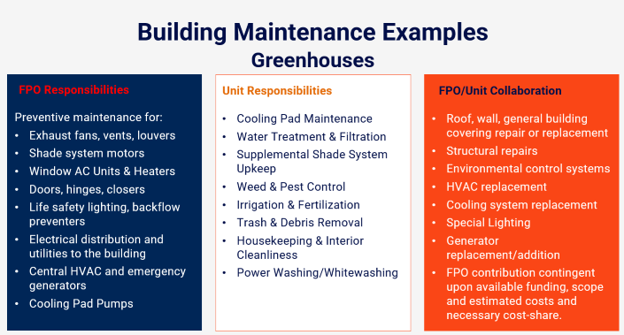
Because every situation is unique, these guidelines should be considered a general reference. If you have any questions or are unsure who is responsible for a particular issue, FPO staff are available to provide guidance and assistance.
To submit a Work Order, click HERE.
 3