There are diseases in the landscape that are spread by the very tools that we use to take care of them.
When we prune out diseased limbs and branches we could be moving the disease from sick plants and spreading it to healthy plants. In this article we will discuss some of these diseases as well as how to clean our tools.
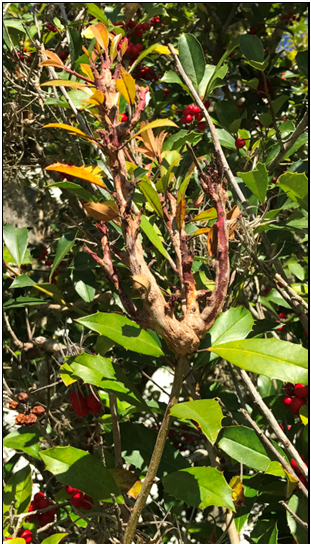
Image credit: Larry Figart UF/IFAS
Sphaeropsis Gall is a disease that has been slowly increasing in our landscapes. It is a disease that affects hollies. The reason for the increase is not that the disease is changing, it is that we are starting to use more and more holly in the landscape. Most of our hollies are susceptible. The disease is first noticed when the leaves at the end of branch tips turn yellow. Then as the disease progresses the branches start to become thicker than the surrounding tissue. In advanced cases a witches broom forms on the diseased branch. Eventually, the diseased branches will die. While this disease can be spread naturally with rain splashed spores, transmission from tree to tree can be reduced by ensuring our pruning tools are clean.
Fusarium wilt in Queen and Mexican Fan Palm was first noticed in Northeast Florida around 2008. It is a devastating disease that can kill a seemingly healthy palm in a few weeks. The symptoms start in the lower fronds and quickly move up the crown until all the fronds are dead. The disease is so quick, the palms often look “freeze dried”, meaning the dead fronds do not droop. Like Sphaeropsis Gall, this disease can naturally spread as spores are carried on windblown rain. However, it typically is spread within landscapes through the use of contaminated pruning tools. There have been many instances where a homeowner looses all of their Mexican fan, or queen palms within six to eight weeks of pruning them. Using clean equipment is key to keep from spreading this disease.
The fungi that causes Botryosphaeria Canker is considered an opportunistic fungi. That means it looks for the “opportunity” to affect a stressed or weakened plant. It is typically described as a weak pathogen. Think of it as the predator that looks to take out the old and diseased plants. So the best way to prevent it is to keep our shrubs and trees healthy and vigorous. Part of that is to prune out any diseased branches. However, if we do not sterilize our tools, we run the risk of spreading this fungus to healthy portions of the plant.
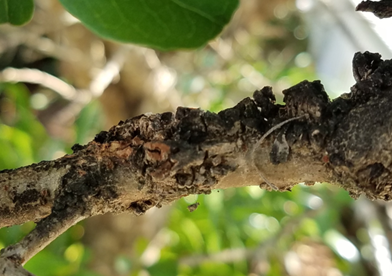
Image credit: Dennis Hamilton, Phillips Garden Club
Other diseases that are commonly spread by infected pruning tools include fire blight and tobacco mosaic virus.
So far we have read about why sterilize pruning tools, now we will discuss the how.
There have been several studies to determine what works best. Diluted alcohol, a 10% bleach solution, trisodium phosphate, and Lysol all work well. One of the studies also found that Lysol was least corrosive and bleach was most corrosive. The method that is recommended is to have a small bucket of solution nearby and two pruning tools. Alternate pruning tools, leaving one to soak, and switch them when moving to the next plant. Some folks carry spray bottles with the solution in it spraying the tools between cuts. By disinfecting our tools we can avoid spreading disease in our landscape.
Article written by Larry Figart, Urban Forestry Agent, Program Coordinator, April 2023
 2
2