As afternoon storms are now a regular occurrence, many thoughts turn to the trees around our home. You may be wondering if they are safe, or if they can hold up against the wind of a thunderstorm, tropical storm, or even a hurricane. Hopefully these questions and answers will help you figure out the best course of action in preparing your trees for storms.
I am worried about my tree falling in on my house, who should I call to determine if my tree is a risk?
Usually, I leave this question to answer last as a summary but let’s be honest, it is what most folks concerned about their tree want to know. Most property damage from trees during storms occurs because of some sort of failure in the structure of the tree. A periodic tree inspection by an ISA Certified Arborist with the Tree Risk Assessment Qualification (TRAQ) is recommended. The TRAQ designation means the arborist has completed training and passed both a comprehensive written exam and a performance-based assessment. To maintain the qualification, the arborist must retrain and retest every five years. To search for an arborist with the Tree Risk Assessment Qualification go to: https://www.treesaregood.org/findanarborist/arboristsearch and look for the arborists with the Tree Risk Assessment Qualification credential.
What things should I look for when scouting my tree?
When you are out in your yard, look up. Take note of any large dead branches. Major deadwood over any structure is an immediate concern. The type of branch attachment is also important. Take a look at how the branches are attached to the trunk. If the attachment of the branch looks like a “V” rather than a “U”, it is a weaker branch attachment. Double trunked trees are especially prone to failure. The reason “V “shaped branch attachments are a problem is because bark gets imbedded or included in the joint and weakens the attachment.
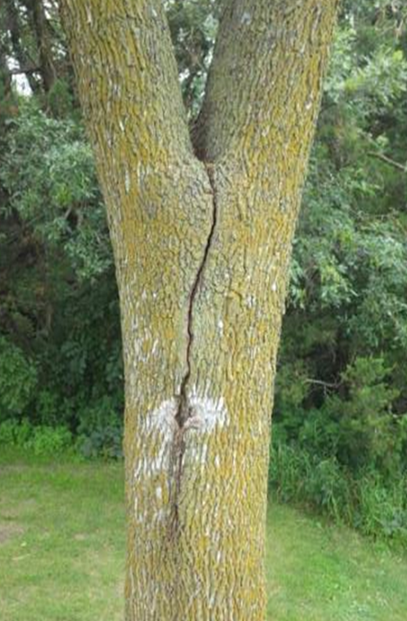
Image by L. Figart
Trunk defects are a little harder to detect than branch defects
The most obvious type of trunk defect is a cavity. Large cavities with decay should be inspected. Any vertical crack in the trunk of the tree that goes deep into the wood of the tree is a warning sign of structural problems and any horizontal crack is a sign of imminent trunk failure. Any mushroom or mushroom like fruiting structure coming out of the trunk of the tree is a sign that the tree has internal decay. If you have cavities, mushrooms, or cracks in the trunk of your tree, the tree should be inspected by a tree professional.
I am concerned it will blow over, what should I be looking for?
The first thing to consider is whether your tree has enough root space to anchor itself in the ground. Assuming a soil depth of at least 3 feet, a small maturing tree will need at least 100 (10’ x 10’) square feet of rooting space, a medium size maturing tree will require 400 (20’ x 20’) square feet or more of rooting space and a large maturing tree will need at least 900 (30’ x 30’) square feet or more of rooting space.
Most root defects can be detected with a little inspection
The part of the root system that bears most of the load in holding the tree up is the root flare. If you picture the tree as a wine glass, the root flare is like the base of the wine glass. The root flare should be readily visible. Many trees have had their root flares covered by soil during construction activities. Mulch volcanoes are formed when mulch is piled over the root flare and against the trunk of the tree. Both situations are bad for the tree because it buries the roots and promotes disease. It also makes inspection of the root flare difficult. If the root flare of your tree has been covered by soil, or mulch, it is important to uncover it for a proper inspection.
As with trunk defects, look for any cavities at the base of the tree, or mushrooms originating from the base or roots of the tree as a sign of possible root decay
Any damage to the root flare by construction, or other means, is a cause for alarm. Recall the wine glass analogy and imagine how unstable the wine glass would be if part of the base were gone. An ISA Certified Arborist should be called in to inspect the tree if any problems with the root system are suspected.
Are there wind tolerant trees?
Between 1992 (Hurricane Andrew) through 2007, the University of Florida studied the damage to trees in urban areas by hurricanes. According to the study, the trees demonstrating the highest survival were American Holly, live oak, southern magnolia, sweetgum, crape myrtle and sabal palm. The trees that had the least survival rates include tulip poplar, spruce pine, sand pine, and southern red cedar. Making a decision for a tree to remain or be removed based solely on its species should be used with caution. There is no such thing as a risk-free tree. In addition, local considerations such as soil, cultural practices, tree age and health, and other urban forest health conditions need to be considered. This publication may be helpful: https://edis.ifas.ufl.edu/publication/FR174.

susceptible to wind damage
Image: L. Figart UF/IFAS
How should I have my tree pruned to make it more wind tolerant?
How your trees are pruned is just as important as if they are pruned. A recent study by the University of Florida looked at how trees handled hurricane force winds. The study showed that properly pruned trees had considerably less damage than unpruned and improperly pruned trees. It used to be said that you should thin the canopy so that the wind blows through the canopy. However, this type of pruning is no longer recommended. The latest research has shown that improper pruning (over lifting and over thinning the crown through the removal of large lower limbs and interior branches) resulted in more damage to the tree during windstorms. Properly pruning trees by using reduction cuts and structural pruning resulted in trees that resisted wind and therefore received less damage.
There is no way to completely eliminate the risk of a tree falling and causing damage in a storm
With regular inspection of your landscape, homeowners can significantly reduce the risk by identifying defects in their trees and taking care of them before they become a problem. More information of trees and storms can be found on the University of Florida “Ask IFAS” website at https://edis.ifas.ufl.edu/entity/topic/trees_and_hurricanes.
Article written by Larry Figart, Urban Forestry Agent, Program Coordinator June 2023
 2
2