Every transformation begins with a question. For me, it started with a thought: What if a forgotten piece of land could come back to life?
From this question, a vision began to take root.
There was a garden along the west side of the FLREC Campus, near UF/IFAS Extension office in Broward County. I pass by that place every day. I often found myself wondering whether this wasteland overgrown with tall bromeliads and ferns could be transformed into something more purposeful.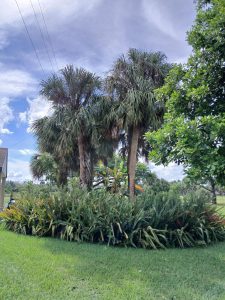
The Thinking Game
It sat unused for quite some time, quiet, overlooked, yet full of potential, right there in front of me. What started as a simple conversation about restoring a wild area with edible plants soon evolved into a fascinating Food Forest project. There was no clear plan at first. Only the need to create a place to sit, relax, enjoy the sunset, and watch plants grow. That desire quickly became stronger than anything else. What followed was not just a landscaping project. It was a journey from silence to balance, music, then an intense and passionate colorful life. Something born out of curiosity, and a deep respect for nature’s resilience.
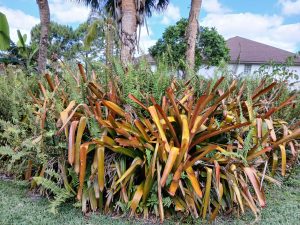 From a distance, the area appeared as nothing more than a jungle of overgrown bromeliads and a dense mass of ferns. Rising above this sea of vegetation were five sabal palms. Reaching them on foot was nearly impossible, due to the very large armed bromeliads. A rhomboid arrangement formed by four of the palms immediately flashed new ideas. I could use the shade they formed for an understory that could flourish in shade. Getting closer, I spotted also a few pink tabebuias and gumbo limbos that were volunteering in the area and were growing nicely and undisturbed. On the far west side of the garden, a fiddlewood grew with sweetly fragrant flowers, surrounded by butterflies and other pollinators.
The Challenge
But butterflies were not the only friends around this area. Underneath, hiding between the thick leaves of the bromeliad foliage, were the biggest enemies I had encountered: iguanas. They made my project way much more difficult to accomplish. But, I realized that this time spent studying their behavior gave me the opportunity to understand what kind of diet they have, and their food preferences.
The Plan
 My initial plan was ambitious: relocate as many of the bromeliads as possible. I wanted also to assess soil conditions, and determine what plant species could thrive in a revitalized garden. The goal was to rescue and reuse every viable plant found in what I referred as the “Wasteland,” giving each one a second chance elsewhere.
But as the project unfolded, it became clear that the scope of this plan far exceeded the time available. Progress was limited to a handful of Saturdays and lunch hours between July 2024 and October 2025 (Date of the actual completion). Despite these limitations, significant results were achieved. Most of the bromeliads were successfully donated. Along with them, six gumbo limbo trees, each approximately five feet tall, and ten young pink tabebuia trees found home somewhere else. Many of these volunteer plants were relocated to my HOA’s landscape, where they have since established and serve as a positive addition to the property landscape.
Moving Along
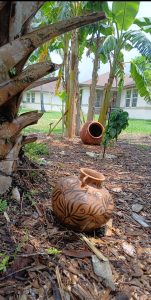
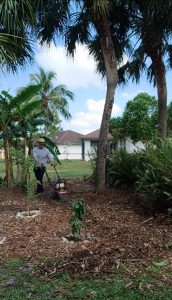 The first phase focused on clearing one side of the project area. I tilled the soil with our little gas powered tiller (small but powerful). I also added new soil (after realizing how sandy the actual soil was) and started the big adventure of collecting as many edible food forest plants as possible. Then great ideas came to mind. I could have added a water structure or a unique decoration. Creativity was taking its place in mind.
As the last bromeliads were finding new homes and the soil was turned for future planting, the “wasteland” had slowly begun its transformation. This space now has a new chance to give something back. Standing there, I realized that it was only the beginning of a journey with much more to offer than only plants. Each tree or new plant brought a cultural meaning. A deep connection with the past, and each feature added to the food forest could provide connection with native cultures.
The evolving Food Forest held many challenges, stories, and lessons beneath its surface.
Part 2 will dive into those next steps including how we shaped its structure, battled the unexpected, and began to see the true “Wonderland” emerge. Wait for it.
To learn more about a Food Forest, check out also this other interesting blog: Cultivating a Food Forest in Your Yard – UF/IFAS Extension Highlands County
 15
15



Comments:
January 24, 2026
Excellent project! I want to congratulate you for caring so much about plants and landscapes. Your idea is inspiring, I will share it at my workplace, it takes many villages to save the planet :- )
August 14, 2025
This is awesome!! I've had the privilege to have worked with Mr brown through out his career for the city of plantation ( 34 yrs). His passion and hard work speaks volumes, he is god given to anyone that comes in contact with him!!! .
April 29, 2025
Thank you, Sherma! I will bring you some seeds, I promise.
April 29, 2025
Beautiful Blog Donna the flower is beautiful.
March 3, 2025
Thank you, Rose, and for all the hard work you have done over the years to make this event a success.
March 3, 2025
Nice job Donna!
May 12, 2023
Thanks, Doug! I loved your YouTube movie! Well done.
May 12, 2023
Thanks, December! We really have to change our thinking about what is acceptable in turf. We can't keep dumping fertilizers and chemicals on the land. We are not only poisoning the environment, but also our own health due to polluted drinking water.
May 12, 2023
PERFECT thought for our times!
May 12, 2023
Yea, good stuff. See my YouTube video on this topic, with emphasis on Florida snow, Richardia: https://youtu.be/srscVpv6cJI
October 12, 2022
Hi Donna, I enjoy your blog is excellent! I also had the fortune last year to get one of these delicious fruits from your yard. It was a challenging process as I had never had one before. You are right, the flavor is a combination of pineapple, banana, and coconut. What a fantastic combination ah? Thank you for sharing! Laura
September 9, 2022
Thank you! It has been a blessing overall. Still, I will miss driving by that beautiful tree...
September 9, 2022
We did loose a treasured tree but we do treasure our new friends and learned a lot about maintaining healthy trees.
August 25, 2022
Thank you! It is an amazing tree. Plant your seedling in a one gallon pot and when it's grown into it, transplant it into the ground in a suitable location if you can. It's worth the wait.
August 25, 2022
I loved your piece on Jaboticaba. I recently tasted the fruit for the first time and was immediately in love. I was able to acquire a small seedling but fear it will be several years before I enjoy the fruit.
May 11, 2022
Thank you for your comment!
May 11, 2022
Thank you!
April 13, 2022
This is really good information!!! Thanks for sharing this!!! https://www.cambialtd.co.uk
April 12, 2022
I like this article it has a lot of info I want to know, thanks for collecting this important info in this article
April 6, 2022
Thank you, Laura!
April 6, 2022
Thank you for your comment.
April 5, 2022
Thank you for your article! It mentions all the talking points for us to consider as we age.
April 4, 2022
Excellent information to share with my participants, adults & seniors. Many of our adults are caregivers of their elder loved ones and with these tips, they can be more energy-efficient helpers. Thank you, Brenda. LNS
February 22, 2022
That's my goal! Thank you, Laura.
February 18, 2022
Thank you so much, Donna. Excellent information! I have been hurting my loquat tree over the years :( I hope the damage is not that big that he can heal. I really enjoy this article, short but rich in knowledge.
February 2, 2022
Thank you, Salvatore! Please let us know if there is a topic of interest you would like to see more information about. Best Wishes in 2022!
February 2, 2022
Hi there! Very nice content and blog, I found it very informative and useful, hope to read more nice articles like this one around here, Keep sharing the best content, Best regards and take care! Your follower Salvatore
January 24, 2022
Thank you for the sensible critique. Me and my neighbor were just preparing to do a little research about this. We got a grab a book from our area library but I think I learned more clear from this post. I'm very glad to see such wonderful info being shared freely out there.
January 23, 2022
Great blog! I am loving it!! Will come back again. I am taking your feeds also.
January 23, 2022
Thank you for your feedback and supporting UF/IFAS Extension on our "Provide for Wildlife-Series". We feature 4 blogs per year on this topic and I am already working on our next one to be released next month! Stay tuned. Have a wonderful week and stay safe.-Lorna B.
January 23, 2022
As I website possessor I believe the content matter here is rattling wonderful , appreciate it for your hard work. You should keep it up forever! Good Luck.
January 12, 2022
Thanks, Charlie! Hope all is well with you as well. Happy 2022!
January 12, 2022
Thank you for the feedback, Janine; I really appreciate it.
January 12, 2022
Nice article Donna. Thanks for sharing this important and often forgotten information about how the seasons, even in South Florida, affect plants.
January 12, 2022
Hi donna, Great facts about our planet that many people are not aware of. Wishing you a new year filled with love, good health and prosperity!
January 4, 2022
Thank you, Rose! Happy 2022!
January 4, 2022
Happy New Year Donna! This is a great article, very informative and interesting.
January 3, 2022
Thank you! I hope that you have a very blessed 2022.
December 24, 2021
This article is great Donna. Thank you so much for the information. Merry Christmas and Happy New Year
December 22, 2021
Hi Cesar. I am familiar with them. How large are they?
December 6, 2021
Thanks for the advice, Donna. My father lives in Florida. I sent him your article. Hope this helps him. There is no way he can improve the green space between the sidewalk and the street.
December 3, 2021
Very nicely done Donna and Mike! There are many alternatives to sod that south Florida residents can try. Frog fruit, rain lilies and mimosa are native choices. Other Florida friendly choices would be perennial peanut and mondo grass. We hope to be offering free trees and alternatives to sod at our 20th Annual Water Matters Day event at Tree Tops Park on March 1, 2022.
October 26, 2021
When adopting these recommendations, one ensures to elongate the body's biological age over the chronological age. In addition to regular exercise one have to be attentive to the intensity of the exercises adopted, as well as the risk of injury, and joins failure due to repetitive impact. Superb blog!
October 12, 2021
Nicely done! Thank you. Rose
October 12, 2021
We are very fortunate in South Florida, to have such knowledgeable professionals in the green industry. I enjoy learning from all of you.
October 12, 2021
Great information. I may need to do this to save some royal poincianas and kapock (ceiba/ silk floss) trees that are growing in the wrong place that I want to move to better places. Please tell me more if you know more about them.
October 12, 2021
Well done. Good information With Sandy soils especially in the drier months especially in warmer climates additional water maybe necessary
October 11, 2021
It is about prevention and preparation. Perfect timing for this type of information, even for the hurricane off season.
October 11, 2021
It is about prevention and preparation. Perfect timing for this type of information, even for the hurricane off season.
October 5, 2021
Thank you! Pruning matters!
October 5, 2021
Good one, this post is really a guide for pruning techniques with profound knowledge! We have a small backyard and we are planning to carry out landscaping work especially the pruning task. We have contacted several local contractors for quotes and finally set up a consultation with one near RI area. Tom and his team would come to our house and provide his guidance and service to get the job done within our budget on tree removal ri. Hope that our backyard would look good and we couldn't wait to see the outcome
September 28, 2021
Yes, you can! I have done it before. The dappled shade works well for many orhchids.
September 23, 2021
Great informacion! Thank you for sharing The shaded area in my garden only has bamboo I was wondering it you also attach orchids to bamboo canes?
September 13, 2021
Thank you, Rose, for the additional information; much appreciated!
September 13, 2021
Donna, Another excellent article. Our native Sabal palms ae the most hurricane resistant of all our palms. In addition they provide great wildlife benefits. Wildlife and Ecology: Provides significant food and cover for wildlife.Larval host for monk skipper (Asbolis capucinus) butterflies. Nectar plant for eastern pygmy blue (Brephidiumisophthalma), southern hairstreak (Fixsenia favonius) and other butterflies.Attracts bee pollinnators. Birds and other animals eat the fruits.
August 31, 2021
Best wishes on the hunt; it is well worth it. Try some of the native plant societies.
August 31, 2021
Thanks! I have a feeling you will find one!
August 31, 2021
It is amazing how much they prefer to be "free"! If you get a hard freeze, then you can wrap a cloth around it. Should be OK. Not plastic, or it will cook it when the sun comes out.
August 29, 2021
Great article! I recently moved a sad, little, indoor orchid out into the palm tree in our front yard. I have been amazed by the successful root growth and it is just now starting to grow a new baby leaf! I’m concerned about protecting it during the winter. If we get a freeze ( in Orlando, FL), what do I do?
August 28, 2021
Thank you! Caught my attention when I saw "True blue," "Polite vine," and "Winter bloom." Will be searching for a Sky Blue Cluster Vine!
August 27, 2021
Donna, reading your blog on Skyblue Cluster Vine was a great way to start my morning. Well done and thank you. Now I have to go out and find one!
August 25, 2021
Great information! I'm sharing with partners!
August 11, 2021
Hi Michael, thank you for your comment. I have given you the most up to date links at the end of the article. Unfortunately, there's not much we can do. However, since the vector is an insect that pupates under the soil, using beneficial nematodes around the target palms may be helpful in lowering the numbers of these insects that spread the disease from tree to tree. You can find beneficial nematodes at many suppliers on line that sell beneficial insects. Hope this helps.
August 11, 2021
Thanks for the info. We have been injecting trees for many years as a prevention method for lethal yellowing and continue to do so and have told our clients we are doing the same for lethal bronzing Any additional info you can send is appreciated
July 29, 2021
Thank you for your comment! I appreciate your feedback.
July 29, 2021
That's a cool idea to use the boots to mount them on! I am going to try this myself. Thanks for sharing.
July 29, 2021
Great helpful tips to keep us on track
July 27, 2021
I remove newer boots, wire 2 together, mount orchid in the middle & hang, not sure of longevity, yet. It can get pretty cold here. We have taken them in, hung christmas lights, covered individuals, piled up & covered with old camping tents (with bottom removed). Determined to get them out of pots, this year has been too rainy.
July 27, 2021
Hi Wanda, I don't suggest mounting on palm boots, because they tend to fall off, and then your orchid goes with it. Trunk is OK, though, or other trees and palms, depending on the orchid and their sun/shade requirements. How likely is it to freeze where you are? Short of 32 degrees, they are safe. You can cover them with cloth if you suspect a hard freeze. Hope this helps, Donna
July 27, 2021
I'm in central Florida, my happiest orchids have crawled out of the pots. I have put several on palm boots, but would like to mount on trees. I'm concerned with how to protect from the cold . . . suggestions please & thank you!
July 26, 2021
Thank you for all the great info. I just retired and am planning on a move very soon from Alabama to the Apopka area. Lots of great trees for attaching orchads and looking forward to becoming more familiar with growing these beauties on trees. Second question. Does anyone have any recommendations on where to purchase good quality orchards in the central Florida area? I know there is a shop in downtown Winter Park, however, I haven't been able to get parking reasonably close to visit.
July 26, 2021
Thank you for your feedback!
July 13, 2021
Mike: Extremely good information and in a tone that residents can understand. Thanks
July 12, 2021
Nice job Mike & Donna! Very good and timely information. Rose
July 12, 2021
I like this article about Consume Safe Drinking Water During an Emergency, the water has an important thing in our life for all humans and animals, thanks for sharing
July 12, 2021
For more than a year, the whole planet is suffering from the corona pandemic. It caused a lot of panic, fear, and anxiety. People started to worry more about themselves, their families, and their beloved ones, which led them to take some more protective actions. A lot of our daily routine has changed; staying home is all we can do now. And if we have to go out a lot of precautions must be taken. We had really missed being in contact, hugging each other, shaking hands, and live freely. thanks for sharing
July 9, 2021
Always excellent information from an expert!!!
July 9, 2021
Good job Mike. Nicely done.
July 9, 2021
Excellent information from the best!! I will share.
June 28, 2021
I don't usually do any pruning when they are on trees. If they are turning brown, they may not be getting enough water or too much sun, or have come loose. Be sure they are attached snugly. You can cut off the dead parts if you wish.
June 28, 2021
Hi John, Thanks for your response. I am well aware of the benefits of Bidens alba for pollinators. I am a beekeeper myself, and I do know they adore it. However, Bidens is a bit of a weed bully, and proliferates and overtakes many other valuable plants, such as the mimosa, which is also great for pollinators. So, while I appreciate it's merits including its being edible, there are times when we need to control it, and that was the basis for this article. Thanks for understanding. Regarding Pine Straw (Needle) mulch, I haven't had any issues with my source, The Bushel Stop.
June 27, 2021
Hi Donna, I wish you had mentioned that the Bidens is also one of our best pollinator plants. Where they are a weed to you, they are wanted by others. They should be left whenever the chance arises. Our pollinators will be helped immensely. You should also mention that there are varying degrees of straw. Some is filthy and full of weed seeds and should be avoided. It can make the problem much worse. Now that I've stopped using it my weeds are going away. If they sit too long mice and rats can infest the bales. Your article was very good in spite of these few mentions. I also love the Mimosa. Just FYI. Thanks for what you do!
June 27, 2021
have been enjoying 4 orchid plants on my palm tree in boca raton, this has been my best. I cut off some of the dead last year, pls advise best way to prune them. Thx
June 18, 2021
Hi Luis, I hear what you are saying, but even if you grow them in pots, and you have a lot of iguanas around, the blooms will be eaten. I have all my orchids, probably close to 100 on trees and rarely have a problem. If you have an infestation of iguanas, you may want to hire a trapper to help control them. It is a serious problem for all or our landscape plants.
June 17, 2021
Regrettably, down here in South Florida with the iguana invasion, the blooms are a favorite food. I am lucky if I bloom lasts more than a day or two before it is eaten. Typically the pseudobulbs and leaves will not be eaten, but then you can’t enjoy the flowers, so be warned.
June 16, 2021
Good to know! It is the best; flexible, the color blends well and lasts long enough for the orchid to attach securely.
June 16, 2021
Michael, I am assuming they are in pots? The one that seldom blooms is most likely not getting enough sun. What kind is it? The struggling one, if not already on a tree, should be placed on one. That usually heals them. If it is on a tree, it may not be in the right amount of light, or not receiving enough moisture; again, what kind is it?
June 16, 2021
Donna, when should we divide our orchids? I have one cluster, very green, seldom a bloom. One that is struggling and hasn't bloomed for years with very little growth. Each orientated appropriately.
June 9, 2021
I really like this topic about Flu Season, it has a lot of info and all I need to know, thanks for your effort and sharing this info
June 8, 2021
I like this article and FAQ about Preventing the Spread of Germs and Viruses, thanks for sharing this info
June 7, 2021
Found pantyhose for $1 at.. the Dollar Store!
June 1, 2021
Thank you for your feedback.
June 1, 2021
Thank you for your feedback.
June 1, 2021
Thank you for your feedback. Take care.
May 30, 2021
In light of the Corona pandemic, people have become in a state of tension and pressure as the world is going through a pandemic, and stay and for from home, these are really difficult days, thanks for sharing these ways to help us
May 23, 2021
It is necessary to live in harmony with the animal world, iguanas are beautiful. Live by yourself and do not offend others.
May 21, 2021
I suggest we see Igurnas in restaurants to eliminate them from over population the state be, if more people see that it's a very good food source , and they can go to most restaurant and by it for dinner or lunch , the people of Trinidad knows how to prepare Igurnas very well , my brother in law cook some for me and my sister , very delicious and tasty , I couldn't get enough ,
May 18, 2021
Hi Kim, No, you do not have to put any moss. It's better if you just attach snugly and let the roots attach to the trunk. Best Wishes, Donna
May 16, 2021
This blog article and the comments were exactly what I needed to push me to move my orchids to my trees! The blooms are starting to come off of the potted plants... so, time to move to a tree! Question: do I put a moss base under the orchid to attach it to the tree? Thank you!! Kim B
May 12, 2021
Good blog for garden lovers. ThstS all.
May 7, 2021
Here is a great resource for finding trees for your zone. I think you are in zone 9b? Take a look. Hope your bees are doing well. https://issuu.com/southfloridawatermanagement/docs/waterwise_south_florida_landscapes?mode=window&proSidebarEnabled=true&backgroundColor=%23222222 and this: https://edis.ifas.ufl.edu/publication/IN1223
May 4, 2021
I live in jacksonville area. What are good trees for me to plant for my bees?
April 28, 2021
Thank you. Depending on the type of orchid, sometimes it's best to leave it because, until it turns completely brown, it could rebloom on that spike and/or is getting nutrition from it as it senesces. Hope this helps!
April 28, 2021
Thank you for viewing this blog article!
April 28, 2021
Thank you for viewing this blog article!
April 28, 2021
Hello! Thank you for your feedback on the article I wrote on the iguana recipes and keeping food safety in mind. Stay safe. Stay healthy!
April 28, 2021
Hello! Thank you for your feedback on the blog about flu season. Please stay safe. Stay healthy!
April 27, 2021
Thanks for the information. Should I cut off the stem where the flowers were before I attach it to the tree?
April 25, 2021
Thanks for sharing this amazing information it will be really helpful for me. I like all your posts and I bookmark your website to see your latest post.
April 20, 2021
Thank you Shalina. Kits will be ready June 11 and August 13th at Extension. If you are interested, you can order them via Fort Lauderdale Orchid Society. The link is on my blog! We also have educational materials on my blog.-Enjoy
April 20, 2021
Thank you! I love my trees and my bees for sure. Regarding a referral, I am not able to name names, but when interviewing for a tree service, you should look for ISA Certified Arborists. Also be sure they are licensed and insured. Each job site should have at least one Certified Tree Trimmer with Broward County. Don't be afraid to ask to see their training card. A good arborist will also give you names for referral, to check on their work. Hope this helps. If you want to find a certified arborist, go to The International Society for Arboriculture.
April 19, 2021
Great content! Love your insights about trees make the best food sources for bees! Do you have any recommendation for a good and reliable tree service?
April 17, 2021
Great blog and article, I appreciate to read your blog, thanks for sharing you experience with us, regards!
April 15, 2021
Wow!!! This is amazing!!! Looking forward to getting a kit and beautifying my landscape with these gorgeous native plants! Thank you for organizing this!
April 15, 2021
An awesome Summer project: decorate the house with nature. I am always impressed with our local UF/IFAS Extension office's phenomenal resources and extensive network of support, that is to our disposal as residents of Broward County, The best part is that Extension is a call or email away.
April 15, 2021
An awesome project for summer and we decorate the house with nature. I am always impressed with our local UF/IFAS Extension office's phenomenal resources and extensive network of support, that is to our disposal as residents of Broward County, The best part is that Extension is a call or email away.
April 2, 2021
Eğitimdili.com sitesi çeşitli kategorilerde eğitim alanında kaliteli içerikler sunarak öğretmen ve öğrencilere yararlı bir site olma yolunda ilerleyen kurumsal şirkete ait eğitim portalıdır. https://www.egitimdili.com/
April 2, 2021
Bedava internet sayesinde Turkcell, Vodafone ve Türk Telekom gibi hatların bedava internet kampanyalarından faydalanın. Ücretsiz internet kullanma keyfine varın. https://www.bedavainternetiniz.com/
March 15, 2021
Hi Rich, I totally agree with you! I have about 6 of these trees in my yard and the bees love them! They are a fantastic plant, growing into a small tree as you said, and giving copious blooms year round! I was sticking to natives in that article, which is why I didn't mention it. Thank you for calling attention to it. Bee well.
March 15, 2021
Great article Donna, I am a particular fan of Melochia, and Jamaican Caper, but you should have mentioned Sweet Almond as well, in my back yard it grows to over 12ft tall so fits into this grouping perfectly. In fact, in less than two years it has outgrown my Jamaican Caper that has been there for probably 8 years. Taller and wider. Rich
March 2, 2021
Thank you for the nice compliment. Your additional advice is helpful, and I thank you for that as well. Happy Gardening!
March 1, 2021
Hi Donna, I love your content, the post is awesome -engaging, insightful and simplified. I must confess, I learnt some tips on orchids. With your tips people would find it much easy to care for their orchids. Just to contribute a little to the post if you don't mind. What to check when buying orchids matters. Here are my tips: • Look for orchids with firm, plump and unblemished leaves • Check to see that the compost is moist. But if the compost is too dry, it’s a sign of neglect, don’t buy. • Check the drainage hole: a few small roots shooting out from the bottom is a good sign. It is a sign of neglect if many roots are shooting out from the bottom because the plant is ready to be potted. • Don’t buy when the pot is packed with a mass of roots so that little soil is visible at surface. It’s a sign of neglect, except you intend potting to a larger container almost immediately when you bring them home • Ensure the pot plant is well labelled with care tag • Don’t buy plants with broken or damaged leaves • Avoid plants that the leaves are lop-sided (not turgid) • Lastly, be bold to turn and examine the leaf underneath for signs of pests and diseases. If you see any, avoid completely. What do you think Matt? Goodstuff, keep up the awesome work Cheers!
February 15, 2021
I am surprised how many details we oversee and consequently put our health at risk without noticing. From washing hands, which we all get it as it is a norm nowadays, to no to wash raw chicken or double dipping, and the rest which are thoughtful advises to protect and improve lives.
February 9, 2021
Here is an edis document that will help you get started: https://edis.ifas.ufl.edu/in109
February 9, 2021
What are the methods of integrated pest management?
February 4, 2021
Excellent edition! I would like to share it with my participants. I am wondering if we can find similar information in Spanish. Thank you, LNS
January 27, 2021
Hi Doug, I added the Latin names as you suggested and some helpful links. Thanks! Send me those pics. Mike is working on a document also about using smaller trees in urban areas.
January 27, 2021
Thank you for the feedback. I appreciate it. Food safety is important!
January 27, 2021
Thank you for the feedback. I appreciate it. Food safety is important!
January 27, 2021
Thank you for the feedback. I appreciate it. Food safety is important!
January 27, 2021
Thank you for the feedback. I appreciate it. Food safety is important!
January 27, 2021
Thank you for the feedback. I appreciate it. Food safety is important!
January 27, 2021
Thank you for the feedback. I appreciate it. Stay healthy.
January 27, 2021
Thank you for the feedback. I appreciate it.
January 27, 2021
Thank you for the feedback. I appreciate it.
January 27, 2021
Thank you for the feedback. I appreciate it.
January 27, 2021
Thank you for the feedback. I appreciate it.
January 27, 2021
Thank you for the feedback. I appreciate it.
January 27, 2021
Thank you for the feedback. I appreciate it.
January 27, 2021
Thank you so much for your thoughtful comments.
January 27, 2021
Thank you for your feedback!
January 27, 2021
Thank you for your feedback!
January 27, 2021
Great, thanks.
January 27, 2021
Thank you. Very nice. Traveling Wilburys T-Shirt
January 25, 2021
This is an eye opener for me. before reading it, I didn't see the importance of a food thermometer but for restaurants. Another eye opener is the fact that the spread of microbes and bacteria need to be contained by limiting and properly washing the utensils used before and after handling row chicken to avoid cross-contamination. Cooking row chicken without washing it makes lots of sense, only after being expose to this UF Blog.
January 18, 2021
Excellent job, I read your whole article. This is really useful information. the points you described above are very helpful for everyone. I appreciate your work and knowledge. I will recommend this blog to others, more people will get the information and help. For the best quality information and quick updates, I use a package point guide. It is also helpful for me Thanks!
January 4, 2021
Good points and tips. It is sometimes frustrating as an arborist when we explain to our customers about how we prune, and why. I try to advise my clientele that a healthy tree is always a safer tree. Also, as an industry expert, it's your responsibility to uphold the ANSI 300 standards, and it's your license on the line. Keep up the good work; our trees need more folks in the industry like yourself. Thank you.
January 4, 2021
These are good questions; thanks for asking! BT is considered OMRI safe, but it's always a good idea to wash your veggies and fruits prior to eating. As for their status as endangered; not at all. When it comes to your tomatoes; it's either you or them, and you have to do something, or else, your plants will be decimated in short order. Here is an article that will give more details: https://edis.ifas.ufl.edu/pdffiles/IN/IN19700.pdf Hope this is helpful.
January 1, 2021
I bought an orchid at Home Depot and moved it into my crape myrtle when it finished blooming. Wish I could figure out how to post a picture,,, It has three bloom spikes coming along now, and the roots are spreading nicely to secure it. It needed protection when it got cold recently but other than that completely carefree and looking very happy! (Fleming Island, near Jax FL)
December 26, 2020
Is this BT toxic to the human being?...Are these moths in any danger of decline in numbers?
December 19, 2020
Thank you for your comment. Any questions you might have email me. lbravo1@ufl.edu Happy Holidays
December 19, 2020
Great Post. Thank you for sharing.
December 16, 2020
Good
December 14, 2020
It is the way of the future. Thank you for being part of the solution!
December 14, 2020
Integrated Pest Management (IPM) is an effective and environmentally sensitive approach to pest management that relies on a combination of common-sense practices. IPM programs use current, comprehensive information on the life cycles of pests and their interaction with the environment.
December 12, 2020
Very nice article, i found it very explanatory and helpful, keep doing this nice job.. Presentes criativos para mulheres ou homens voce encontra na Loja Presentes, onde você compra presentes com criatividade, baratos e com garantia. Presentes Criativos escolha o melhor presente na Loja Presentes. Best regards take care
December 8, 2020
Thanks for sharing! This was really insightful :)
December 7, 2020
You developed some decent points there. I looked on the internet for that problem and found many people will go coupled with with all of your internet site.
November 19, 2020
Nicely done! The Master Gardener Volunteer scholarship is a great opportunity.
November 16, 2020
Keep up the great work, I read few articles on this web site and I believe that your website is real interesting and contains bands of fantastic info.
November 16, 2020
Thank you, Mary! Thanks to you as well, as a Master Gardener Volunteer and all you also do to educate on best management practices.
November 16, 2020
Great article Donna. Thanks for being an informed and understandable voice for our natural world. We must guard and protect it so it can carry on productively for us! Kudos to all our boots on the ground voices.
November 16, 2020
I saw a lot of website but I conceive this one has something special in it in it
November 14, 2020
Nice!!Valuable writing.Thanks.
November 12, 2020
Thank you, Judy! I will look into how we can promote this program and possibly do more collaboration with the Garden Clubs throughout our state. Good thinking.
November 12, 2020
Thank YOU Donna! Perhaps this course could be 'promoted' to all the garden clubs in Florida? I feel that it would be VERY beneficial to include garden club members who are interested in our Florida Environment, are active within our communities, HOA's and local governments. Garden Club members in fact are wonderful 'activists' for the environment. Why not include them in the promotion of GI-BMP courses? Thank you for all you do to keep our beautiful state safe and protected.
November 9, 2020
Usually I don at learn article on blogs, however I would like to say that this write-up very pressured me to take a look at and do it! Your writing taste has been amazed me. Thanks, quite great post.
November 8, 2020
Thank you for sharing this information.It's really vital to know.
November 7, 2020
Really your detailed explanation was very easy to understand.
November 6, 2020
It's my pleasure to be a part of this program! I wish every county required this before they could become landscapers...
November 6, 2020
Thank you for spreading the word out Donna. It is important that Landscapers and even the general public understands the Green Industries Best Management Practices for the protection of our water bodies.
November 5, 2020
Excellent information!
November 2, 2020
Thank you for your feedback. I appreciate it! Stay safe. Stay healthy.
November 2, 2020
Thank you for your feedback. I appreciate it!
November 2, 2020
Thank you for your feedback. I appreciate it!
November 2, 2020
Thank you for your feedback.
November 2, 2020
Thank you for your feedback Rose. I appreciate it!
November 2, 2020
Thank you Alex for your feedback. I appreciate it!
November 2, 2020
Thank you for your feedback. I appreciate it!
November 2, 2020
Thank you for your feedback.
November 2, 2020
Thank you for your feedback. I appreciate it!
November 2, 2020
Thank you for your feedback. I appreciate hearing from you.
November 2, 2020
Thank you for your feedback. I appreciate it!
November 2, 2020
Excellent information! With COVID-19 now is easy to understand the importance to isolate yourself in case of a flu sickness that way you stop to spread the virus everywhere. I whish this article be share in a massive way because, our community needs to be educated in this topics . Thank you for sharing.
October 31, 2020
OH! an interesting post AND a mass of info. Thank you for sharing.
October 25, 2020
Great one. keep going.
October 24, 2020
Thank you for sharing such info.
October 19, 2020
My interest has genuinely peaked in this post. All your efforts in this respect. A good thing.-A good thing. Happily, I recently found your blog accidentally. Later, I had it book-marked! Thanks for that info.
October 10, 2020
I never thought iguana could be eaten. But, we eat crocodile in Australia, so I guess it shouldn't come as a surprise!
October 8, 2020
That's a nice article, i found it very well written, best regards and thanks for shariing. Alex Nomes
October 8, 2020
Thank you, Rose!!
October 6, 2020
Nice job Brenda!
September 27, 2020
I'm never going to stop asking you about your article. You know, I can't say anything about your post. Boy, you're doing a fine job.
September 20, 2020
It as hard to come by well-informed people about this topic, however, you seem like you know what you are talking about! Thanks
September 20, 2020
Thank you for your question! Due to covid-19, our BBQ competitions have all been cancelled for the time being. Our competitions are generally only open to youth active in 4-H community clubs or school clubs. If you had a high school group who wanted to learn about BBQ as a 4-H project and then compete in the competition, we could arrange for that. You can email me at kricedavid@ufl.edu if you want more information on how to start a 4-H club at a school.
September 19, 2020
Hi, can high school barbq teams enter the competition?
September 15, 2020
Amazing post with lots of usefull information. Well done!. Keep Posting check out similar website like this jual pipa benteler
September 9, 2020
Great points you make. It's up to us in the industry to set and keep the standards. Thank you.
September 9, 2020
Dead Right, Donna. Lots of palm trees too here in Florida that looking like more like pineapple tops after their "hurricane cuts"! It's good to spread the word on what makes a good trim that benefits a tree's long-term health. Not enough people know. Some of my arborist clients say they are torn between doing what the client wants (yes, even hat-racking sometimes) and what's good for a tree's vigor and longevity. A good way to weed out the amateur tree firms is to ask to see their latest insurance certificates (General Liability and Workers Comp). If they skimp on coverage, it's unlikely they'll follow American Standards for best practice tree pruning (ANSI -A300). Start A Tree Business The Right Way
September 9, 2020
Dead Right, Donna. Lots of palm trees too here in Florida that looking like more like pineapple tops after their "hurricane cuts"! It's good to spread the word on what makes a good trim that benefits a tree's long-term health. Not enough people know. Some of my arborist clients say they are torn between doing what the client wants (yes, even hat-racking sometimes) and what's good for a tree's vigor and longevity. A good way to sort out the amateur tree firms is to ask to see their latest insurance certificates (general Liability and Workers Comp). If they skimp on insurance it's unlikely they'll follow Americam Standards for best practice tree pruning. Start A Tree Business The Right Way
September 8, 2020
T1his blog is definitely helpful and informative. Great blog by the way and thanks for sharing these!
August 28, 2020
Great blog!
August 27, 2020
You are welcome. Take care.
August 27, 2020
Thank you for your comment. Respiratory etiquette is very important. Stay safe!
August 27, 2020
I agree! They are so much happier and easier to maintain on a tree that meets their light requirements. As for the pantyhose, I haven't worn those in years! They work well if you have them, but t-shirt or any flexible cotton fabric works as well. Thanks for the tips.
August 27, 2020
I no longer keep any orchids in pots. After they drop their flowers, I cut off the spent flower spikes, trim back the pot bound roots and move them out into the trees. I use strips of old panty hose to attach the orchids. Panty hose is very elastic and holds the orchids snug against the tree bark. It will eventually disintigrate, leaving the orchid and tree in a true epiphitic relationship. If you appreciate the sunlight requirements of the different orchid types, you will have great success
August 26, 2020
Thanks for mentioning that covering your nose and mouth when coughing and avoid touching your face are just some of the preventative measures to spreading germs. The manager of the store I work in is considering getting sneeze screens for our registers because our owner is thinking of opening more lines for customers to use. I think it's wise for my manager to consider getting equipment from a reputable supplier to help prevent spreading germs.
August 25, 2020
thank you for your writing. introduce me Boiler Fabrication company from Indonesia Jual Hot Thermal Oil - HTO
August 13, 2020
Thank you, Brian. Yes, they do need to get on board. This is one thing we can do to help mitigate this issue of deteriorating water quality.
August 13, 2020
Great article Donna. Makes sense not to limit fertilizers in the summer months. Do you know of any other Cities that have implemented this? With the recent fish kills in Biscayne Bay, Miami and Miami Beach need to get on board!
August 12, 2020
Thank you! You can try Lesco for the formulation. However, perhaps you can forgo the fertilization during the black-out period?
August 12, 2020
Thank you for the feedback, Doug. I agree; Latin names are important to avoid confusion. Congratulations on your retirement! I would enjoy working with you on this issue of diversification in our tree canopy. Feel free to reach out anytime. donna.torrey@ufl.edu Donna
August 12, 2020
Hi Donna, Yeah we are over oaked here in Collier County HOA developments. Landscape architects can actually use Fiddlewood has a large canopy tree but nobody does . Adding scientific names would be helpful also for the plants and insects, etc Doug Caldwell Commercial Hort extension emeritus Collier County, retired - but would like to work with you perhaps on this topic we need a tree preservation ordinance. I can share some pictures with you of things that are happening that shouldn’t be when live Oaks are put in small spaces!
August 12, 2020
Very nice article! Can you suggest trade names or where to buy the summer formulation that contains no N or P?
August 3, 2020
Good Morning, Marla. Thank you for correcting me. It was a long time ago.
August 2, 2020
I believe that Mirabel Osler, not Sara Stein, wrote the book A Gentle Plea for Chaos.
July 30, 2020
Thank you for your feedback Beverly. Sounds like you are doing great with your gardens! Stay healthy and safe.
July 30, 2020
Thank you for your feedback.
July 22, 2020
Thank you!
July 22, 2020
Thank you!
July 22, 2020
Thank you. I appreciate the feedback on this food safety article.
July 22, 2020
Thank you Google News India. Food safety if very important. I appreciate the feedback.
July 22, 2020
Thank you for reading this blog and thank you for your comments. I appreciate it.
July 22, 2020
Borotalco- I appreciate your feedback. Thank you for your comments.
July 22, 2020
Hello- I appreciate your feedback. Thank you for reading this post. Take care.
July 22, 2020
Hi Sofia-Thank you for your comment. I appreciate it.
July 22, 2020
HI Jeff- Thank you for your feedback. Food safety is very important. Take care.
July 22, 2020
Hi MD- Thank you for your feedback. I appreciate it very much.
July 22, 2020
Rolet-Thank you for your feedback. Take care.
July 20, 2020
Im no professional, but I believe you just made the best point. You undoubtedly understand what youre talking about, and I can seriously get behind that. Thanks for being so upfront and so sincere.
July 16, 2020
Thanks. I cook up about one a week! My dog catches them and when she does... Iguana. It's what's for dinner.
July 11, 2020
An outstanding post. Exceptional report. I wondered, and I'm really glad that I find your page.
July 11, 2020
Thanks to the writer for sharing this blog post it's very helpful to me
July 6, 2020
Thank you so much for your comment. Glad you enjoyed the article. Have a great day.
July 5, 2020
Your site is incredible! At the pics you write, I smile and laugh loud. I am so pleased that I have found this website, and I share several ideas. Thank you all for your service, your imagination and your passion!
July 1, 2020
Yes it is; they feel "at home" on a tree! Best wishes.
July 1, 2020
Thank you! That you are sharing the information is the best encouragement. Best wishes with your orchids; they will love it!
July 1, 2020
Does it freeze in Deland? Thanks for your encouraging words! I do enjoy writing about my garden and spreading the knowledge I have gained here in the last 25 years.
June 30, 2020
Very nice! I have shared it on Macaroni Kid Boca Raton!
June 25, 2020
Wonderful article! I look forward to moving a few of my babies onto a tree. What a great way to make use of our humidity.
June 22, 2020
HI Erik-Thank you for your thoughtful comments and feedback. Have a nice day.
June 22, 2020
Hi Brenda, nice list here. Simple and sweet. As a licensed therapist, I have also been suggesting many of these items to my clients. I have especially been suggestive of going for a walk outside if possible. It gets some exercise, sunshine and good thinking time which is similar to meditation. It all depends on the client because some clients really struggle with "being in their own thoughts" so I recommend talking on the phone with someone they care about. I like your list because it's not an exact science for every person because every needs something different. Thanks again for the reminders on a few others though!
June 15, 2020
Very nice!
June 12, 2020
Thank you Liz. Have a great day.
June 12, 2020
Thank you, Rose; I'm preaching to the choir on this one, I suspect!
June 12, 2020
Thank you, Dianne; I appreciate that very much. Have fun with your orchids and trees!
June 12, 2020
Let's hope so! Thank you!
June 12, 2020
Good job guys, as long as people read more than the title.
June 12, 2020
Great info Donna. I am working on removing my orchids from their pots of the next week. I have already replanted several into wooden baskets but I love the idea of attaching them to trees. I did this in Pompano Beach but not in DeLand until now. Again, I am enjoying your blogs. You go girl!!! Sorry if this is not politically correct. Dianne
June 12, 2020
Excellent article Donna and Mike. Rose
June 12, 2020
Very nice article. Rose
June 9, 2020
Please contact Henry Mayer at hmayer@ufl.edu about the LIAF CEU's and Catherine Mannion about the recording of the class: cmannion@ufl.edu. Thank you.
June 9, 2020
Thanks so much for the post.Really looking forward to read more. Really Great.
June 3, 2020
Hi Alice, I agree that Royal Poinciana are one of the most beautiful trees in the world, and you should make every effort to save this tree. How were the termites identified? By a tree professional? I would need you to send me some photos of this to try and make a ID and maybe would have to bring in a sample to be a positive ID. Please give me more information and photos, and please, don't cut it down! Termites can be treated. Email: donna.torrey@ufl.edu Thank you!
June 3, 2020
I have a Royal ponciana tree in my back yard, we been leaving in this house for 35 year years. I believe the tree was planted in 1953. After a bad hurraicane two years ago A huge branche was destroy by the wind, so after cutting it ,we have termite on. I need despeetly advice what to do best. We were told to cut the tree complety. I cannot imagine doing so, I deeply love this tree. Please can you advice us who can help to evaluate what is the best what to do. Thank you very much Mrs Schipani
June 2, 2020
Hi Cindy- Thank you for your comment.
June 2, 2020
Thank you for your comment. Have a great day.
June 2, 2020
Greetings! Thank you for your comment.
June 1, 2020
Thank you Brenda, for sharing this nice content with us, hope to read more articles like this one! Greetings from Brazil Nomes
June 1, 2020
Really your articles are amazing very informative. Thanks for sharing Brenda.
June 1, 2020
Really your articles are amazing very informative. Thanks for sharing Brendy.
May 29, 2020
Thank you for your comment Liz. Have a great day.
May 29, 2020
Great information and recipe. Thanks!
May 29, 2020
Great recipes! Thanks!
May 28, 2020
Thank you, Juan! Yes, absolutely true. It covers multiple benefits, making this a very sustainable effort. We are looking forward to expanding on this project.
May 28, 2020
Thank you. Have a great day.
May 28, 2020
Hi Peter- Thank you for your feedback and comments. Food safety is very important. Have a great day.
May 28, 2020
Hi Alex- Thank you for your feedback and for following. Have a great day.
May 28, 2020
Thank you for your feedback. I am glad you enjoyed this blog article. Have a great day!
May 28, 2020
Hi Judi- Thank you for your feedback. I appreciate it. Have a great day!
May 28, 2020
Hi Rose- Thank you for your feedback. That is an excellent suggestion! Thank you for sharing. Have a great day!
May 28, 2020
Thank you for your feedback Lourdes! Enjoy the recipes. Have a great day!
May 28, 2020
Hi Beverly- Hope you are doing well. Thank you for your feedback. You are doing great work in the community with the gardens. Stay healthy and have a great day.
May 28, 2020
Thank you Rose. I agree with you and hope the curve continues to flatten. Yes, proper handwashing will always be important. Have a great day.
May 28, 2020
Thank you so much for your comment! Stay healthy and have a great day.
May 28, 2020
Great blog! Growing hydroponically helps a balanced life as it greatly contributes to adopting the right nutrition choices; If able to do it at home, it helps the family life with doable projects and budget, especially now with a pandemic and a new normal.
May 27, 2020
These recipes sound great. Thanks
May 26, 2020
Star fruit upside down cake is beautiful and delicious. Use the same recipe for pineapple upside down cake substituting the pineapple with starfruit. Substitute pineapple juice with passionfruit juice. The star shapes on top the cake are lovely and festive.
May 25, 2020
Thanks, I ave recently been hunting for information about this subject matter for ages and yours is the best I ave found so far.
May 25, 2020
I truly love this blog article.Thanks Again and again. Will read on
May 18, 2020
I really liked your blog.Much thanks again. Will read on
May 15, 2020
Good Afternoon, I missed the May 13th webinar, but would like to see the information if possible. Also, can you clarify how to get LIAF CEUs? Thank you.
May 14, 2020
Thank you for the compliment; I truly appreciate it. I agree with you; why not plant to feed the wildlife and ourselves first? Attracting butterflies and birds make our yards come alive!
May 14, 2020
I'm starting a garden and I'm happy I found this!I look forward to including these and replacing some plants that never bloom. I loved your garden center
May 11, 2020
I really like that recipe!
May 4, 2020
This is one awesome blog post.Thanks Again. Will read on
May 2, 2020
Great Post
April 30, 2020
Are you sure you are commenting on the right blog? Trees don't care if you wash your hands or not, lol! They just want you to plant more of them!
April 30, 2020
So good to know thanks and to think it can all start by washing our hands ❤️❤️❤️❤️
April 28, 2020
Thank you for your feedback!
April 28, 2020
Thank you Donna!
April 28, 2020
Nice job, Brenda! These are even good to remember post Covid-19!
April 25, 2020
This is what I was looking for for this coming week, I love them all! Our food recipes inventory was low, until I read this! UF/IFAS Extension produces relevant information! Thank you!
April 25, 2020
Thank you so much for your feedback. Stay healthy!
April 25, 2020
Thank you for this comprehensive recipe to embrace stress. This time, more than ever, we all need to check on our habits and give smart use of our time in pursue of a balanced, happy life. The new normal is be ready to adopt new routines, open mentality to deal with abrupt changes in our lives, and aware of our surroundings to provide help to others in need. @Dr. Brenda Marty Jimenez, I really like this blog style. It is an all included resource: fun and short to read, extensive to address many angles, and interactive to explore a deep research on the topic.
April 24, 2020
These are great. Can't wait to try these.
April 16, 2020
Thank you so much, Rose! We have so many amazing trees to choose from and it's disappointing how few folks know they exist. I am hoping that this article will encourage more of our professionals and homeowners to try them.
April 16, 2020
Thank you so much for your feedback. I am very happy you and your family enjoyed the recipe. Stay healthy. Take care!
April 16, 2020
So delicious recipe!! I just tried in my kitchen and enjoy with my kids and family. Thanks for share this recipe.
April 15, 2020
Excellent article Donna! Our wildlife can benefit greatly from incorporating native plants into our urban landscapes.
April 10, 2020
Thank you for sharing your blog with us, hope to read more interesting articles like this one about Iguanas around here, Best regards, Your follower, Alex Carros
April 10, 2020
Thank you so much Mike. Stay healthy.
April 9, 2020
Nice article Brenda. Well done!
April 8, 2020
Thank you, Mike! I am glad that you found the information useful. We need to increase the diversity of our tree canopy for sure. We have such a wealth of tree species here in South Florida.
April 8, 2020
Great information for landscape architects and city planners. Well done!
April 2, 2020
Thank you for your feedback.
April 2, 2020
Thank you for your feedback!
April 2, 2020
Wow awesome Writing. really you have shared a useful web page with us. thanks for sharing.
March 31, 2020
Thank you Ada. Stay healthy.
March 31, 2020
Thank you Rose. Stay healthy.
March 28, 2020
Love reading your blog, just ordered St.John-opoly, my family is coming to visit St.Johns in March we have a son their working can’t wait
March 27, 2020
The information provided was excellent, and an eye opener. It is very sad that we are all going through this and I hope the curve flattens soon and we see major improvements in the health of our community. Once this all passes, we all should continue to practice good hygiene. Thank you, Rose
March 27, 2020
Thanks for this fantastic article on the prevention of the spread of germs and viruses. We appreciate having reliable and up-to-date information. Keep up the good work!
March 23, 2020
Beautiful poem!!! You have a gift for writing. Congratulations!
March 23, 2020
Thank you for your feedback.
March 23, 2020
Amazing post with lots of usefull information. Well done!. Keep Posting check out similar website like this jual boiler solar 500 Kg
March 20, 2020
Thank you for your feedback and comments. Thank you for all you are doing for the community!
March 20, 2020
Thank you for your comment and feedback!
March 19, 2020
Excellent information! Thank you for sharing and helping to keep us all safe and healthy!
March 19, 2020
Good afternoon, I am following the instructions given. It’s amazing why we are where we are now. It’s always better to stay ahead and realize how dangerous things like this can be when allowed to fester. Stay safe. We are still taking care of the gardens, but doing it safely. Beverly Williams
March 17, 2020
Thank you for your comments. Yes! We must all practice good personal hygiene.
March 16, 2020
Thank you for the best practices and keeping us update. Yes, we are entering into new waters, and in a multidimensional way; indeed, year 2020 marks the beginning of exponentially new ways to do and see the world. Today more than ever, success requires a learning based, radically open minded mentality, fast adoption and adapting to be uncomfortable. The jobs of today most likely wont exist in ten years or even less. Seamless, organizations have visionaries and shapers, need to quickly adapt and move fast in adoption, and it is happening with the help of COVID-19, which is already contributing to massive remote work adoption, that otherwise would be having a slow process of internalization to be fully embraced. Also, it is helping to deploy a radical change in our culture, the way our society operates, and it will accelerate evolution in unthinkable ways. As streets are empty social media platforms are full of live. For UF/IFAS Extension, embracing online learning and similar ways to serve the community in a relevant way, the data from the community should be scrutinized and readily available for fast adoption and fast deployment to truly impact the community. This should be a key component of the upcoming road map. I just hope this is the right venue to elaborate and brainstorm on this.
March 16, 2020
Thank you for sharing. This comprehensive list of recommendations is very appropriate for the present times. If I may, I would add avoid touching your nose, eyes, mouth, and face in general.
March 16, 2020
You are welcome! Thank you for your comments. Take care.
March 16, 2020
Thanks for the reminder about sick day meals! Your lists are great. I reviewed mine after seeing them!
March 14, 2020
Thank you for your comment!
March 13, 2020
Thank you, it expands my basic knowledge to be prepared during a quarantine. Is clear, uses a simple but clear language that everybody can understand and implement. Excellent!
February 28, 2020
Thank you for taking the time to comment on this article. I appreciate the feedback.
February 26, 2020
A fascinating article indeed. I have been exploring different exotic dishes for some time but have never tried iguana. These safety tips really help, many thanks for your input.
February 3, 2020
Thank you for your comment.
January 31, 2020
Thank you.
January 31, 2020
Hi Darcy- I reached out to you but haven't heard back. Do you still need to speak with me?
January 31, 2020
Thank you so much for your comment.
January 29, 2020
Major thankies for the article. Really Cool.
January 22, 2020
Hi! I'm Darcy, a reporter at Insider (insider.com), and I'm interested in learning more about the iguana taco recipe. Would Brenda or another expert be willing to get in touch with me for a brief interview and more information for a story on Insider? Thank you! Look forward to being in touch.
January 6, 2020
Thank you for your comment. I appreciate it. Happy New Year!
December 23, 2019
Y90aUH Really appreciate you sharing this blog post. Awesome.
December 17, 2019
Thank you for reading this blog and thank you for your comments.
December 17, 2019
Thank you for your comment. I hope you found the references useful.
December 17, 2019
Thank you for your reply! Good luck with your blog.
December 17, 2019
I must thank you for the efforts you have put in penning this website. I really hope to see the same high-grade blog posts by you later on as well. In truth, your creative writing abilities has inspired me to get my very own blog now Fabrikasi Boiler di Indonesia
December 1, 2019
Great post! High blood pressure is a silent killer indeed. I appreciate the references as I want to expand on this.
November 12, 2019
I hope the answer to your question was helpful.
November 12, 2019
Thank you for your comment.
November 12, 2019
Thank you for your comment.
October 30, 2019
Florida has a iguana problem this might help with that.
October 28, 2019
Thank you!
September 20, 2019
Excellent article, thanks for taking the time to be so in-depth about food safety (even with exotic items!). Keep it up, cheers!
June 28, 2019
smart irrigation systems are best and i think in future the satellite remote sensing and Artificial Intelligence can help us more in future
June 15, 2019
I have a young mango tree in my backyard in Orlando, Fl. which is not flowering as usual this year 2019. In years 2016 and 2017 it yield rich flavored fruit. In year 2018 this beautiful tree did not gave flowers nor fruit due to a cold season which put all leaves out. This year 2019 it is full of big green leaves and at this very moment, June 16, 2019, new leaves are still developing. In years 2016 and 2017 this "mayaguezano" tree (quite similar to "Kent" variety) got thousand of flowers by March and juicy mangos by June. This June is running and no flowers seems to appear. Is it normal considering changes observed in world's climate. Is it possible to expect flowers and fruit by late October this year? Thanks for your time and answer.
May 10, 2019
Thank you for your question! At this point we do not have any other special events planned for youth. You can follow our Facebook (@Broward4HYouthDevelopment) for youth volunteer opportunities that may come up. Plus, several of our clubs meet over the summer. You can find contact for club leaders and more information about those here: https://docs.google.com/document/d/1TJvKoTgM3YSBmuwBp-DBPxBjKswNhgxeZSs09xKm-XA/pub
May 10, 2019
Are you doing any special events during the week that summer campers from other summer camps can participate in?
November 19, 2018
Thank you for your comment.
November 19, 2018
Thank you for your comment.
November 19, 2018
thank you for your comments and input.
November 19, 2018
Thank you for your comments!
November 14, 2018
Frequent hand washing has become a habit, with a surplus of minimum exposure to getting sick. Valid recommendation: Keep in mind MyPlate, the doctor, sleep, hydrate, stress, and exercise!
November 13, 2018
I inferred that edible plants and fruits with hard layer are less susceptible to poisoning and contamination; still, cleaning and washing is required as a vital part of the food preparation.
October 16, 2018
Please spell ceviche correctly. Thanks
August 24, 2018
Thank you for your comment.
August 24, 2018
Great article Brenda. Very informative and very important topic living in South Florida.
August 11, 2018
This is a great blog! Thanks for sharing this information and the recipe!
March 9, 2018
I’ve recently started a blog, the info you offer on this website has helped me tremendously. Thank you for all of your time & work.
December 10, 2017
This web site is often a walk-through for all of the knowledge you wanted concerning this and didn’t know who must. Glimpse here, and you’ll absolutely discover it.
Comments are closed.