Graduate students from the UF School of Art and Art History gathered at the Department of Soil, Water, and Ecosystem Sciences’ Experiential Learning Lab (ELL) throughout 2025. They were in Professor of Art and Technology Katerie Gladdys’ fall seminar, The Vegetal; Assistant Professor of Ceramics Grace Sachi Troxell’s fall seminar, The Poetics of Clay; and instructor Anna Metcalfe’s spring seminar, Graduate Seminar in Ceramics. Ann Wilkie, a SWES professor and ELL director, facilitated the opportunity for students to connect their art to natural elements at the ELL. As a result, they toured the facility and engaged in outdoor art activities. These ranged from harvesting clay for artwork to barrel-firing their creations.
“Graduate seminars encourage students to continue rigorous studio practice while simultaneously studying with a professor on a theme of the professor’s choosing,” explained Grace Sachi Troxell. “In all three seminars, students explored material agency and vibrancy.”
The Vegetal seminar
Students explored how an art practice rooted in plant consciousness, ecological awareness and interspecies collaboration can generate new ways of thinking and making. As part of their exploration of plant-human relationships, students visited the ELL to learn about its biodigester and composting demonstrations.
“The biodigestor and compost systems reframe decomposition as an active, cyclical exchange between humans, plants, microbes, and technology,” said Katerie Gladdys. “Dr. Wilkie demonstrated how organic waste ferments to produce biogas. She used that to boil water for tea to enjoy with cookies during our visit.”
“Watching waste turn into something that fostered conversation and community made the system feel especially tangible,” she added.
Wilkie also explained how the on-site Compost Cooperative and Gardens operate. She invited students to compost their own organic waste, offering them a way to practice sustainability.
“I hope that learning about these processes prompted the class to consider decay, time, and transformation as regenerative, rather than an end point,” Wilkie said.
The visit included a tour of the lab’s algae experiments, where glowing green flasks gently bubbled, captivating students with their unusual beauty. Altogether, the hands-on experience expanded students’ understanding of plants and ecological systems. That positions ecological fieldwork as a form of studio practice.
“I didn’t know about the biodigestor. It essentially ‘digests’ food scraps and turns them into biofuel and fertilizer,” said third-year MFA student Aurora Pavlish Carpenter. “I found this concept especially inspiring. I often think about waste in my art practice, and how to turn waste into something new.”
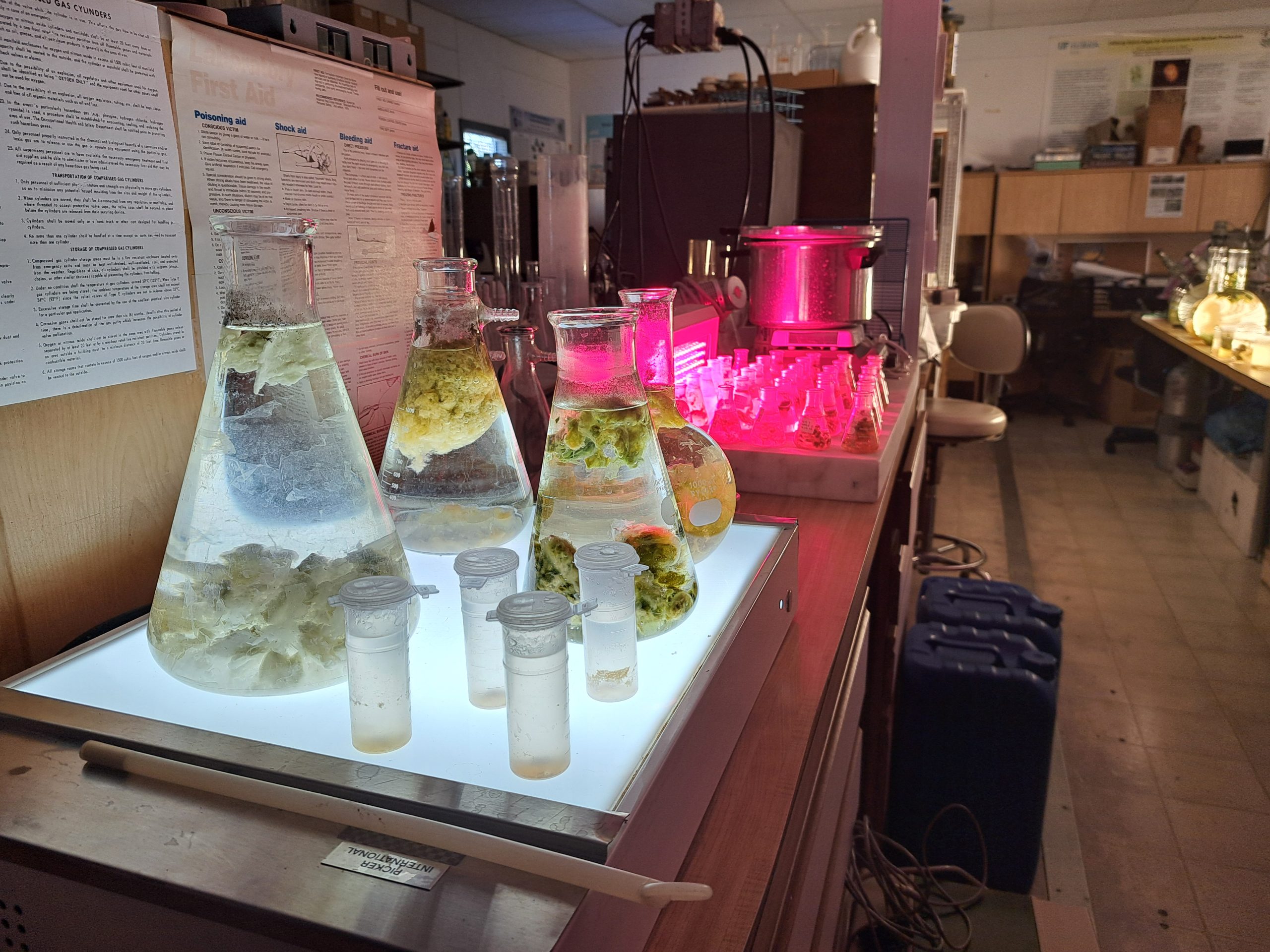
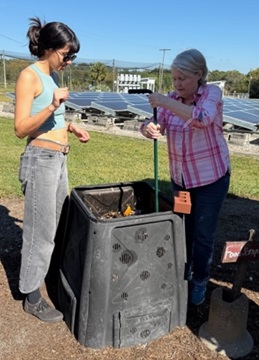
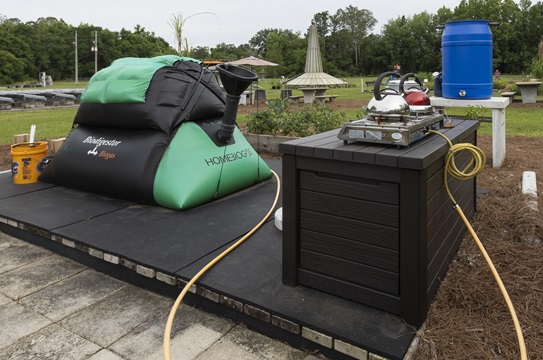
Algae growing in the lab and Dr. Wilkie demonstrating turning food scraps in the compost bin. (Photos provided) The biodigestor creates a natural gas that fuels the portable stovetop. (UF/IFAS photo by Tyler Jones)
The Poetics of Clay seminar
Working beyond the art quad at the ELL allowed the class to engage with the environment in a multifaceted way. They explored elemental time and earth, air, water and fire in relation to contemporary and historical art practices. The culminating event of the class was a barrel firing. Conducting this as a communal activity allowed students to expand what art curator Glenn Adamson refers to as material intelligence, or their literacy of the physical world.
“We retrofitted barrels, placed them on top of bricks, and voila, a kiln was made,” explained Grace Sachi Troxell. “It’s a direct firing process where a kiln can be made and fired within a day.”
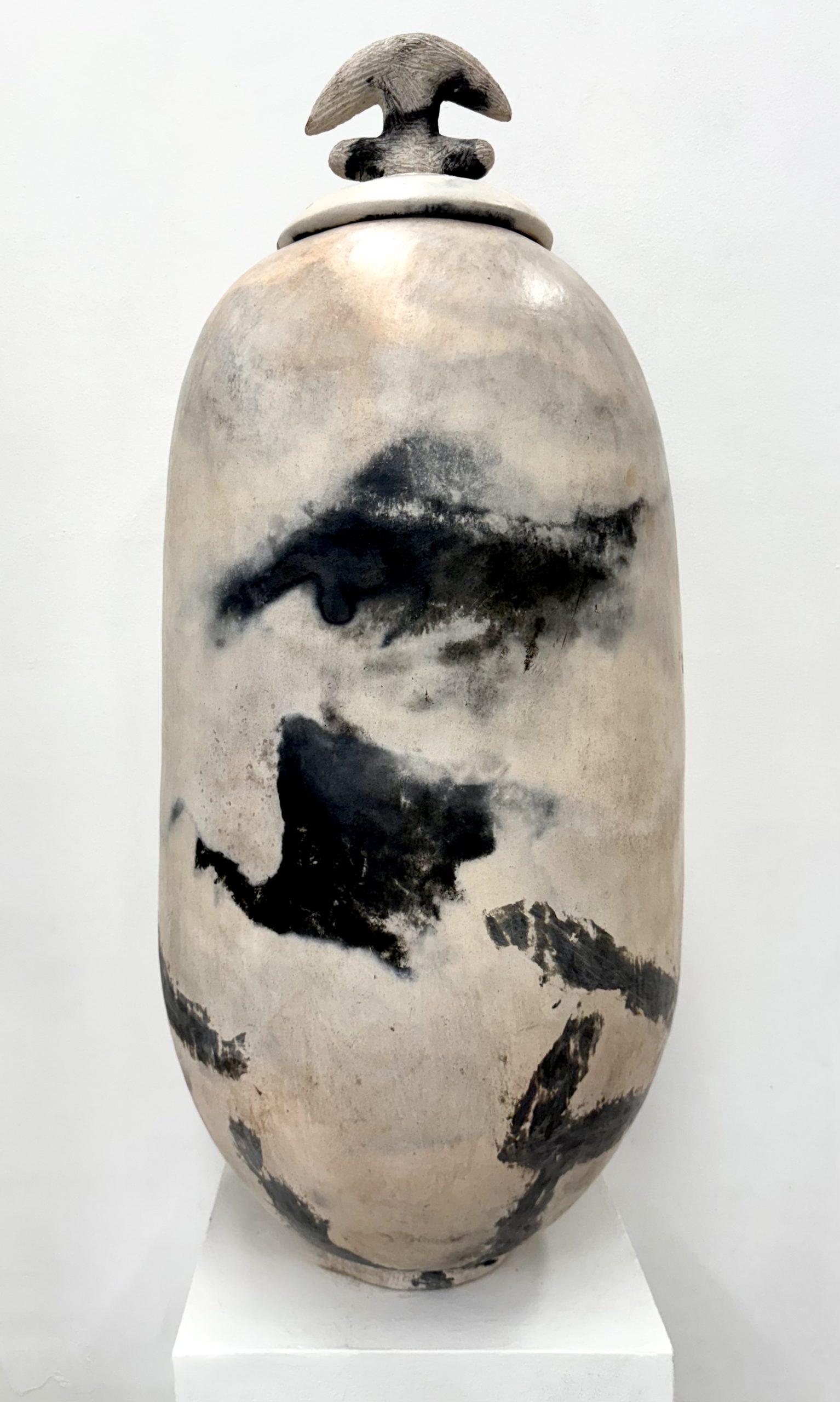
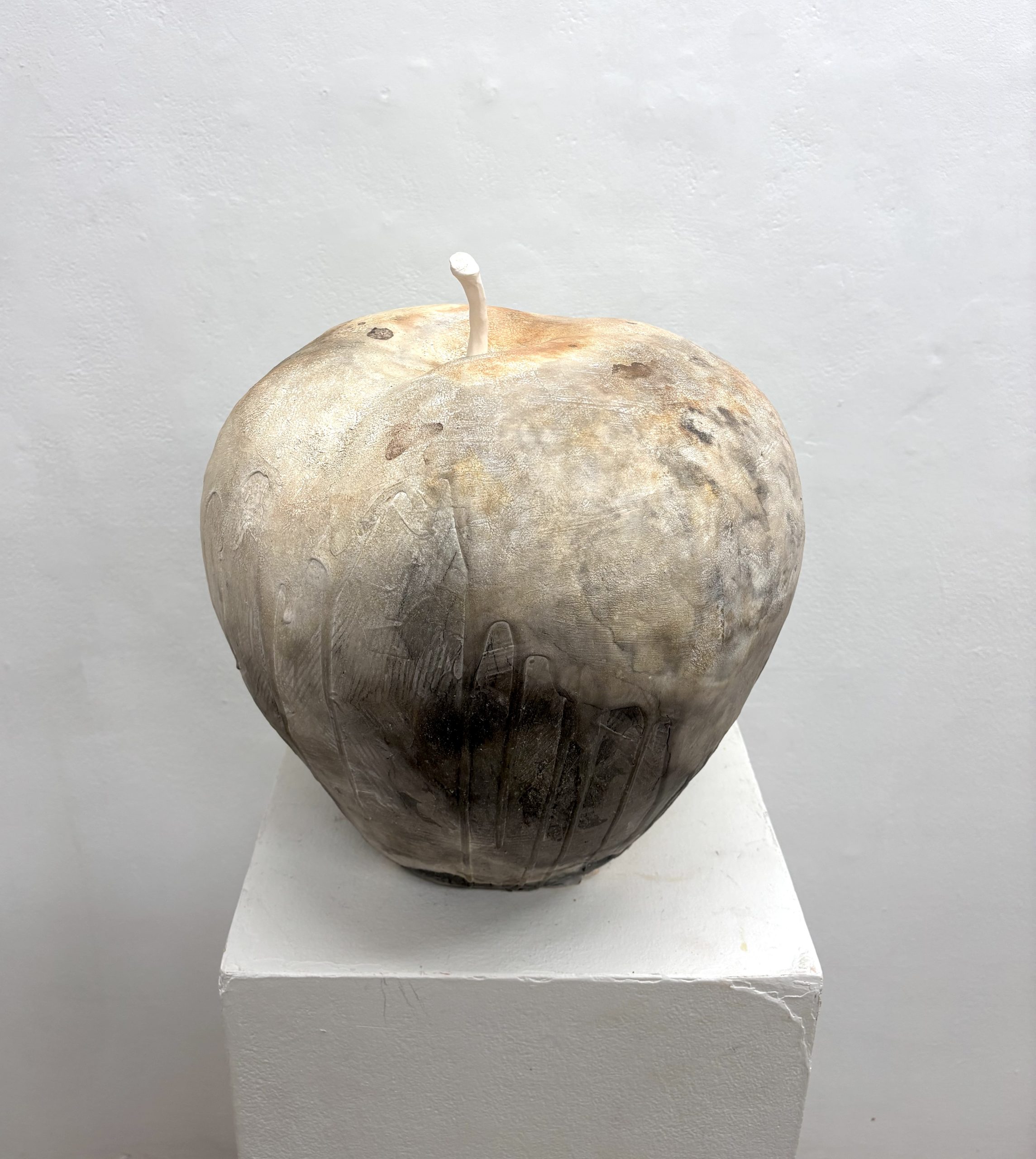
This alternative firing method uses combustible materials to create distinctive surfaces. Students experimented with a variety of dried organic biomass from the ELL. Artists achieved orange colors using salt-soaked straw and seaweed and black using hardwood. They also used sugarcane bagasse harvested at the ELL. The pieces created for the barrel firing — an apple, a tree made from casts of local bark, and a Ghanaian water jug — were produced as reflections on Ursula K. Le Guin’s The Carrier Bag Theory of Fiction.
“Unlike my usual work in the controlled environment of an electric kiln, this process required me to entrust the results to the elements—fire, air, oxides, and organic materials—which felt like a completely new approach for me,” said first-year MFA student Eo Jin Lee. “While there were some challenges, I view them as necessary preparation for achieving better results in the future. It was a truly valuable learning opportunity.”
The pieces fired at the lab were exhibited in a pop-up exhibition, Interlocking, at the A. Quinn Jones Museum and Memorial Center in Gainesville. Afterwards, students donated some of them to the ELL for an informational display. The collaboration gave students an experience with fire that was both ancient and contemporary.
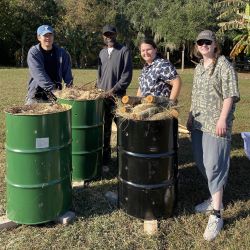
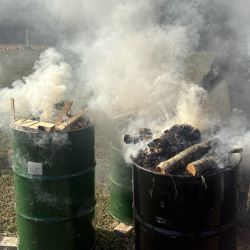
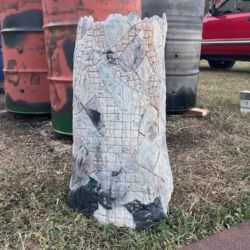
The barrel firing process, before and in progress, and one of the finished pieces. (Middle photo by Eo Jin Lee, right photo by Kelsey Barton)
Graduate Seminar in Ceramics
Students traveled to the Experiential Learning Lab to harvest local clay. Second-year MFA student Kelsey Barton participated in all three seminars and described harvesting and processing wild clay as extremely rewarding.
“Digging, collecting, and sieving the clay was a labor-intensive process. It reminded me of the processes that early ceramicists followed,” she said. “The clay has unique aesthetic properties like its rich red-brown color after firing that make it appealing as both a clay body and glaze for future projects.”
To make the harvested soil workable as clay, students sieved it through a relatively fine mesh due to the high sand content of Florida soils. Activities like this gave students a greater appreciation for soils and the location-specific properties that affect the clay used to create art. Barton connected two seminars by using ELL-harvested clay as a glaze for her piece, Traces, in The Poetics of Clay.
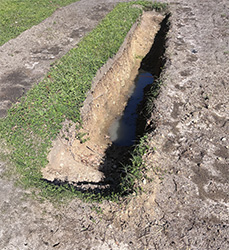
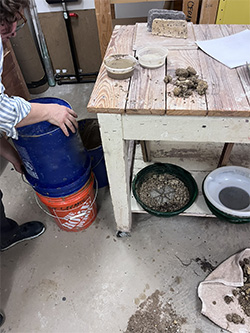

The soil pit at the ELL was the clay harvesting site. Back at the School of Art and Art History, the process of sieving the clay to work with and a finished work of art made from the clay. (Photos by Kelsey Barton)
Creative Collaborations
“Collaborating with the Experiential Learning Lab and Dr. Wilkie was meaningful to the students,” Grace Sachi Troxell said. “It helped them to investigate the materiality of making and interspecies relationships.”
“While soil, water, and ecosystem sciences are the primary teaching and research focus here at the ELL. This relationship with the School of Art and Art History shows how that can take different forms,” Wilkie said. “We invite instructors to experiment with their students out here and individuals to reach out if they have a project in mind.”
This blog article was written by Grace Sachi Troxell. Mike Loizzo edited and posted the article.
Feature image by Tyler Jones, UF/IFAS Communications.
 8
8