When most first-year undergraduate students were still finding their footing on a large campus like the University of Florida, environmental science major Rebecca Walters was taking significant academic steps. In just her second semester, she contacted Dr. Ann Wilkie, director of the UF/IFAS Experiential Learning Laboratory (ELL), with a request. She wanted to interview Dr. Wilkie and learn more about the activities at the ELL for a class report.
Not surprisingly, her discussions with Dr. Wilkie stimulated her interest in scientific research, resulting in a semester-long study at the ELL that introduced her to hands-on scientific work. It also expanded her academic confidence and reshaped how she viewed the process of discovery.
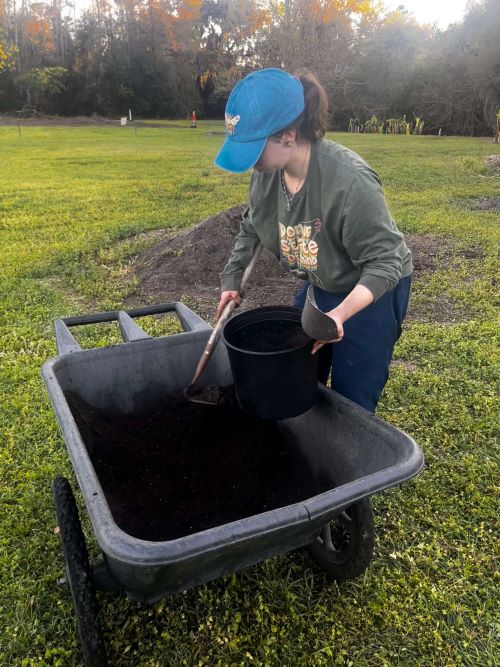
“Seeing all the exciting and groundbreaking projects that the lab was tackling under Dr. Wilkie’s guidance was exhilarating,” Walters said. “So much so, that when Dr. Wilkie mentioned having space in the lab for an undergraduate project for the spring semester, I practically leapt at the opportunity.”
“I wanted to find out if I could turn an idea into something real, even early in my college experience. Dr. Wilkie was incredibly welcoming and supportive, and the ELL gave me the perfect environment to learn by doing.”
Walters enrolled in SWS 4911, Supervised Research in Soil, Water, and Ecosystem Sciences. She spent the 2025 spring semester exploring the potential of dried marigold petals to influence insect activity in vegetable gardens. While her initial hypothesis assumed pest-repelling benefits, she discovered something else. The treatments attracted a variety of insects — many of them beneficial, like ladybugs, bees and spiders.
The real outcome, however, was the experience of learning to meet her expectations. This research project taught her to have an open mind in her pursuit of knowledge.
“I had to let go of the idea that I’d find exactly what I was looking for,” she said. “I learned to follow the data, not force it.”
Supportive environment for student growth
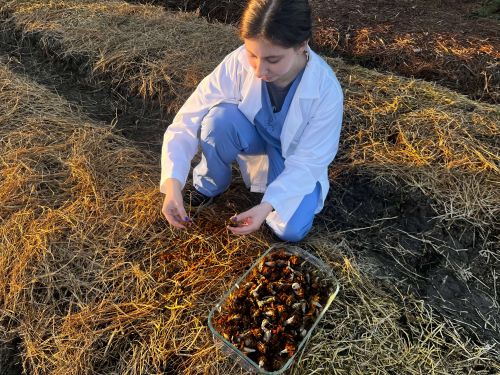
Wilkie, a professor in the UF/IFAS Department of Soil, Water, and Ecosystem Sciences, designed the ELL as a living classroom. Students can explore topics like regenerative agriculture, waste management and renewable energy systems. She said Walters’ initiative is exactly what the lab is meant to support.
“Rebecca reached out as a first-year student ready to engage in real science. That kind of curiosity and courage is rare,” Wilkie said. “We want students to feel empowered to start asking questions early in their college journey — and the ELL is the ideal place for that.”
Walters detailed her study in a report and presented her project at both the Soil, Water, and Ecosystem Sciences Research Forum in February and the campuswide Undergraduate Research Symposium in April. She learned to tailor her explanations for audiences with different scientific backgrounds — a skill she said would benefit her throughout her academic and professional future.
She also credited the experience with teaching her time management, adaptability and the value of documenting every step of a project.
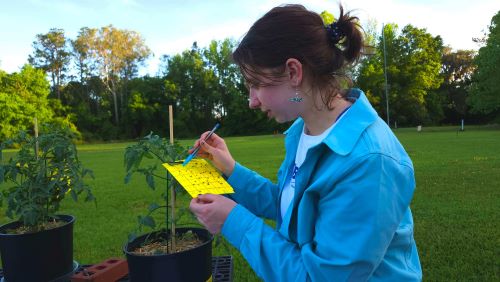
“Research has taught me that important discoveries often come from unexpected places,” she said.
Looking back, Walters said beginning research during her first year at UF was one of the most valuable decisions she’s made.
“Research gave me the ability to depart from the traditional classroom mindset. I didn’t know where the project would lead — but I knew I wanted to start.”
Get involved
For students interested in pursuing research or hands-on learning experiences, the ELL provides a welcoming space to explore, experiment, and grow. Visit the ELL’s website to learn about hands-on research experiences
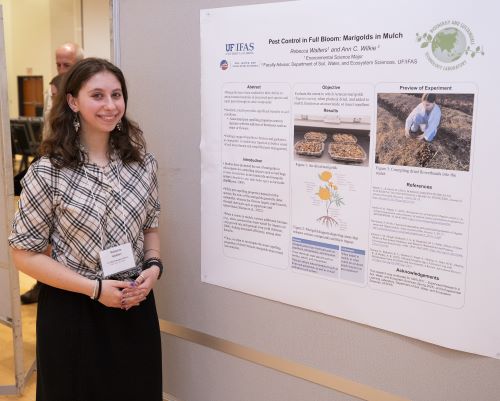
Featured image by Tyler Jones, UF/IFAS photography.
 6
6