Middle and high school teachers from across Florida gathered in Gainesville on Saturday, May 17, to learn about the viruses, bacteria and other pathogens that threaten our plants.
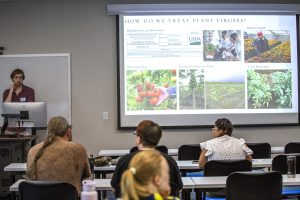 Graduate students from the UF/IFAS Department of Plant Pathology led sessions on viruses, bacteria, microbes and fungi at the Plants Get Sick Too! workshop, funded through grants from Corteva Agriscience and the National Science Foundation, an independent federal agency that supports science and engineering research.
Dr. Erica Goss, professor of plant pathology, is one of the workshop’s organizers. The workshop is a great way to introduce a topic that not many people, even science teachers, are familiar with. “A lot of the teachers have modules about plants or infectious diseases, but plant pathogens aren’t usually part of that curriculum,” Goss said. “The idea is to expose them to a lot of different information, so they can incorporate that into what they teach.”
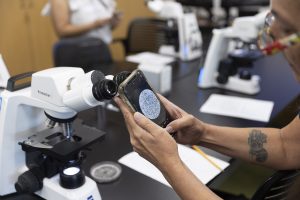 Kelly De Curtis, a biology and forensics teacher at Wiregrass Ranch High School in Wesley Chapel, saw the workshop as a way to learn more about the subjects she teaches. “It’s hard sometimes as a teacher to find content-specific development,” De Curtis said. “We talk about teaching methods, but it doesn’t matter how I teach if I don’t know what I’m teaching.” She hopes to bring that knowledge back to the classroom: “It’s important to have an in-depth answer when students ask questions that go beyond the textbook,” she said.
 In addition to exposing science teachers and their students to the field of plant pathology, the workshop presents an opportunity for plant pathology graduate students. “They’re learning how to talk about their research to a broader audience, and they get lots of questions from people who don’t have a specialist background,” Goss said. “Talking about their work in a way that is accessible is a good skillset to develop.” For graduate student Sean Wang, teaching a session about fungal pathogens was a great fit for his outgoing personality. “We don’t want to limit our knowledge to the plant pathology field,” Wang said. “We want to bring our knowledge to a wider audience, so they can understand what we’re doing.”
 The workshop is promoted through the Scientist in Every Florida School program from the Thompson Earth Systems Institute at the Florida Museum of Natural History, and through the UF Center for Precollegiate Education and Training. The programs offer development opportunities for teachers and students, and Jessica Baldwin, a biology teacher at Haines City High School, took advantage. “My county doesn’t offer much hands-on training, so the moment I learned about these workshops, I signed up for as many as I could,” Baldwin said. She hopes to apply plant pathology knowledge to her own life, in addition to helping her students. “I have my own plants, but I’m not a successful gardener. This is informing me of things I could be looking at with my plants,” she said. “And we have an ag department and an environmental club at school, so it would be nice if I could share my knowledge with them.”
Graduate student AJ Lawrence saw his plant virus presentation as a way to get plant pathology knowledge “out there.” “Plant pathogens are real and impactful,” he said. “We need research, just like with human pathogens, to make the world a better place.”
###
 12
12