The featured Gulf Coast Catch and cook species for November 2025 is the Stone Crab!
Stone Crabs are fun to catch and delicious to eat! November is the perfect time to catch Stone Crabs in the Gulf as the season is newly opened and the weather is just right!
Read on to learn how to harvest Stone Crab claws and make a delicious and healthy meal!

Fun Facts
- Stone crabs have a favorite claw and can be left or right “clawed”!
- The claws from stone crabs can be harvested without killing the crabs and can grow back!
- Florida makes up 99% of all stone crab harvest in the US.
Species Profile
The Florida Stone Crab (Menippe mercenaria) and the Gulf Stone Crab (Menippe adina) are two very closely related stone crab species that can be found in the Gulf off the Florida coast. The Gulf Stone crab typically lives in the northern regions of Florida, near the Big Bend and panhandle, while the Florida stone crab can be found anywhere along the coast, but is more common to the south. While they are different species, they can have similar habitats and are harvested following the same rules. They can be differentiated by slight color differences and general locations; however, in some cases, they can breed and become hybrid species. Near west central Florida, such as Pasco County, we tend to find the Florida Stone Crab.
They are a marine crustacean which tends to live in near-shore shallow waters. They can often be found near jetties, oyster reefs, seagrasses or mudflats. They are known for their strong crushing claws, used both for eating and defense. The harvest of stone crabs is unique in that only the claws of the crab are harvested, with the living crab returned back to the water to regrow its claws. While the crabs can live after the claws are harvested, the water temperature and the method of removal of the claws will impact the survival chance.
Appearance

The Florida Stone Crab has a oval shaped shell that is a light brown to pink-tan color with grey spots, while the Gulf Stone Crab is a darker red to brown color. Both have large claws, sometimes as big as the body, which are black on the tops of the pinchers. One of the claws is typically larger than the other, as the crabs can be left or right handed, favoring one claw.
Biology and life cycle
Stone crabs will live for around 7 to 9 years of age and grow to have a shell size of 5- 6 inches wide, however their claws can grow up t0 5 or more inches and weigh up to 8 oz. The typical claws must be 2 3/4 inches to harvest. The female stone crabs will typically have a larger shell (carapace) than the males, while the males tend to have larger pincher claws. In ordered to grow larger the crabs molt, where they shed their outer shell and form a new shell. The crabs will only molt at night, as they are vulnerable during the molting period, and must find a safe place for this to occur. The ability to molt helps the crabs to recover from the loss of limbs or wounds, however this can be a slow process. Juveniles can molt several times a year, allowing them to grow back limbs in several months, however adults may only molt once a year. This means it may take over a year to grow back a limb that’s lost from fighting or harvest. Its estimates that it takes around 3 years for an adult to grow back its limb to 95% of its original size, however, most will not live long enough to full regrow a limb.
The males can be very territorial, often showing off their large claws as a form of dominance. The crabs will also use their large claws to fight over territory or females, often resulting in damage to their shells or loss of limbs.

Stone crabs will reach sexual maturity at around two years of age, where the female will carry up hundreds to thousands of egg’s. The female must mate after molting while they shell is still soft, and the males will protect them during this vulnerable time. They typically mate i the fall, however the females will store the sperm of the male until they are ready to fertilize the eggs in the spring season. The eggs are then kept as a mass below the body of the female in what’s called the ‘sponge’, for around two weeks until the larvae are ready to be released. The eggs can have a variety of colors from orange to red to grey, where the females may have up to six egg sponges a year. It is illegal to harvest from crabs with eggs as they eggs can be easily damaged. The juveniles crabs will undergo several stages of metamorphosis as they mature into adult crabs.
Habitat
The stone crabs will live in coastal and offshore waters, favoring muddy to sand bottoms, however they are also known to burrow under hard substrate or seagrass beds. They can also be found near oysters, rocky outcrops, or human made structures where they can hide from predators. When living among oysters and use their large claws to break open the oyster shells to eat, however they are also scavengers and will eat mollusks, worms, crabs, and occasionally seagrass or dead fish. They tend to be nocturnal animals which scavenge at night.
The stone crabs are generally considered to have few predators due to their hard shell and strong claws for protection, where their claws can pinch up to 14,000 pounds per square inch of pressure. They are at risk from a few predators, however, such as octopus, groupers, cobia, turtles, and horse conchs. Most predation occurs in the juvenile stage, however octopus are a major threat to adults, often even hunting them in the crab traps.
Catch
Declawing
While the stone crab fishery is dominated by commercial fishers, recreational harvest is also allowed. Stone crabs are one of the only species which is caught, harvested and returned to the waters to continue to live. Fishermen will remove the large claw of the stone crabs for harvest and return them back to the ocean where they can regrow their claws. While this method should allow for the harvest of stone crabs to remain sustainable, there is controversy surrounding this method.

The survival of the stone crabs after release, relies on the number of claws removed, type of break, and the water temperature at the time of release. A study conducted assessing the mortality (death) rates of the crabs after claw removal and release found that 23-60% of crabs dies with one claw removed and 46-82% dies with both claws removed (Gandy, R., 2015). Warmer then normal temperatures also resulted in higher mortality rates. The largest factor relating to mortality however was the type of break, where the claw can be removed in a clean or “bad break”. A clean break occurs more naturally where the joint of the crab is left in tact. In this case the claw will be able to regrow over time. A “bad break” or forced break pulls out the joint and rips muscle from the crab, causing it to bleed to death. In an FWC sampling, nearly 31% of claws removed showed this forced break. Thus if harvesting stone crabs, try your best to properly remove the claws are avoid any damage to the joints, allowing the crab to live and regrow its claws. It is also recommended to only remove one claw per crab allowing them to keep a claw for defense. Read on to learn more about claw removal methods.

Season and Regulations
To maintain a healthy fishery, it is important to use sustainable fishing practices when catching and releasing marine species. A Florida fishing license is required to land all saltwater species in Florida regardless of where they are caught (state or federal waters). Florida fishing licenses require a fee, however, fishing licenses from a shoreline are free. Both types require you to register for the license on the FWC website which can be found here: https://license.gooutdoorsflorida.com/
For Stone Crabs, recreational fishers are also required to add a Recreational Stone Crab Trap Registration to their fishing license. With this they will get a trap registration number to mark traps with (see below for trapping info!).
- FWC Fishing license and Recreational Stone Crab Trap Registration required
- Minimum Size: The minimum size limit is 2 7/8 inches per claw. *Use a measurement tool
- Only the claws can be harvested, the live crab must be returned to the water.
- Daily Bag Limit: Fishers are allowed 1 gallons of claws per person per day and no more than 2 gallons per vessel (need at least 2 fishers).
- No egg bearing crabs can be harvested.
- Open Season: October 15th – May 1st
- Claw removal: Legally both claws can be removed, however we recommend only taking one claw
Fishing regulations can change frequently, always check current FWC regulations before fishing. Recreational Stone Crab regulations can be found here: myFWC Check out this video from FWC for some great tips and best management practices * note a machine puller cannot be used by recreational fishers as of 2024.
Claw Harvest
Be carful when harvesting the claws. If the stone crabs pinches you’re fingers its going to hurt and may even break a bone!!!!
Measurement
Stone crab claws must be more that 2 7/8 inches in length from the elbow joint to the tip of the lower, non mobile, claw. A plastic or metal measurement tool should be used to measure the claw size. These are often sold as spiney lobster and stone crab measurement tools.

https://www.youtube.com/watch?v=YTgXTS8gLjU&t=29s
Claw removal
As mentioned above proper removal of the stone crab claws is essential for the survival of the stone crabs. If removed incorrectly, the stone crabs will die, leading to an unstable fishery. Make sure to follow the best practices to remove the claws properly and avoid killing the crabs.
There are multiple ways the claws can be removed, but make sure to measure the claw before you remove it! Claws can be removed without any tools by grabbing the claw and forcing it downward, this will result in a sharp snap at the joint. Twisting during this motion can cause the joint to rip, so its best to avoid this motion. Other methods that are less likely to cause tearing of the joint involve sticking a tool suck as a knife into the joint of the crab and wiggling. The crab will self amputate the arm due to this. This method takes a little longer and some practice but it will make a clean break and is less likely to kill the crab. This is the recommended method to ensure the crabs survival.
While both claw can legally be removed from the stone crabs, we recommend only taking one. Stone crabs rely on these claws for defense from predators, and to harvest food. While they can still eat small amounts of food without their main claws it takes a lot of energy to grow them back. Leaving the crabs will one claw will help them to live and be able to regrow the missing claw more quickly. Check out the video below from FWC for some great tips and examples of claw removal.
Harvest Methods
Stone Crab Traps are the most common way to catch Stone Crabs, however they can also be caught by hand or with nets while diving. Dip nets are allowed, however no gear that can crush, spear, or puncture the crab is allowed.
Crab Traps
Most harvesters of stone crab use crab traps, as they can be placed for several days and then returned to to check for crabs. Traps are typically made of plastic, wood, or wire and have a concrete base. Traps will be loaded with bait and throw overboard, marked with a floating buoy. The crabs will crawl into the traps and become stuck until harvesters check traps. They traps are highly regulated to protect the crabs and the trap regulations must be followed. Regulation traps can be purchased.
When applying for the Recreational Stone Crab Trap Registration you will get a trap registration number.
Trap regulations
- Recreational fishers are allowed 5 traps per person.
- Traps must be marked with harvester’s name, address, and recreational trap registration number permanently affixed to each trap and legible.
- A 6 inch buoy must be attached to the trap with the letter “R” marked on buoy (greater than 2in).
- Traps can be placed in the water 10 days before the opening of the season but cannot be checked until the season starts.
- The traps have a size limit of 24 x 24 x 24 inches and can be made of wood, wire, or plastic.
- The entrance must be 5 ½ inches by 3 ½ inches in size.
- All traps must have a degradable panel that is 5 ½ inches by 3 ½ inches and is made of cypress or untreated pine slat no thicker than ¾ of an inch.
- An unobstructed escape ring 2 3/16 inches in diameter must be located within a vertical exterior trap wall for all recreational and commercial plastic or wood stone crab traps.
- Traps must be pulled by hand (no machines)
- Traps must be pulled in daylight hours
- Traps cannot be placed in navigation channels
-

- FWC Trap regulations. Image source: https://myfwc.com/fishing/saltwater/recreational/stone-crab/

Bait
Stone crabs are opportunistic eaters and will scavenge for foods. Using protein based foods in the traps will lead to the best success. Fish carcasses, chicken, and even pigs feet can be used in your traps. They like anything stinky!
Tips
- Check your traps often. Stone crabs can starve and die if you leave them without food for to long.
- Soak your traps in the water before baiting them, as the crabs can we weary of new traps.
- Try new types of bait if your not catching any crabs.
- Try to place traps near ledges or structure where the crabs may be hiding.
- Keeping the traps inshore will help you to pull them more easily.
Diving
While traps are the most common method for catching stone crabs, they can also be caught by hand why free diving or scuba diving. This method is similar to lobstering where they crabs can be found hiding under ledges or in rocks. To catch them you can dive down and use a stick or net to move them out of the cracks (remember nothing sharp can be used). You can then grab them by hand or with a dip net to measure and harvest the claws. This method is fun but can be more difficult! Always take precautions to be safe when diving, especially at great depths. It is best to go with an experienced diver or be trained before attempting this method.
Cook
In the Gulf, U.S. wild-caught stone crab is considered sustainable as they crabs are released after harvest and have the ability to grow the claws back over time. Several organizations, however, such as Seafood Watch, consider the Stone Crab fishery to be unsustainable due to the high mortality rates of the crabs after claw harvest. FWC currently allows commercial harvest and has best management regulations in place to protect the fishery. If you follow the fishery best management practices of proper claw removal and only take one claw at a time, you can help to keep the fishery sustainable.
Claws can be purchased from commercial fisherman and are usually sold by claw size: Medium (3 oz), large (3-5 oz), jumbo (5-7 oz), and colossal (7+ oz). The price will be based on the size of the claws! Stone crab can be expensive to buy and changes with market price, so catching your own is a great way to have them on a budget!
Stone crabs are delicious white tender meat, which is slightly sweet. They can be enjoyed simply by cooking and eating straight from the shell (hot or chilled) or dipped in butter! See below for another recipe to enjoy them!
Steamed Stone Crab with Mustard Sauce
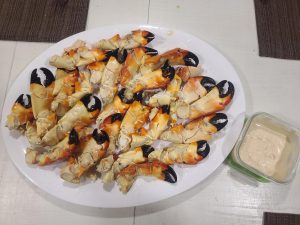
Serving size: 1 pound per person
Ingredients:
- 1 pound of stone crab claws
- 1/2 cup mayonnaise
- 1 tbs whole grain mustard
- 2 tsp Worcestershire sauce
- 1/4 tsp lemon juice
- salt to taste
Instructions:
Stone Crab Claws:
If you catch the stone crabs yourself you will need to cook them before you eat them. If you purchase stone crabs from a commercial fishery, they will come pre cooked!
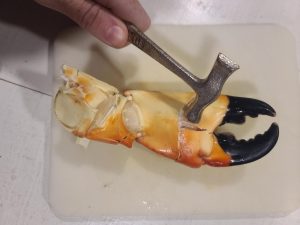
- Steam the claws. Place the claws in a steamer basket with boiling water beneath. Steam the crabs with the lid on for 5 to 10 minutes or until fully cooked.
- Chill claws. Its typically to serve the claws chilled (although they can be eaten hot. Place the claws in the fridge for an hour or more until cold.
- Crack claws. Stone crabs have very hard shells which need to be cracked to access the meat. Cracking all of the shell before serving is ideal. Shells can be cracked using a hammer, knife spoon, or cracking tool. Hit the shell just hard enough to crack it without smashing the meat. This takes a little practice but you will be an expert in no time!
Mustard Sauce:
- While the claws are cooling you can prepare your mustard sauce.
- In a small bowl mix together the mayonnaise, whole grain mustard, Worcestershire sauce, lemon juice, and salt to taste.
- Let mustard sauce marinate in the fridge until ready to serve.
Serve the cooled and cracked stone crab claws on a tray with a side of dipping sauce for each person and enjoy!
*Remove the other shell to eat the meat inside!
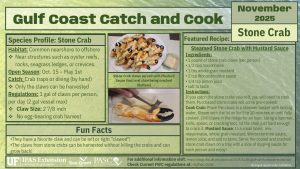
Next month sneak peek!
Our featured Gulf Catch for December is the Redfish!
- Redfish can live in different salinities, including freshwater to brackish to salty open water.
- Male Red Fish will produce a “drumming” sound to attract females.
Do you have a favorite Redfish recipe or a photo of you with your catch? Share it with us for a chance to be featured as a photo or recipe of the month! Submit here
More information on the Stock assessment for the Gulf can be found here: NOAA Stock Assessment
Learn more about Stone Crabs here: FWC Papers
Check out the other Gulf Coast Catch and Cook blog posts!

Have a question? Ask the Author!
For more detailed information, contact your local University of Florida Extension Office.
Follow us!
An Equal Opportunity Institution.
 0
0