Fertilizer, What Is It?
It is not food.
Plants make their food through a process called photosynthesis. You know, the process that turns sunlight into food.
Fertilizer on the other hand is more of a nutrient boost. The official definition is “any material, organic or inorganic, natural or synthetic, which supplies one or more of the chemical elements required for the plant growth.”
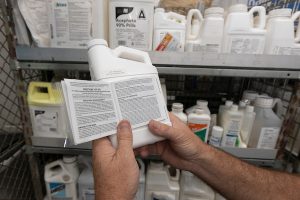
Simply put, fertilizer is not plant food (plants make their food!); its plant nutrients – like sulfur, calcium, nitrogen, etc. – required for the plant to grow, develop, and reproduce. There are different sources of nutrients that plants can use. It’s sometimes hard to know what to apply since there are so many options.
Types of Fertilizer
There are two main types of fertilizers: organic and inorganic.
- Organic ones are naturally derived, meaning they aren’t man-made.
- Inorganic fertilizers, on the other hand, are the factory-made, water-soluble counterparts.
While both have their merits, it’s important not to overdo the use of either type.
- Applying too much, or applying them when plants aren’t actively growing, can spell trouble for both your plants and the environment.
- Think nutrient runoff wreaking havoc on water quality and contributing to pesky problems like algal blooms. 
Regardless of the type of fertilizer, they can do damage to plants and the environment. Luckily, the same basic principles of selection and application apply to both organic and inorganic, or synthetic, fertilizers.
Do I Need Fertilizer?
In the wild, plants get their nutrients from natural cycles. In developed areas, we use fertilizers to mimic the nutrients these cycles provide to wild plants. The term “developed” is in reference to plants and turf in lawns, landscapes, and potted or raised beds. Fertilizers should be applied when the essential nutrients for plant growth are depleted, which is common in “developed” situations.
Think of fertilizers like multi-vitamin plants use to support their growth and survival.
These are the 3 main nutrients are responsible for keeping plants thriving.
- Nitrogen (N) supports plant growth
- Phosphorus (P) supports root health and flowering
- Potassium (K) supports immune functions
These are often referred to a macro nutrients – not because they are the most important, but they are typically required in the highest amounts when compared to the micronutrients (think calcium, iron, sulfur, etc.). Each fertilizer is different, often mixtures are tailored to specific plant species or needs. Ideally, the plant requirements should match the fertilizer and soil composition.
The Impacts of Fertilizer
Timing is everything. Plants need a schedule to keep them thriving. Proper application of fertilizers is a big factor to making a garden the best version it can be. Overapplication can damage plants and is financially wasteful. The extra nutrients get washed away and enter water sources, which negatively impacts public health and aquatic ecosystems.
Picture this: Florida, a sunshine paradise, plagued by issues like red-tide and blue-green algae. Sound familiar?
Yep, blame it on eutrophication. Eutrophication is the fallout from excess nutrients in the water, courtesy of nutrient runoff.
- Fertilizer runoff can wash away to local water sources or contaminate drainage waters.
- When these excess nutrients enter bodies of water and soil, it causes plant and bacterial overgrowth.
- This overgrowth has significant negative effects on both marine and terrestrial life by disrupting ecological balance and decreasing oxygen levels in the water, among other issues.
Reading a Fertilizer Label
Remember, fertilizers are regulated materials that contain plant nutrients. On the label, there must be a nutrient analysis. This analysis is the representation of the nutrients as a percentage of weight. These materials are listed on the nutrient analysis, as well as any additional nutrients. So, it is important to be able to read and understand the label to choose the right one. Let’s learn how:
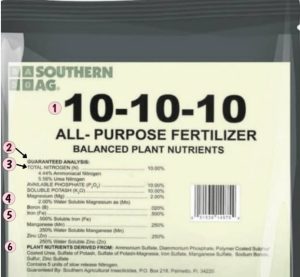
- Nutrient Analysis: you can identify this by looking for the 3 numbers on the label. These numbers give the percentage of the three main nutrients, nitrogen (N), phosphorus (P), and potassium (K), by weight. So, think N-P-K when you see these 3 numbers. For example, a 100lb bag has 12-3-4, this means that there are 12lbs of N, 3 lbs. of P, and 4 lbs. of K.
- Guaranteed analysis: this is the analysis by weight of each element present in the fertilizer, warranted by the manufacturer.
- Total Nitrogen: the total amount of nitrogen expressed as a percentage.
- Additional Macro-nutrients: additional nutrients displayed as a percentage by weight of the total amount of fertilizer.
- Additional Micro-nutrients: micronutrients displayed as percentage by weight of the total amount of fertilizer. In Florida, our sandy soil may tend to have low levels of micronutrients, but your soil content should be determined by a soil test. Excess amounts of these nutrients can damage and kill plants.
- Nutrient Sources: details where the fertilizer was derived from.
Which Fertilizer Is Right for Me?
So which fertilizer is right for you? Start with a soil test.
Choosing the right fertilizer depends on a lot of factors. The type of plant, soil, and time of year are just a few considerations. Lawn fertilizers would burn garden plants because they contain too much nitrogen and sometimes other chemicals that are meant to control weeds, so it is important to do your research and pick the best fertilizer for your type of plant. One size does not fit all when it comes to fertilizing your plants.
You can easily take a soil sample at home with a kit, or that can be sent to the UF/IFAS soil laboratory, where inexpensive testing is available to the public. Or you can pick up an online based soil test kit at your local Extension Office. Either kit is simple, provides specific instructions, and provides recommendations based on the specific plant and situation you note on the form. Based on the results, choose a fertilizer that caters to the specific nutritional needs of your plants.
Types of Fertilizer
- Complete fertilizers: this type of fertilizer contains all three of the primary macronutrients – nitrogen (N), phosphorous (P), and potassium (K).
- A balanced fertilizer contains equal amounts of nitrogen, phosphate, and potassium – like a 10-10-10 fertilizer.
- It may be beneficial to apply this type of fertilizer if your soil lacks all three nutrients, but if your soil is rich in 2, applying all 3 nutrients could burn your plants and lead to toxicity as well as waste your money!
- Incomplete fertilizer: a fertilizer that lacks one or two of the three major plant nutrients.
- Slow & Controlled release: provide nutrients to plants over an extended period of time. The idea is to save money by fertilizing less frequently and prevent excess nutrients from entering waterways.
- Read the label to find the percentage of slow – or controlled-release nutrients in the fertilizer, paying particular attention to the higher amounts of slow-release nitrogen.
- In Florida, any fertilizer that is labeled “slow-release” or “controlled-release” must contain at least 30% or more slow – or controlled-release nitrogen.
- Organic fertilizer: made from materials that are derived from plants and animals, like manure.
- Inorganic fertilizer: materials that are mined or synthesized from non-living materials.
- Dry fertilizer: made of powder or granular materials that dissolve in water.
- Water-soluble/liquid fertilizer: water soluble powders or liquid concentrates that mix with water to form a solution.
Check out Types of Fertilizer – Gardening Solutions – University of Florida for more information.
Next up, read about how to apply fertilizer!
Visit our page for more tips and tricks on maintaining a home garden!
More resources from UF/IFAS Extension Pasco County:
- UF/IFAS Extension Pasco County
- UF/IFAS Extension Pasco County Community Gardens
- Dr. Whitney Elmore’s Podcast: Rooted in Florida
More about fertilizer from UF/IFAS Extension:
- Soils And Fertilizers For Master Gardeners: Glossary Of Soil And Fertilizer Terms
- Fertilizing The Vegetable Garden
- Fertilization And Irrigation Needs For Florida Lawns And Landscapes
- Organic Gardening Guide
Supervising agent: Dr. Whitney Elmore.
 6
6