Explore Your Options
While you could say overhead irrigation is a method that mimics natural rainfall, there are many drawbacks:
- wets the foliage of the plants, which invites pests and diseases.
- encourages weed growth.
- more water evaporates, and there’s a higher chance of run-off on hot, windy days
- This makes it hard to track how much water the plants are getting, versus how much water is being wasted.
This method is not necessarily bad for plants, but there are alternative practices that are much more efficient for your plants (and wallet). Alternative methods include:
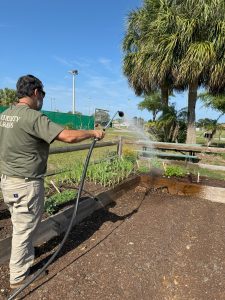
- Hand watering: manually water using a pail or a hose to water your veggies.
- while this option is the lowest tech, it is still effective and efficient.
- Micro-Irrigation: delivers water to the base of the plant. This type of irrigation consists of drip, micro-sprinklers, and bubblers.
- this doesn’t mean irrigation on a ‘small’ level
- is a more efficient (with water and money) than sprinklers
- is better for plant health
- require more maintenance than sprinklers
Tips for the Floridian Gardener
- Water plants when they are wilted in the early morning (many plants wilt in the heat of the afternoon, this is “heat-wilt”, and the plant recovers in the evening) and wait to water until the plant starts to wilt again.
- This practice builds strong root systems and conditions plants to survive with less water.
- Set your system to deliver 3/4 of an inch of water per application. If the area needs more water, up the frequency of the waterings, not the run time.
- Stay informed on the forecast and work that into your watering schedule. If you have a sprinkler system set on a timer, it could be detrimental for your plants if they get watered, and then it rains.
- Established trees and shrubs (plants 3+ years old) should not receive supplemental watering.
- Calibrate and maintain your system frequently (check to see if the rain sensor is still functioning; they have a short lifespan of typically one to two years before they need to be replaced!). Learn how to calibrate your sprinkler system.
- Resource Links – Florida-Friendly Landscaping™ Program – University of Florida, Institute of Food and Agricultural Sciences – UF/IFAS
Plan Ahead
Plan a landscape that reduces the use of water, fertilizer, and pesticides. Learn about UF/IFAS’s recommended Florida-Friendly Landscaping™.
Read the Florida-Friendly Landscaping Program and UF/IFAS publications for more information about recommended gardening choices.
-
- If you use lawn or landscaping services, review guidelines for hiring a landscape professional.
Read the next part: Ways to Water: Ways to Water: Seasonality and Irrigation Requirements – UF/IFAS Extension Pasco County
Conclusion
By being mindful of how we use water in our gardens and on our lawns, we can help conserve this precious resource while keeping our plants happy and healthy.
For more information about water use and conservation in Florida, see Water Resources.
Follow us!
We have several ways to connect. Visit our Facebook, Instagram, Eventbrite, Blogs, Florida-Friendly Facebook, & Website. Supervising agent: Dr. Whitney Elmore.
 0
0