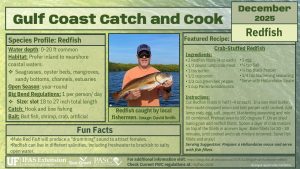
The featured Gulf catch and cook species for December 2025 is the Redfish!
Redfish are fun to catch and delicious to eat! Redfish can be caught in the Gulf year-round!
Read on to learn how to catch Redfish and make a delicious meal!
Fun Facts
- Male Red Fish will produce a “drumming” sound to attract females.
- Redfish can live in different salinities, including freshwater to brackish to salty open water.

Species Profile
The Red Drum (Sciaenops ocellatus), also commonly referred to as a Redfish, are named so due to their red coloring. They are a member of the Drum family, and closely related to the Black drum. The red and black drum have even been found to breed, creating hybrid species. They are found through the western Atlantic Ocean, along the eastern United States, through the Gulf of American, into South America and the Caribbean. Due to aquaculture the presence of Red drum are spreading globally.
Appearance
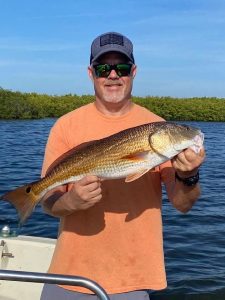
Redfish are dark red to copper in color along the top and fade to a light white to pink along the belly. Their most identifiable characteristic is a black spot which appears near the base of their tail. Juveniles may have multiple spots, but they often lose them, keeping only the one main spot as they grow older. Redfish will very rarely have no spot. It is thought that the spot acts as a way to trick predators, by looking like an eye. They have an elongates body shape, with a rounded blunt head, downward turned mouth, and a large truncate tail. Their pectoral and anal fins are a lighter pink to bright red color and they have large scales which cover their body. One of the notable features of a redfish are it powerful pharyngeal teeth used to crush shellfish, like oysters. They will use them to crush and grind the shells of pray animals.
Habitat
Redfish typically live in inshore coastal water environments, such as seagrass beds, mangrove roots, oyster bars, sandy bottoms and tidal creeks. While estuaries and river mouths are common areas for the red drum, they will move offshore to spawn. They frequent shallow waters ranging from a few feet to 20 ft, but have been found in waters greater than 60 ft in depth. Young Redfish will often live in shallow nursery habitats, including seagrass beds or mudflats. As they mature they may spend time between shallow and deeper waters, changing between preferred habitats. During colder months the Redfish may enter freshwater rivers or springs to find warmer waters as they can tolerate a variety of salinities including salty to brackish waters.
They are opportunistic bottom feeders and will often search along the seafloor to target their prey. As juveniles they will eat plankton and small crustaceans, however, as they get older they will eat larger crabs, shrimp, oysters, and smaller fish.
Biology and Life cycle
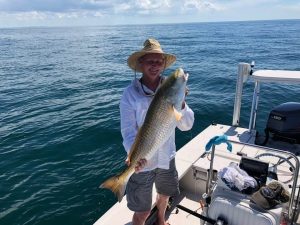
Redrum grow on average 30 to 36 inches, although they can reach more then 60 inches in length and live up to 60 years. Fish over 40 inches are often referred to as “bull reds” while smaller fish are called “puppy drums”. Males are typically smaller than the females and reach maturity sooner. Males reach maturity between one and four years old at a size between 20-28 inches, while females will mature between the age of three and six, reaching a length of 31-36 inches. The largest Redfish on record was caught in North Carlina at 94 pounds. In Florida, the largest redfish caught was 52 pounds 5 ounces in Cocoa beach.
The majority of mating in the Gulf occurs in the late summer to early fall, where redfish may move to deeper waters to spawn or in deeper estuarine environments. The male redfish will make a drumming sounds, originating from their swim bladder, to attract females. Juvenile redfish will grow rapidly, living in shallow inshore coastal and estuarine environments, and will move to adjust to changing salinity levels. As they grow older they may also frequent deeper near shore waters.
Catch
To maintain a healthy fishery, it is important to use sustainable fishing practices when catching and releasing fish. A Florida fishing license is required to land all saltwater species in Florida regardless of where they are caught (state or federal waters). Florida fishing licenses require a fee, however, fishing licenses from a shoreline are free. Both types require you to register for the license on the FWC website which can be found here: https://license.gooutdoorsflorida.com/
Habitat
- Common in 1 – 20 ft water depth, can be found in waters up to 60 ft in depth
- Prefer inland to nearshore coastal waters (i.e. seagrass beds, oyster beds, mangrove roots, sandy bottom, river channels, and estuaries)
- Inshore bottom feeders who target prey such as crabs, shrimp, oysters, and small fish

Season and Regulations
-
- Redfish fishing in the Gulf State waters is open year-round, however each region has different regulations to follow.
- Check each regions rules here: https://myfwc.com/fishing/saltwater/recreational/red-drum/
- For the Big Bend region:
- You are allowed to keep 1 Redfish per person, per day (4 per vessel limit).
- Redfish are a slot species, meaning they have a lower and upper size limit. The slot size limit is more then 18 inches and less than 27 inches total length. Redfish must be between 18 and 27 inches to keep.
Measurement: Measure the Redfish with the mouth closed and tail pinched. Measure from the tip of the snout/mouth to the end of the compressed tail.
Fishing regulations can change frequently, always check current FWC regulations before fishing. Regulations can be found here: myFWC
While you always hope to catch “The Big One” small fish are often caught during a fishing trip. If your catch is smaller than the regulations allow make sure you return them right. Fish should be returned to the water as quickly as possible and resuscitated. Learn more about the Return ‘em Right program here.
If in deep water (>50 ft) a descending device should be used to help the fish make it home. Using best release practices will help the future of your local fishery!
Descending devices are required when fishing for reef fish. You can get a free descending device sent to you by following this link: https://returnemright.org/
Methods
Hook and line and cast nets are all legal ways to catch a Redfish. It is ILLEGAL to spearfish, bow fish, snatch, or use multiple hooks in conjunction, with live or dead bait to catch Redfish.
Hook and line fishing
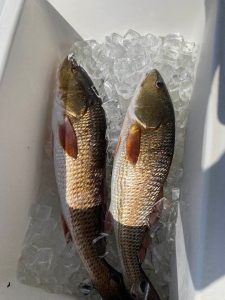
Hook and line fishing is the best way to catch Redfish. Redfish can be targeted year-round, however in the Gulf late fall to winter can be ideal. Timing the tides can help you to catch Redfish as well. They prefer strong incoming or out going tides where water is moving quickly. Low tides may make it easier to see the Redfish and directly target them however. Look for creeks, flats, channels, rivers, or potholes where Redfish may be hiding.
Their typical diet includes crustaceans, mollusks, and small fish, so sticking with these baits will give you your best chances of success. Although artificial jigs can be used!
Below are some great bait choices for targeting Redfish:
- Shrimp
- Crabs (fiddler)
- Sand fleas
- Finger Mullet
- Pinfish
- Artificial jigs
Tips and Tackle
Redfish can grow large in size requiring larger tackle, however they can also be skittish and see your line.
- Target inshore areas with hiding places such as seagrasses, mangrove roots, channels, or pot holes.
- Use your eyes. Look for the redfish in shallow water and cast baits in front of them. In shallow water the tails of the redfish may stick up out of the water.
- Redfish are bottom feeders so present bait near the bottom for them.
- Try slow bait retrieval, sight fishing, or letting bait sit with a bobber.
- Use light tackle for smaller redfish. 10-20 lb monofilament or 15-20 lb braided line works best.
- Upgrade to heavier line for bigger Redfish.
- The best hook sizes for Redfish are 1/0 hooks.
For best fishing practices and to learn more fishing tips, tricks, and regulations check out the free Florida Friendly Angler course: Florida Friendly Angler Certification Program
If you want to go fishing but don’t have a boat of your own, fishing charters are a great option! You can find a list of certified Florida Friendly Fishing Guides here: FFA Guides
Cook
In the Gulf, the Redfish fishery has made a strong recovery since the increased management in 1989. In the late 1980s Redfish were strongly overfished, with a collapsing fishery. The imposed slot limit on size, limited bag limit, and shortened season allowed for a recovery of the fishery.
Wild caught Redfish is considered a a sustainable seafood choice due to its management regulations. Redfish cannot be caught commercially, so you will need to catch it yourself to try for dinner!
Redfish meat is firm, moist, white, and has a mild, slightly sweet flavor. It can be prepared in a variety of ways, fried, grilled, sautéed, steamed, and more! Below is a delicious recipe for cooking up your fresh catch:
Crab Stuffed Redfish
Serving size: 1/2 fillet
Ingredients:
- 2 Redfish fillets (4 oz each)
- 1/2 pound lump crab meat
- 1 tbs butter
- 1/2 cup onion, chopped
- 1/2 cup green bell pepper chopped
- 1 cup Panko breadcrumbs
- 1 egg
- ¼ tsp Salt
- ¼ tsp Black Pepper
- 1/4 tsp blackening seasoning
- *Serve with Hollandaise Sauce
Instructions:
- Cut Redfish fillets in half (~4 oz each)
- In a pan melt butter, then sauté onion and bell pepper until cooked. Add lump crab, egg, salt, pepper, blackening seasoning and mix till combined.
- Preheat oven to 350 degrees F.
- On an oiled pan add redfish fillets. Spoon a layer of crab mixture on top of the fillets in an even layer.
- Bake fillets for 20 – 30 minutes, until cooked an crab mixture browns.
- Serve fish fillets and enjoy!
Serving Suggestion: Prepare a Hollandaise sauce and serve with fish fillets.
More information on the Stock assessments can be found here: NOAA Stock Assessment
Check out the other Gulf Coast Catch and Cook blog posts!
Have a question? Ask the Author!

For more detailed information, contact your local University of Florida Extension Office.
Follow us!
An Equal Opportunity Institution.
 0
0