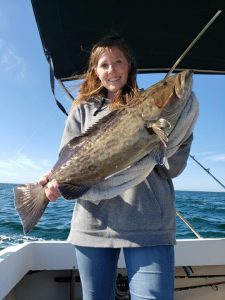
The featured Gulf Coast Catch and cook species for September 2025 is the Gag Grouper!
Gag Grouper are fun to catch and delicious to eat! September is the time to target Gag Grouper as they have a limited fishing season.
Read on to learn how to catch the Gag Grouper and make a delicious and healthy meal!
Fun Facts
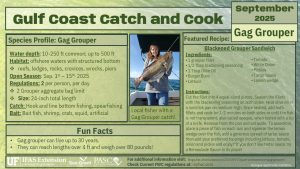
- Gag grouper can live up to 30 years.
- They can reach lengths over 4 ft and weigh over 80 pounds!
- Gag Grouper begin life as females and can transition into males around ages 8-11.
Species Profile
The Gag Grouper (Mycteroperca microlepis) is a grouper species that range from the Gulf of America (formerly the Gulf of Mexico) through the western Atlantic Ocean. They typically live near coastal regions and are found along wide continental shelves, favoring hard bottom habitat.
Appearance
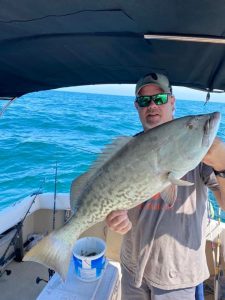
Gag grouper are a dark brown to tan color along the head and upper body and fade to a lighter tan towards the belly. Tan to dark brown spots or “kiss” shapes are common across the sides of the body. They have small scales that cover their body which their scientific name, microlepis, come from “micro” small “lepis” scale. They have two sharp canine teeth and large mouths used to eat prey whole. They have an elongated, oblong-shaped body and a broad tail. The gag grouper can sometimes be confused with the black grouper; however, their patterning and fin color can help to distinguish them.
Biology
The Gag grouper grows relatively slowly, but can weight up t0 80 pounds and reach a length of 4 feet or more. It can take many years to reach the minimum size for harvest. They will grow consistently for the first 10 years reaching sized up to 40 inches, then growth slows.

The Gag Grouper is near the top of the food chain in their habitat. They are opportunistic predators and will feed on fish, crustaceans (shrimp, crabs, lobsters), and octopus! They typically ambush their prey and swallow them whole using their large mouths. The juvenile gag groupers will often target smaller fish species in the sea grass habitats. While they don’t have many predators, larger grouper, sharks, or humans will hunt them.
They are considered to be “marine engineers”, as they dig out structures along the sea floor creating new habitats for themselves and other marine species, often around wreck, reefs, or hard bottom.
Life cycle
Gag grouper often move to shallow waters to spawn in the Gulf from January to May. They typically will reach sexual maturity and begin spawning around 4-8 years of age. Gag grouper are born female and can spawn several times before they transition into males between the ages of 8-11 and ~37 inches. Gag grouper under the size of 32 inches and less than 5 years old are female, while larger fish >42 inches are often males. The gag grouper will live to around 30 years in age.
Gag grouper are broadcast spawners and spawn along the west Florida shelf. Gag group larva will drift in the current for ~40 days after spawning occurs, then settles down in shallow coastal habitats, including seagrass beds, oyster reefs, or mangrove roots. Juveniles will remain in shallow water habitats for up to a year before they move offshore to deeper waters. Adult Gag Grouper move offshore to find hard-bottom or structured areas. They prefer to live on reefs, ledges, and limestone rock caves, although they can be found on wreck structures. Adults can form schools for spawning but typically live solitary lives.
Catch
To maintain a healthy fishery, it is important to use sustainable fishing practices when catching and releasing fish. A Florida fishing license is required to land all saltwater species in Florida regardless of where they are caught (state or federal waters). Florida fishing licenses require a fee, however, fishing licenses from a shoreline are free. Both types require you to register for the license on the FWC website which can be found here: https://license.gooutdoorsflorida.com/
Habitat
- Common in 10 – 250 ft water depth (although they can be found as deep as 500 ft)
- Prefer a hard bottom with structure. i.e. reefs, ledges, rocks, crevices, and artificial wrecks
- Live along the ocean floor
Season and Regulations
- Gag Grouper Season is limited in the Gulf and changed yearly.
- In 2025 it is open only between September 1st – 14th, 2025.
- You are allowed to keep 2 Gag Grouper per person, with a 4 grouper aggregate limit. The Grouper aggregate limit means that no more than 4 total groupers of any combination of species can be harvested per person.
- The minimum size limit is 24 inches in total length. Gag grouper must be 24 inches or greater to keep.
Fishing regulations can change frequently, always check current FWC regulations before fishing. Regulations can be found here: myFWC
While you always hope to catch “The Big One” small fish are often caught during a fishing trip. If your catch is smaller than the regulations allow make sure you return them right. Fish should be returned to the water as quickly as possible and resuscitated. Learn more about the Return ‘em Right program here.
If in deep water (>50 ft) a descending device should be used to help the fish make it home. Using best release practices will help the future of your local fishery!
Descending devices are required when fishing for reef fish. You can get a free descending device sent to you by following this link: https://returnemright.org/
Methods
Hook and line fishing is the most common way to catch Gag Grouper. Spear fishing is also a common practice, however they are often in deep water and hidden in structure.
Hook and line fishing
Gag grouper are a highly sought after fish both recreationally and commercially. They are highly regulated and have a short open season in the Gulf and must be targeted during that time. While they are often found in deeper bottom waters, fishers have caught keepers from docks or piers. As they are opportunistic feeders they can be targeted with live, dead, or artificial baits. Gag grouper often stay near the seafloor, so bottom fishing is the best method for catching them, however, trolling can also be used!
Bait
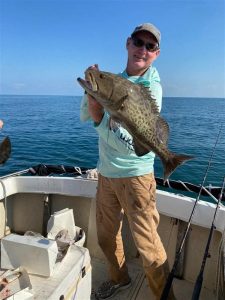
Gag Grouper love live bait, as they are the most natural prey choice. A small pinfish, grunt, or minnow will usually be eaten quickly. However frozen or artificial bait can also be used with great success. Below are some great bait choices for targeting Gag Grouper:
- Pinfish
- Grunt
- Squid
- Octopus
- Shrimp
- Crab
- Artificial Jig-Head tipped with squid
- Trolling lures
Tips and Tackle
When fishing for reef fish in the Gulf it is required to use non-stainless steel, non-offset circle hooks when using natural bait. A dehooking tool and descending device are also required for fishing in federal waters.
Gag Grouper are strong and powerful fish. Having stiff rods and heavy conventional fishing reels will help to bring the fish quickly to the surface. Grouper are smart and very fast, after being hooked they will try to rush back into the rocks or structure to hide. It is important to quickly reel the grouper up as soon as it hits your line to prevent it from breaking your line off in the rocks!
- Target areas with some structure, such as reefs, ledges, and wreaks.
- Go deep, depths over 30 feet will have larger fish.
- Using heavy tackle conventional reels will help you to retrieve the fish from the depths
- 60 – 80 lb braided line works best for deep waters, but a monofilament leader can be added to prevent breakoff in rocks
- For bottom fishing:
- use a lead weight above your hook to get the bait to the sea floor.
- move bait slowly or leave it to attract the fish, fast movement may spook them
If you aren’t in the mood for bottom fishing, try using a diving fishing plug or planer and troll the artificial lure behind the boat over structured bottom.
For best fishing practices and to learn more fishing tips, tricks, and regulations check out the free Florida Friendly Angler course: Florida Friendly Angler Certification Program
If you want to go fishing but don’t have a boat of your own, fishing charters are a great option! You can find a list of certified Florida Friendly Fishing Guides here: FFA Guides
Spearfishing
The most sustainable way to catch Gag grouper is by spearfishing, however they can be difficult to catch this way. With this method, there is no bycatch and no harm being done to undersized fishes. Gag grouper are large fish for targeting, but they can be spooked. They will often hid in ledges or under overhangs. You have to be patient and sneaky to catch them.
Always take precautions to be safe when spearfishing, especially at great depths. It is best to go with an experienced diver or be trained before attempting this method.
When spearfishing you still have to follow fishing regulations, meaning that you cannot shoot a Gag Grouper in the Gulf less than 24 inches in total length. As the spearfishing method requires you to estimate the fish size, make sure you have practice with accurately estimating fish size underwater! You can practice hunting fish species of non-regulated sizes, like the white grunt, until you feel comfortable with this skill!
*Remember fish can look bigger underwater, so be careful when picking your target!!!*
Clean
Learn how to fillet your Gag Grouper Catch with Florida Sea Grant Agent Michael Sipos!
Cook
In the Gulf, U.S. wild-caught Gag grouper is a smart seafood choice because it is sustainably managed and responsibly harvested under U.S. regulations. It was once over fished in the Gulf, however rebuilding plans are established to promote population growth. Following open season regulations and fishing gear rules will help to keep the fishery sustainable.
Below is a healthy recipe from Mayo Clinic for cooking up your fresh catch:
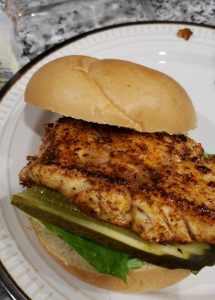
Blackened Grouper Sandwich
Serving size: 1/4 fillet (serving size: 4)
Ingredients:
- 1 grouper fillet
- 1/2 Tbsp blackening seasoning
- 1 Tbsp Olive Oil
- 4 Burger Buns
- Lettuce
- 1 Tomato
- 1 White Onion
- Pickles
- Tartar Sauce
- Lemon wedge
Instructions:
- Cut the fillet into 4 equal sized pieces. Season the fillets with the blackening seasoning on both sides.
- Heat olive oil in a nonstick pan on medium-high. Once heated add both fillets and cook for 1-2 minutes on both sides or until the fish is not transparent, also called opaque, throughout when tested with a tip of a knife. Remove from the pan and set aside.
- To assemble, place a piece of fish on each bun and squeeze the lemon wedge over the fish, add a generous spread of tartar sauce then add your preferred toppings including, lettuce, tomato, onion and pickle and enjoy!
*If you don’t like tartar sauce try a Remoulade Sauce in its place!
Next month sneak peek!
Our featured Gulf Catch for October is the Triple tail!
Triple tails are known for their three fins forming a tri-looking tail. They are great at camouflage often lying on their sides to resemble floating seagrass or debris to hide from predators.
Do you have a favorite Hogfish recipe or a photo of you with your Triple tail catch? Share it with us for a chance to be featured as a photo or recipe of the month! Submit here
More information on the Stock assessment for the Gulf can be found here: NOAA Stock Assessment
Check out the other Gulf Coast Catch and Cook blog posts!

Have a question? Ask the Author!
For more detailed information, contact your local University of Florida Extension Office.
Follow us!
An Equal Opportunity Institution.
 0
0